



 Advanced Search
 « Go back« Go backPrevious Product (FRP4119)Next Product (FRP4085)
F-rsin Plastic FRP4112

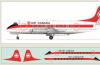
- Description:
- Air Canada Vickers Viscount 700. Laser-printed decals.
- Manufacturer:
- F-rsin Plastic
- Code Number:
- FRP4112
- Scale:
- 1:144
- Item type:
- Aircraft kits (injection)
- Price:
- £18.99
- Order Quantity:
- Quantity In Stock:
 2
2
- Availability:
- This will usually be dispatched within 24/48 hours of receiving your order
- Wish List:
- Department:
- Catalogue
Here are some books and decals you might find useful for this kit
Found 12 related products
 | 26 Decals - STS44275 - 1:144 | Gulf Air Vickers VC-10 Series 1101 [VC10] More | Aircraft decals (civil) | Catalogue | £12.00 | |
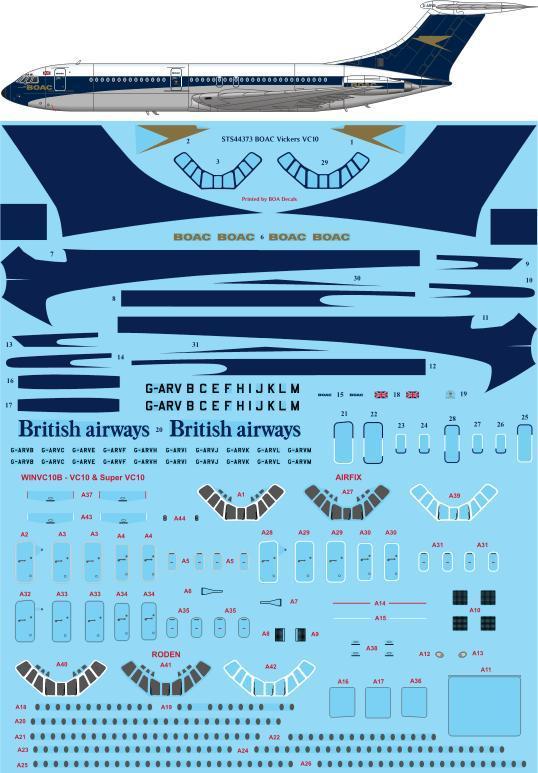 | 26 Decals - STS44373 - 1:144 | RE-PRINTED! BOAC Vickers VC-10 screen printed decal - (designed to be used with Airfix kits) More | Aircraft decals (civil) | Catalogue | £13.20 | |
 | Thunderbird Models - TBM144002 - 1:144 | TCA/Trans-Canada Airlines Vickers Vanguard More | Aircraft decals (civil) | Catalogue | £6.60 | |
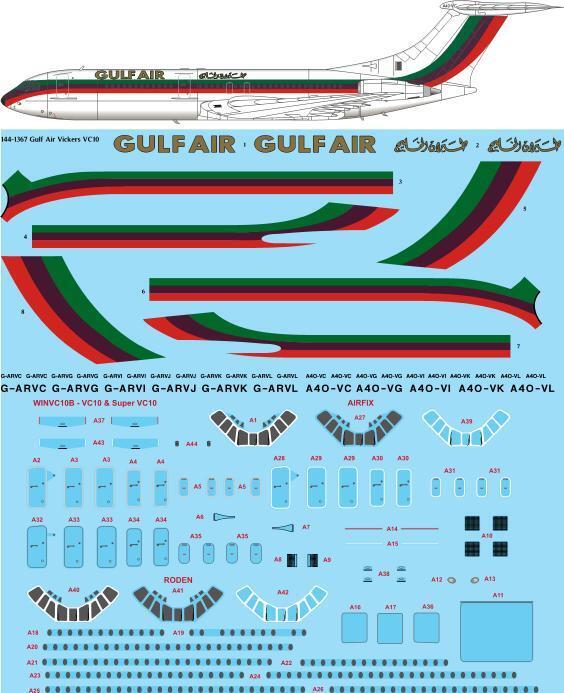 | 26 Decals - TS144-1367 - 1:144 | Gulf Air (early livery) Vickers VC-10 laser decal with screen print details More | Aircraft decals (civil) | Catalogue | £12.00 | |
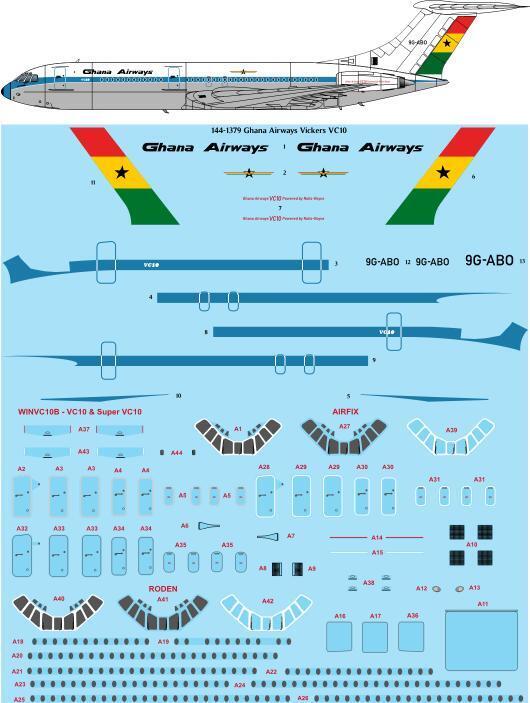 | 26 Decals - TS144-1379 - 1:144 | Ghana Airways Vickers VC10 laser decal with screen print details More | Aircraft decals (civil) | Catalogue | £12.00 | |
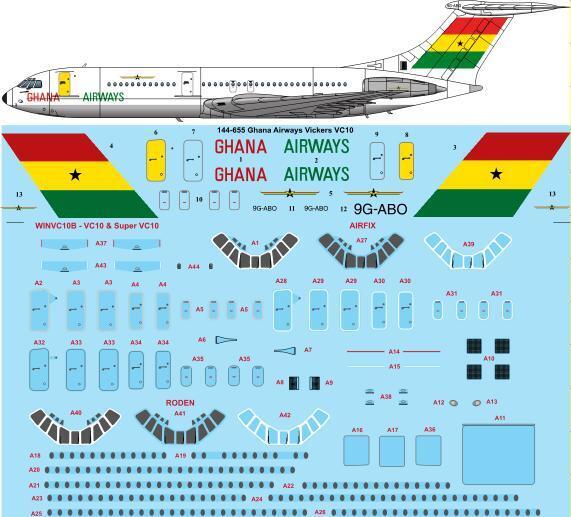 | 26 Decals - TS144-655 - 1:144 | Ghana Airways Vickers VC-10 laser decal with screen print details More | Aircraft decals (civil) | Catalogue | £12.00 | |
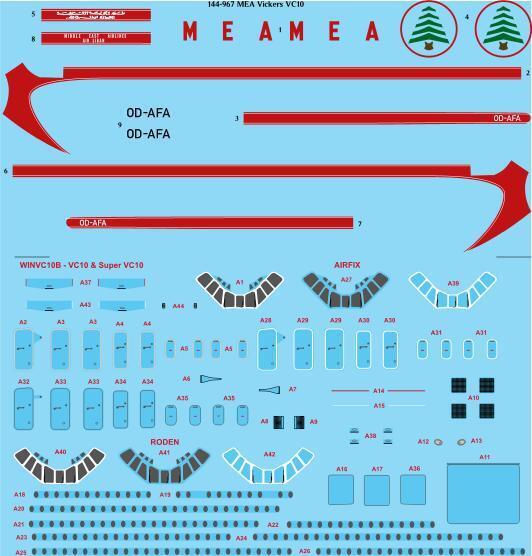 | 26 Decals - TS144-967 - 1:144 | MEA Middle East Airlines Vickers VC-10 laser decal with screen print details More | Aircraft decals (civil) | Catalogue | £12.00 | |
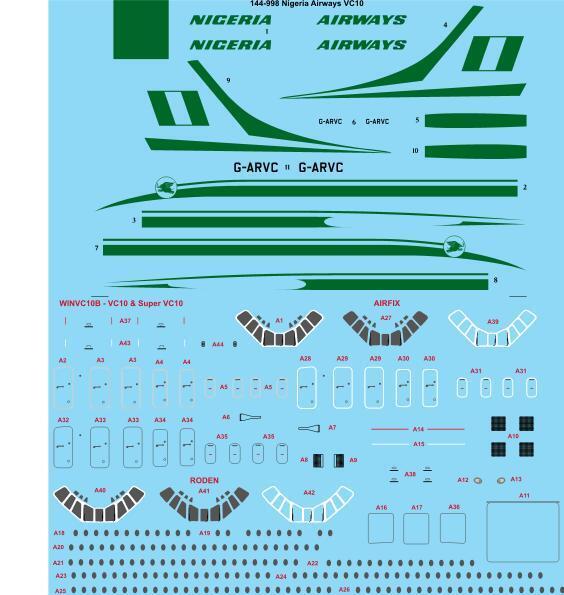 | 26 Decals - TS144-998 - 1:144 | Nigeria Airways Vickers VC-10 laser decal with screen print details More | Aircraft decals (civil) | Catalogue | £12.00 | |
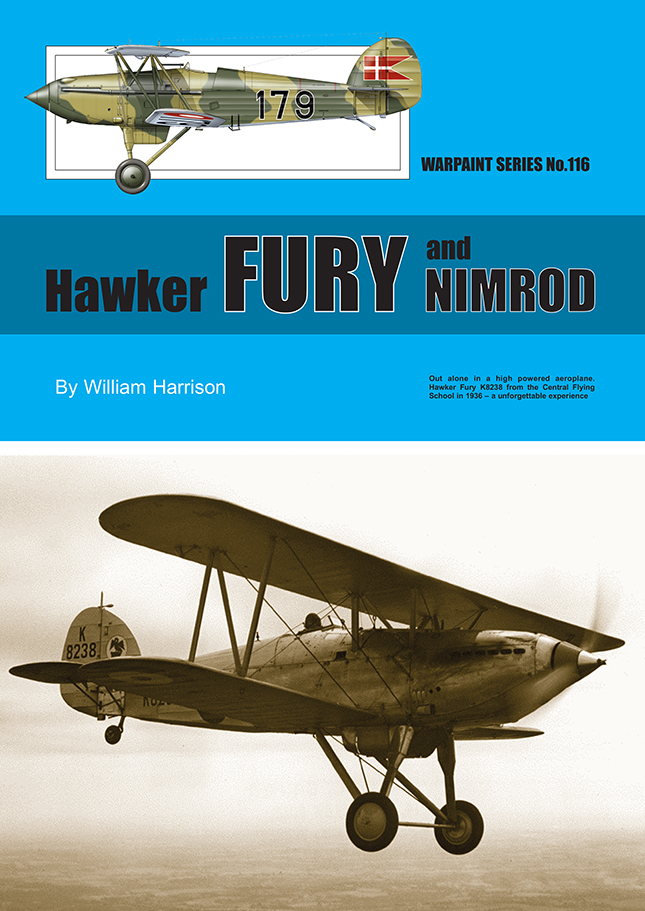 | Warpaint Series - WPS116 - No Scale | Hawker Fury and Nimrod Author: William Harrison The first RAF front line fighter to achieve more than 200 mph was the Hawker Fury, and its naval counterpart the Hawker Nimrod. These two attractive fighters came from the design office of the late Sydney Camm, Hawker's chief designer. The Fury started life as a private venture known as the Hornet but when this machine exceeded expectations the name was changed to Fury. Although only ordered in small numbers owing to financial constraints during the Great Depression production eventually exceeded 260 machines with orders from the RAF, Royal Navy, Persia (now Iran), Portugal, Spain, Yugoslavia and more than 30 supplied (ex-RAF) to the South African Air Force. The Fury entered service with No.43 Squadron who accepted 16 during May 1930 and stayed in front line service until January 1939 when it was replaced by the Gloster Gladiator, although quite a few remained in the training role until mid-1941. The Furies were used in combat during WWII by Yugoslavia where they were quickly despatched by the more modern fighters of the Luftwaffe. South Africa used Furies in the East African war until 1941 and the three supplied to Spain were in action, one of them serving on both sides! The Nimrod, while bearing a distinct resemblance to the Fury, flew early in 1930. Changes for the RN included longer exhaust pipes extending down both sides of the fuselage as far as the pilot's cockpit; an oil cooler fitted beneath the engine bay and at a later date arrester gear was fitted for carrier use. Later series Nimrods featured a larger tail surface to improve inverted spinning characteristics when fitted with floats. Deliveries of Nimrods started in September 1933 and they remained in use until May 1939. Only a small number of Nimrods found their way abroad, two went to Denmark to act as pattern aircraft for licensed production, one was shipped to Japan and one to Portugal. Although one Fury managed to survive in the scrapyard of a London dealer it fell to John Isaacs, a draughtsman from Vickers Armstrong, to design and build both a 1/7th scale Fury and Spitfire, both of which continue to be built by members of the Light Aircraft Association, nee the Popular Flying Association. This book is written by William Harrison and is superbly illustrated by Richard J.Caruana. More | Aircraft books | Catalogue | £16.00 | |
 | Warpaint Series - WPS141 - No Scale | Vickers Viking, Valetta & Varsity In Military Service. By Adrian M. Balch £19.00 56 pages The Vickers VC.1 Viking was a British twin-engine short-range airliner derived from the Vickers Wellington bomber and built by Vickers-Armstrongs Limited at Brooklands near Weybridge in Surrey. After the Second World War, the Viking was an important airliner with British airlines, pending the development of turboprop aircraft like the Viscount. The Valetta was a military derivative of the Viking developed in transport and training variants for the Royal Air Force, while the Varsity was a versatile twin piston-engined aircraft developed from the Viking and Valetta but with a tricycle undercarriage and ventral pannier for bomb-aimer training, among other changes. It was brought into RAF service in 1951 for crew training as a replacement for the Wellington T.10. This Warpaint relates the history of all three types, focussing on the military operators, as per the series title. It is profusely illustrated by 125 top quality photographs, nearly all in colour, from the author's extensive photograph archive and supported by excellent colour profiles and plans by Sam Pearson. More | Aircraft books | Catalogue | £19.00 | |
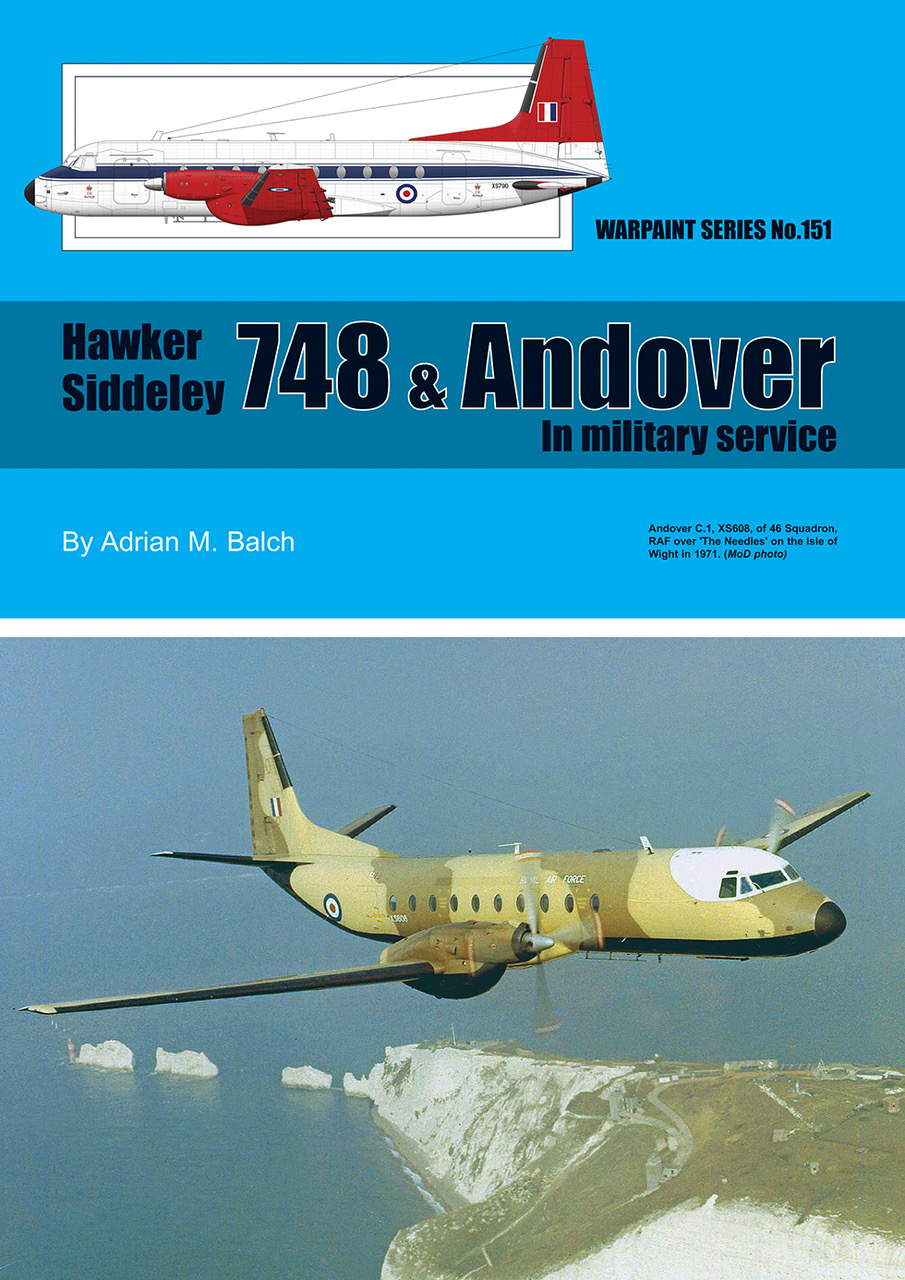 | Warpaint Series - WPS151 - No Scale | Hawker-Siddeley 748 & Andover in Military Service. Author Adrian Balch 56 pages Making its first flight on 24 June 1960 the prototype AVRO 748, G-APZV, became a very successful rugged replacement for the many DC-3 Dakotas flying around the world. In production, it became the second most successful British turboprop transport aircraft and was only superseded in numbers produced by those of the Vickers Viscount. A total of 381 Hawker Siddeley HS 748 aircraft were built, including eighty-nine manufactured under license by Hindustan Aeronautics Limited (HAL) in India, with production running from 1960 to 1988 for this successful turboprop airliner and its military variant, the Andover. The total included, thirty-seven Andovers for the RAF and RNZAF. Over fifty military HS 748s were sold, seventy-two for the Indian Air Force, plus others for RAAF, Brazilian Air Force and others, making a substantial portion of the 381 total built, with many going to various air forces worldwide for roles like transport, navigation training and VIP transports. The HS748 was selected for the Royal Family as the Andover CC.2 and three of them served The Queen's Flight faithfully and reliably for over twenty years from 1964 There are other publications that focus on all the civil airlines that have operated the HS748, but as a Warpaint publication, this is the first time all those that saw military service with air forces around the world have been featured-and nearly all in over 160 top quality colour photographs with notes on colour schemes and markings. This is another quality Warpaint by author Adrian Balch, supported by accurate profile drawings by artist Sam Pearson and a must-have addition for aviation historians and modellers alike. More | Aircraft books | Catalogue | £18.00 | |
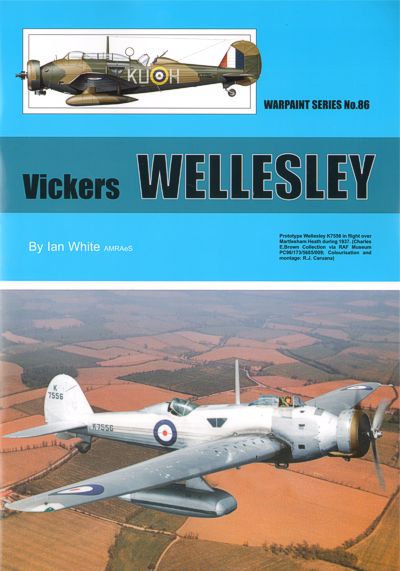 | Warpaint Series - WPS86 - No Scale | Vickers Wellesley by Ian White. Created on the drawing boards of the Vickers (Aviation) Company by Barnes Wallis using the geodetic form of construction he devised for Britain's R.100 airship, the Wellesley was designed to fulfil an Air Ministry specification for a reliable, general purpose bomber and torpedo-bomber, that was required to carry a heavy load over long distances. Originally conceived as a biplane, but converted to an all-metal geodetic monoplane by Barnes Wallis, and powered by the highly reliable Pegasus radial engine, the Wellesley was built in reasonable quantities to begin the re-equipment the embryo Bomber Command in 1937. Following testing at Martlesham Heath, the first production Wellesleys were delivered to the RAF early in 1937 and within one year formed the equipment of six UK squadrons. The Wellesley's flying qualities were such that it was chosen to equip the RAF's Long Range Development Unit, under whose guise it undertook a record breaking flight from Cranwell to the Persian Gulf and back to Ismailia in July 1938 and a second from Ismailia to Darwin, Australia, the following November, when the aircraft covered a distance of 7,157 miles without refuelling. By the outbreak of war the Wellesley was rendered obsolete in the European theatre, but was supplied in large numbers to re-equip the RAF's squadrons in the Middle East and East Africa. It was in the latter theatre that the aircraft showed its true metal. Supported by dedicated ground crews and the ever reliable Pegasus engine, the Wellesleys of Nos.14, 47 and 223 Squadrons battled the Italian Regia Aeronautica and the Italian Army in the Sudan, Abyssinia, Eritrea, Somaliland the Red Sea from June 1940 to November 1942. Despite being decidedly obsolete by the early months of 1943, the Wellesley was employed on transport, anti-submarine and convoy protection duties in the Eastern Mediterranean until March of that year, when the small number that remained were finally retired. More | Aircraft books | Catalogue | £14.00 |
Hannants Search Engine
Convert Currency
Copyright © 2001-2026 H. G. Hannant Limited. All rights reserved. | Website by Dessol
Privacy Policy | Cookie Information | Switch to Mobile Version