Cookies are small text files that are placed on your computer by
websites that you visit. They are widely used in order to make
websites work, or work more efficiently, as well as to provide
information to the owners of the site.
Here is a list of cookies this site uses:
Cookie name
Description
existing_user
Stores the email address used to previously log into the site, used to prefill forms like on the reset password screen
authchallenge
Authentication security checks
hcart
Stores the anonymous customer\'s cart token. If items are added to the card while not logged in, if you log in the items will be added to the customer\'s existing cart
hannants
Stores the session information while you remain on the site
pricer
Stores if the export or eu prices is selected on the catalogue page
hidefilter
Stores if the search filter panel is hidden or shown
AWSELB
Stores which server you\'re connected to so to access the same server while you navigate around the site
Wehrmacht Light Armored Vehicles. Sd.Kfz.222, Sd.Kfz.223, Sd.Kfz.260 and Sd.Kfz.261.
The history of German light four-wheeled armoured cars (leichter Panzerspahwagen) began in the mid-1930s, when the need arose to replace the outdated Sd.Kfz.13 and Sd.Kfz.14 models. The new series was developed on a specialised standardised chassis (Einheitsfahrgestell) produced by Horch, featuring all-wheel drive, independent suspension, and a rear-mounted engine.
Several variants of light armoured cars were produced within this new series. The most numerous version was the Sd.Kfz.222, with 989 units manufactured between 1935 and 1943. This armoured car was intended for reconnaissance missions and was armed with a 20 mm KwK 30 or KwK 38 automatic cannon paired with an MG 34 machine gun. A distinctive feature of the Sd.Kfz.222 was its open-topped, ten-sided turret protected by folding mesh screens against hand grenades. The crew consisted of three men: commander/gunner, loader, and driver.
Another model, the Sd.Kfz.223, served as a communications and reconnaissance vehicle, maintaining contact between reconnaissance units and headquarters. Its most recognisable feature was a powerful radio set equipped with a large folding frame antenna (Rahmenantenne). A total of 550 vehicles of this type were produced.
The Sd.Kfz.260 and Sd.Kfz.261 modifications (Kleiner Panzerfunkwagen) were developed as specialised armoured radio vehicles for higher headquarters and communications units. They used the same armoured hull as the reconnaissance variants but lacked a turret and main armament, with the crew carrying only a submachine gun for self-defence. The absence of the turret provided sufficient interior space for a four-man crew and extensive radio equipment. Altogether, 493 vehicles of these variants were produced.
All of these armoured cars proved themselves highly effective under combat conditions, and thanks to their reliability, they remained in service until the very end of the war in 1945.
[+] More...
Manufacturer:
ICM UK
Code Number:
ICMDS7207
Scale:
1:72
Item type:
Military vehicle kits (injection)
Price:
£33.32
Order Quantity:
Quantity In Stock:
5+
Availability:
This will usually be dispatched within 24/48 hours of receiving your order




 Advanced Search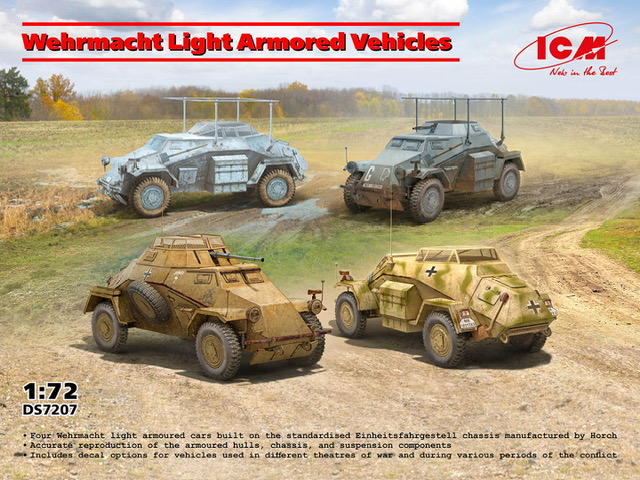
 5+
5+