



 Advanced Search
 « Go back« Go backPrevious Product (ZVE6184)Next Product (ZVE7013)
Zvezda ZVE6218


- Description:
- Fairey Battle
- Manufacturer:
- Zvezda
- Code Number:
- ZVE6218
- Scale:
- 1:144
- Item type:
- Aircraft kits (injection)
- Price:
- £6.25
- Order Quantity:
- Quantity In Stock:
 1
1
- Availability:
- This will usually be dispatched within 24/48 hours of receiving your order
- Wish List:
- Department:
- Catalogue
Here are some books and decals you might find useful for this kit
Found 14 related products
 | Guideline Publications - AIP01 - No Scale | Armour in Profile-Armoured Fighting Vehicles USA 1945-2018 By MP Robinson, David Grunnitt, Leif Robinson Armour in Profile: Armoured Fighting Vehicles of the United States Army, 1945-2018 contains profiles of five armoured fighting vehicles that have shaped the strategy and tactics of the United States Army since the end of World War II. From the battlefields of the Korean Peninsula and the jungles of Vietnam, to the plains of Central Europe and deserts of Iraq and Kuwait, these vehicles are iconic of American military might. Beginning with the M47 and M48 Patton tanks, replacements for the M4 Sherman, it goes on to examine the M60 tank and the mighty M1 Abrams Main Battle Tank, a vehicle that is expected to serve as the principal weapon of the U.S. Army for at least another two decades. As well as these main battle tanks, it profiles the 'King of Battle', the M109 self-propelled howitzer, another relic of the Cold War continuously updated to meet the challenges of warfare in the twenty-first century. Finally, the book looks at the 'REFORGER' exercises held in the 1970s and 80s, at the height of the Cold War, and which moved thousands of U.S personnel and vehicles to Germany on an annual basis. More | Military vehicle books | Catalogue | £11.99 | |
 | AML - AMLC4016 - 1:144 | Hawker Hurricane Mk.I Czechoslovak pilots in Battle of Britain More | Aircraft decals (military) | Catalogue | £2.50 | |
 | Guideline Publications - GP565310 - No Scale | Airlift Force RAF Transport Command 1948-1967 By Colin Ovens Consider, for a moment, these three Royal Air Force Command titles:- "Royal Air Force Bomber Command"- a name that, for many, may generate imposing images of Wellingtons, Halifaxs, Stirlings, Lancasters, Mosquitos, Lincolns, BAC/EE Canberra s, and the V-Bombers; "Royal Air Force Fighter Command"- a Command title that readily conjures up exciting images of Hurricanes, Spitfires, Tempests, Meteors, Vampires, Hunters, and Lightnings; "Royal Air Force Coastal Command"- a renowned name that may prompt dramatic over-water images of Sunderlands, Beaufighters, Mosquitos, Catalinas, Liberators, and Shackletons. Now, consider the title "Royal Air Force Transport Command"... to many readers this may prompt images of huge formations of Dakotas, disgorging paratroops over Normandy, Arnhem, or the Rhine; others will have a recollection of the Berlin Airlift. On the other hand, many of us will recall seeing, and ignoring, the occasional Argosy, Beverley, Bristol Britannia , Hastings, Comet, or, perhaps, a VC-10, in the static park at a Battle of Britain Open Day, while they aimed their cameras at the Hunters, Gloster Javelins, Lightnings, V-Bombers, or Shackletons on show- these were the exciting defenders of these isles; and those others..? "They're just superannuated airliners", as a school-friend airily dismissed Transport Command's contribution to a Battle of Britain Open Day, at RAF Biggin Hill in the mid-1960s, when we two were teenagers. 92 pages perfect bound More | Aircraft books | Catalogue | £19.00 | |
 | Guideline Publications - GPSAM02 - No Scale | Camouflage & Markings 2: The Battle For Britain-RAF May to December 1940 More | Aircraft books | Catalogue | £14.95 | |
 | Beacon Models - GQBON03 - 1:144 | Battle of Britain Decals RAF Spitfire 1940 Markings: Squadron code letters Fin flash variants Fuselage roundel variants Under wing roundel variants Jagdgeschwader 2 1940 Markings: Staffel numbers and emblems Gruppe emblems Staff emblems More | Aircraft decals (military) | Catalogue | £4.95 | |
 | Start - LIF25 - No Scale | Luftwaffe im Focus Edition No.25 50 pages, 64 photos - thereof 8 in colour, 2 colour profiles, 2 coloured maps, Readerforum - Close-Support Aircraft: Fw 190 F-8 der II./SG 2, 1945 - Personal Emblems: A Supplement to the Hs 129 with Impressive Scoreboard from Edition 22 - Color Photos: Zellhausen, An Operational Airfield like a Model Diorama - Photos with a Story: 6 May 1941-Air Battle over Calais (JG 51 Encounters No. 74 Squadron RAF) - Technology + Equipment: An Ar 96 with Dive Brakes - Unusal: Manufacturer's Code and Werknummmer on the Nose - Scenery: The 500th Operational Sortie by 4.(H)/12 in Africa - Bomber: He 177 of I./FKG 50 at Brandenburg Briest - Tails: 1944-An Emblem on the Tail of a He 111 of 14.(Eis)/KG 55 - Seaplanes: Friend and Foe, To the Aid in White (Norway) and photos to more topics More | Aircraft books | Catalogue | £17.80 | |
 | MA Publications - MAE06 - No Scale | Building the Supermarine Spitfire The iconic Supermarine Spitfire, the most strategically important British single-seat fighter of World War II. The Spitfire, renowned for winning victory laurels in the Battle of Britain along with the Hawker Hurricane, served in every theatre of the War and was produced in more variants than any other British aircraft. The Spitfire was designed by Reginald Mitchell of Supermarine Ltd., in response to a 1934 Air Ministry specification calling for a high-performance fighter with an armament of eight wing-mounted 0.303-inch machine guns. The airplane was a direct descendant of a series of floatplanes designed by Mitchell to compete for the coveted Schneider Trophy in the 1920s. One of these racers, the S.6, set a world speed record of 357 miles per hour in 1929. Designed around a 1,000-horsepower, 12-cylinder, liquid-cooled Rolls-Royce PV-12 engine (later dubbed the Merlin), the Spitfire first flew in March 1935. It had superb performance and flight characteristics, and deliveries to operational Royal Air Force (RAF) squadrons commenced in the summer of 1938. A more radical design than the Hurricane, the Spitfire had a stressed-skin aluminum structure and a graceful elliptical wing with a thin airfoil that, in combination with the Merlin's efficient two-stage supercharger, gave it exceptional performance at high altitudes. The version of the Spitfire that fought in the Battle of Britain was powered by a Merlin engine. Faster than its formidable German opponent the Bf-109 at altitudes above 15,000 feet and just as manoeuvrable, Spitfires were sent by preference to engage German fighters while the slower Hurricanes went for the bombers. More Hurricanes than Spitfires served in the Battle of Britain, and they were credited with more 'kills,' but it can be argued that the Spitfire's superior high-altitude performance provided the margin of victory. Meanwhile, Supermarine was developing more-capable versions of the Spitfire driven by progressively more-powerful Merlin's. The eight 0.303-inch machine guns gave way to four 0.8-inch automatic cannons, and by war's end the Spitfire had been produced in more than 20 fighter versions alone, powered by Merlin's of up to 1,760 horsepower. Though outperformed by the German Fw-190 on that aircraft's introduction in 1941, the Spitfire restored parity the following year and eventually regained the advantage. It remained a first-line air-to-air fighter throughout the war. Spitfires were used in the defence of Malta, in North Africa and Italy, and, fitted with tail hooks and strengthened tail sections, as Seafires from Royal Navy aircraft carriers from June 1942. Spitfires helped to provide air superiority over the Sicily, Italy, and Normandy beachheads and served in the Far East from the spring of 1943. Fighter-bomber versions could carry a 250 or 500lb bomb beneath the fuselage and a 250-pound bomb under each win One of the Spitfire's most important contributions to Allied victory was as a photo-reconnaissance aircraft from early 1941. Superior high-altitude performance rendered it all but immune from interception, and the fuel tanks that replaced wing-mounted machine guns and ammunition bays gave it sufficient range to probe western Germany from British bases. n late 1943 Spitfires powered by Rolls-Royce Griffon engines developing as much as 2,050 horsepower began entering service. Capable of top speeds of 440 miles per hour and ceilings of 40,000 feet, these were used to shoot down V-1 'buzz bombs.' During World War II, Spitfires were exported in small numbers to Portugal, Turkey, and the Soviet Union, and they were flown by the U.S. Army Air Forces in Europe. When production ceased in 1947, 20,334 Spitfires of all versions had been produced, 2,053 of them Griffon-powered versions. Fighter versions of the Spitfire were withdrawn from RAF service during the early 1950s, while photo-reconnaissance Spitfires continued in service until 1954. In Model Aircraft 'Extra Special' #6, the biggest book of this series some 22`Spitfire build projects will be included, in a 'how-to' format, and continue this fantastic series modelling guides from MA Publications, the new name in scale modelling. More | Aircraft books | Limited Availability | £14.99 | |
 | Guideline Publications - MMI-IA - No Scale | Imperial Armour: Modelling AFVs of the Japanese Army 1939-2020. 84 pages. Since the 1930s the armed forces of Japan have deployed a wide range of armoured fighting vehicles from diminutive tankettes to modern, state-of-the-art Main Battle Tanks. This new 84-page book from Guideline Publications and the team that bring you Military Modelcraft International presents a series of step-by-step guides and reference articles on Japanese AFVs from 1939 to the present day. Using kits from Dragon, Finemolds and Tamiya, some of the best modellers from the MMI stable go through construction, detailing, and painting and weathering, while in-depth reference articles look at Japanese armour in World War II and today. As well as collecting and reimagining some of the best features on the topic from MMI over the past decade and more, the book has new content that will both inspire and inform anyone wanting to tackle their own Japanese armour project. More | Military vehicle books | Catalogue | £19.99 | |
 | Naval Fighters - NF106 - No Scale | Vought SB2U Vindicator by Steve Ginter with Joe Weathers, Jr. 248-pages, 89-color photos, 22-duotone photos, 506 b&w photos and 25-drawings. The Vought SB2U Vindicator Scout Bomber was the Navy's second production carrier monoplane to fly after the Douglas TBD and for a time was the fastest aircraft in the Navy's inventory. The extremely clean aircraft was a unique blend of the old stick-and-rudder fabric covered construction and that of the new all-metal monoplanes that followed. About half the aircraft was metal skined and half fabric covered and each fuselage structure was individually hand made from steel tubing. The SB2U was built in three models. The very simular SB2U-1 and SB2U-2 for the US Navy, and the long range SB2U-3 for the Marines. Aircraft were also supplied to France and the United Kingdom and are covered in the book. Equipped with folding wings and capable of carrying a 1,000 lb bomb, they were in service from 1938 to 1943. By the time of the Pearl Harbor attack, the Navy Vindicators had all been assigned to the Atlantic fleet, but the Marine SB2U-3 were on the East Coast and at Pearl Harbor and aboard the Lexington for delivery to Midway. The VMSB-241 Vindicators at Midway saw the planes only combat on 4-to-6 June 1942 during the Battle of Midway and Henderson Field was named after the squadron CO who lost his life during the squadron's attack on the Japanese fleet on 4 June. Maj Hendersons replacement Maj Norris was also lost on 4 June during the squadron's 2nd attack. On 5 june, Capt Fleming was also lost during his attack on the cruiser Mikumo, for which he received the Medal of Honor for his actions. This book has extensive first person narative from Vought test pilots and USN/USMC pilots as well as the French V-156-F commander gathered by Joe Weathers in 1966 through 1974 when their minds were still sharp and their memories strong. All of which are gone today. A truly interesting read. More | Aircraft books | Catalogue | £43.99 | |
 | Print Scale - PSL14416 - 1:144 | Hawker Hurricane Mk.I/Mk.IIB Battle Of Britain Aces More | Aircraft decals (military) | Catalogue | £11.80 | |
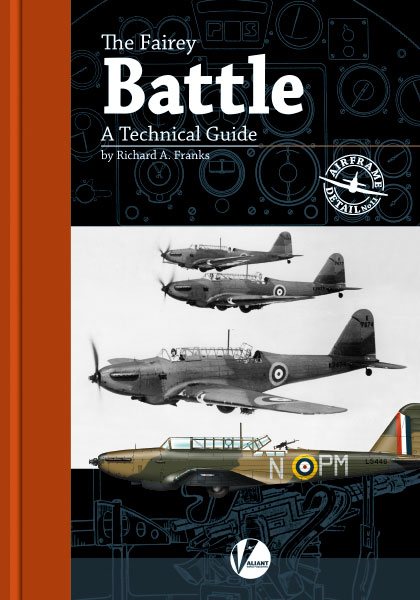 | Valiant Wings Publishing - VWPAD-11 - No Scale | AD-11 Fairey Battle. The eleventh title in the Airframe Detail series is an essential companion for anyone tackling the 1/72 scale kit from Azur-Frrom, the Trumpeter example in 1/48 scale, or even one of the older toolings. Contents include: Period detail images during production and testing including data from flight manuals and spare parts catalogues A wealth of historical technical photographs and diagrams Detailed walkaround images of preserved examples Over 50 full colour profiles by Richard J. Caruana Concise camouflage and marking notes Lists of all Battle kits and accessories produced in all scales Full detailed build of the Trumpeter 1/48 Battle Mk.I kit by Steve Evans and the Azur-Frrom 1/72nd Battle Mk I kit 'In Belgium' by Libor Jekl 136 pages plus cover More | Aircraft books | Catalogue | £22.45 | |
 | Warpaint Series - WPS102 - No Scale | Convair (Consolidated Vultee) B-36 'Peacemaker' Conceived when the Americans thought that the stuttering British candle would be snuffed out by Germany, the Consolidated Vultee, Convair, B-36 was intended to take the air war to Europe from the Continental USA. Fortunately Britain hung on and caused the cancellation of the invasion due to the stalwart efforts of the RAF during the Battle of Britain. As global war developed the B-36 programme was put on the back burner as other needs were more pressing. Eventually the B-36 would resume this time as a high altitude long range nuclear delivery platform. Numerous versions entered service with USAF covering both the bombing and reconnaissance versions, both undertaking overseas deployments in support of their intended missions. Continued production of the B-36 caused a great rift with the U.S. Navy whose first super carrier was cancelled to pay for more B-36's that the Admirals regarded as redundant. It would be the emergence of the reliable turbojet engine that would spell the end of the B-36 as a front line aircraft as both the Boeing B-47 and B-52 bombers would quickly see the types demise. Outside the needs of Strategic Air Command there were other uses for the B-36 airframe, one would be used to transport a B-58 Hustler fuselage/ wing assembly for structural testing, another would become the NB-36 and carried a working nuclear reactor aboard whilst the final throw of the dice saw the type developed into the YB-60 eight engined bomber in competition with the B-52. The basic design threw up one more off shoot, the XC-99 transport that saw a new fuselage married to the original wings and fittings plus the original tail feathers, as a unique one off the XC-99 survives in preservation. This book is written by Kev Darling and is superbly illustrated by Richard J.Caruana. More | Aircraft books | Catalogue | £16.00 | |
 | Warpaint Series - WPS83 - No Scale | Fairey Battle. British Prime Minister, Winston Churchill, said in the House of Commons on 20 August, 1940 - ....'on no part of the RAF does the weight of war fall more heavily than on the daylight bomber'.... . A reflection of what happened in the Low Countries during May/June 1940. The Battle was not mis-used during this debacle. The Air Staff, before the war, had planned against such an attack by Germany through the Low Countries, the Blitzkrieg was just outside their experience and the light bombers were thrust in at low level against a rapidly moving and heavily armed enemy. It is also unfair for aviation journalists to compare the performance of a Battle against the new emerging single-engined fighters. It was a large but graceful design, and by contemporary standards was advanced for its day. Originally conceived within the limits of the Geneva Disarmament Conference the Battle would, by the time the second world war opened, have over 1000 aircraft in RAF service providing vital aircrew experience of a modern monoplane with a retractable undercarriage, variable-pitch propellers and hydraulic systems. After withdrawal from front line squadrons the Battle airframe was adapted to provide experimental test bed work and give trainee aircrews extensive flying training in the UK, Australia, Canada, South Africa and Southern Rhodesia. More than half of all Battles built were later used in the training role - many continuing in use until 1945 or after! More | Aircraft books | Catalogue | £16.00 | |
 | Xtradecal - X44007 - 1:144 | RAF Update 2013-2015 (13) Some very attractive and colourful Anniversary schemes. Eurofighter EF-2000A Typhoon FGR.4 ZJ925/DXI XI(F) Sqn 100th Anniversary. Wg. Cdr C. Layden with black fin RAF Coningsby; Typhoon FGR.4 ZJ946 EB-A 41(R) TES Sqn Flt Lt D. Forbes RAF Coningsby standard scheme; Typhoon FGR.4 ZK315 41(R) Sqn 100th Anniversary Wg.Cdr S.A.Berry RAF Coningsby Typhoon FGR.4 ZK344/H II(AC) Sqn Wg. Cdr R.G. Elliott RAF Lossiemouth standard scheme; Typhoon FGR.4 ZK342 6 Sqn with desert camouflage on fin and spine Wg.Cdr.Mike Baulkwill RAF Lossiemouth 2014; Typhoon FGR.4 ZK343/BX 29 Sqn black fin with Squadron logo Flt.Lt. Noel Rees RAF Coningsby 2014; Typhoon FGR.4 ZK348/FN 1Sqn Wg.Cdr.Mark R.Flewin RAF Lossiemouth; Typhoon FGR.4 ZK308 TP-V 29 Sqn D-Day stripes; Typhoon FGR.4 ZK349 GN-A 29(F) Squadron Flt Lt B. Westoby-Brooks RAF Coningsby in markings carried by Hurricane of 249 Sqn flown by Flt Lt E.J.B.Nicholson VC, the only VC in the Battle of Britain. Typhoon FGR.4 ZK353 /BQ 29(F) Sqn 100th Anniversary. Flt Lt Jonny Dowen with ruby red fin, RAF Coningsby; Tornado GR.4 ZA412 617 Sqn 70th Anniversary Wg.Cdr.D.S.Arthurton/Fg.Off R.D.Hartley RAF Lossiemouth Tornado GR.4 ZA461 XV(R) Sqn 100th Anniversary. Wg. Cdr Jon Nixon/Sqn Ldr Conan Mullineux with red fin RAF Lossiemouth; Tornado GR.4 ZA456 9 Sqn 100th Anniversary. Wg. Com I.J. Sharrocks/Flt Lt A.H.Lock black fin RAF Marham Please note this decal is 1:144 scale and NOT 1:48 scale as reviewed in Scale Aviation Modeller. [Eurofighter EF-2000A Typhoon] More | Aircraft decals (military) | Catalogue | £7.99 |
Hannants Search Engine
Convert Currency
Copyright © 2001-2026 H. G. Hannant Limited. All rights reserved. | Website by Dessol
Privacy Policy | Cookie Information | Switch to Mobile Version