Cookies are small text files that are placed on your computer by
websites that you visit. They are widely used in order to make
websites work, or work more efficiently, as well as to provide
information to the owners of the site.
Here is a list of cookies this site uses:
Cookie name
Description
existing_user
Stores the email address used to previously log into the site, used to prefill forms like on the reset password screen
authchallenge
Authentication security checks
hcart
Stores the anonymous customer\'s cart token. If items are added to the card while not logged in, if you log in the items will be added to the customer\'s existing cart
hannants
Stores the session information while you remain on the site
pricer
Stores if the export or eu prices is selected on the catalogue page
hidefilter
Stores if the search filter panel is hidden or shown
AWSELB
Stores which server you\'re connected to so to access the same server while you navigate around the site
Lockheed XST Have Blue. Stepping stone of the F-117A Nighthawk. In 1975, the USAF and DARPA initiated a XST program to study the concept of a very low observable military aircraft. DARPA penned the requirements for the ATA designs that was a small aircraft about the size of F-15. Northrop and Lockheed were asked to design a prototype. In early 1977, Lockheed won the contract for the construction of two 60-percent scale flyable...
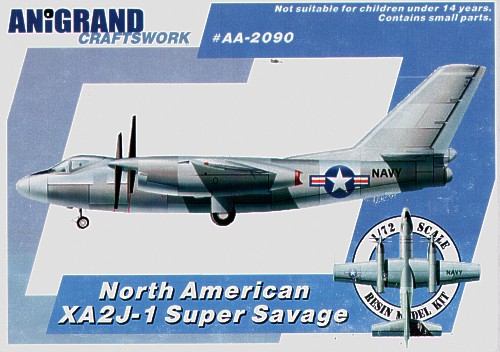
North-American XA2J-1 Super Savage. Most powerful savage bomber. In 1945, after the first atomic bomb was dropped successfully, the U.S. Navy launched a program for a carrier-based attack aircraft that would be capable of delivering a atomic bomb. The North-American AJ Savage won a Phase 1 competition, a turbo-prop powered aircraft being phase 2, and the phase 3 was a larger jet-powered attack aircraft. In 1947, the Navy reque...
Yakovlev Yak-24 Horse. In 1965, the U.S. Army launched the Utility Tactical Transport Aircraft System (UTTAS) program. The initial specification called for an aircraft able to carry a crew of three and eleven troops with the main goal of replacing the Bell UH-1 Huey. Requests for proposals were issued to the industries in 1972. All the designs proposed in response to the specification were required to use two G.E. turbo-shaft ...
Handley-Page HP.115. In the late 1950s, the United Kingdom, France, United States and Soviet Union were considering developing supersonic transport. BAC was largely funded by British government on the design called the Type 223. The T.223 was a thin-winged delta shape aircraft but the cost for starting construction was so high. British government required BAC to proceed with small-scale delta wing prototype testing before any ...
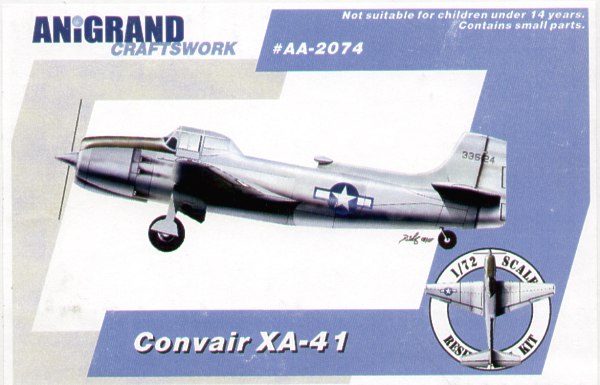
Convair XA-41. In 1942, USAAF requested for a single-seat dive bomber design that powered by the new Pratt & Whitney XR4360 engine. The Vultee proposed their Model 90, and was awarded a contract for two prototypes, designated XA-41. After a mockup inspected in March 1943, the USAAF decided that it no longer needed dive bombers and changed the contract for a low-level ground attack aircraft instead. By this time, Vultee had mer...
Douglas C-124A/C Globemaster. After the end of the second World War, the USAAF found the C-74 Globemaster was a very capable and useful aircraft, and began to consider acquiring an improved version proposed by Douglas. It used the same wing, tail and engines from the C-74, but featured a new and enlarged fuselage, as well as clamshell doors in the nose. The result was the Douglas C-124 Globemaster II. The YDouglas C-124 protot...
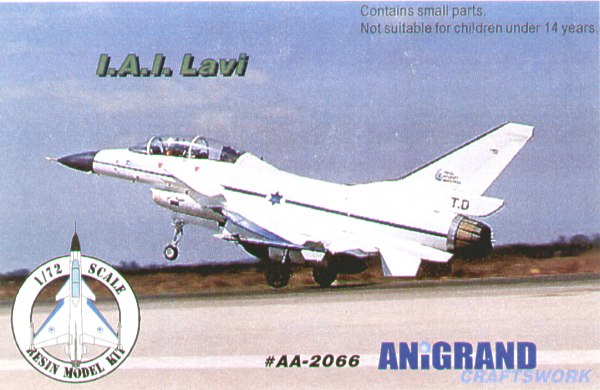
I.A.I. Lavi. In the end of 1970s, the Israel Defense Force perceived that the IAI Kfir was no solution for future growth. So it announced the requirement for a new combat aircraft which powered by a much more powerful engine and compactable to carry more armament. In February 1980, IAI launched the Lavi program. The development phase was to involve five prototypes, the B-01/-02 was two-seats trainer, and B-03/-04/-05 were sing...
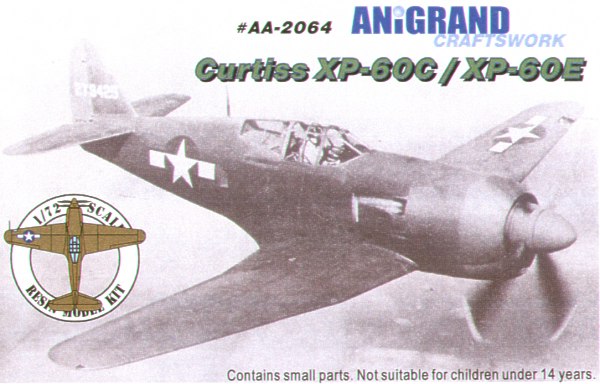
Curtiss XP-60C / XP-60E In 1940, Curtiss proposed a initial design for the eventual replacement for the Curtiss P-40 to the USAAF. It was inverted the continental engine to the Curtiss P-40 fuselage and tail assembly. This proposal was accepted and a contract for two prototypes, XP-53 was issued. At the end of 1940, USAAF modified order to install the XP-53 with British Merlin engine. The prototype was redesignated XP-60. Due ...
Platt Le Page XR-1 first U.S.Army helicopter. Aircraft History and Specification. In 1937, two engineers, Laurence LePage and Haviland Platt, traveled to Germany to view the Focke FA-61 tandem-rotor helicopter. There they obtained an option to build the Focke helicopter in U.S., but deteriorating conditions between two governments prevented the deal from going through. After returning to the U.S., they formed Platt LePage Airc...
Republic XF-84H Thunderscreech. In 1950, Wright Air Development Center of the U.S.A.F. had worked with Curtiss and Hamilton to study the concept of new propeller which could approach supersonic speed to a piston-engine fighter. The engineers of the WADC needed a suitable airframe to test the concept, they selected most powerful Allison turboprop engine at the time, and chose to modify the F-84F for this new role. The concept a...
Republic XF-12 Rainbow. In 1943, USAAF confronted with the problem of photographic information which collecting from the Pacific theatre while U.S. did not had close airfield in Pacific to be able to use photo-reconnaissance aircraft. So USAAF issued a request for a new long-range / high altitude reconnaissance airplane. In March 1944, Republic proposed to modify its civil model, RC-2 to install with the photographic equipment...
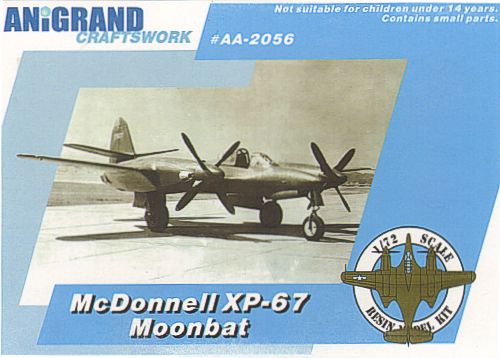
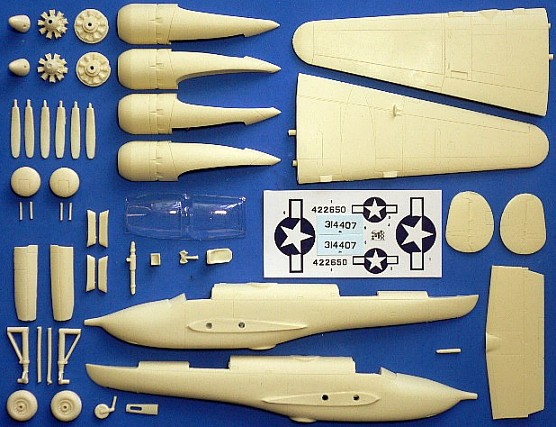
McDonnell XP-67 Moonbat. In 1939, USAAF issued a specification 'R-40' for a long-range twin-engine fighter. McDonnell submitted company's first design but was rejected. McDonnell modified the design and resubmitted to USAAF in 1941. This time it was accepted and received order for two prototypes, designated XP-67. The XP-67 was created an unusual looking that the fuselage and the engine nacelles were merged together in order t...
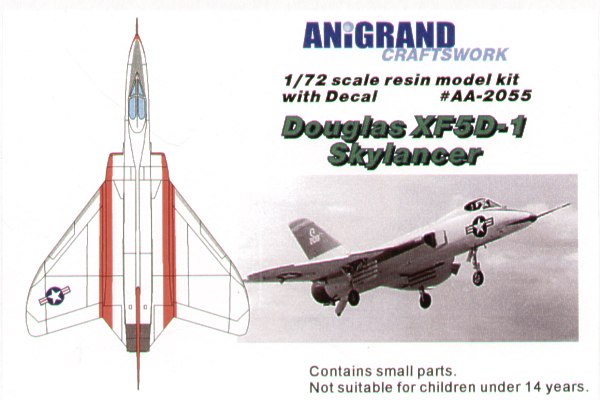
RE-RELEASED!!! Douglas XF5D-1 Skylancer. In 1947, based on the German Lippish's delta wing design, Douglas designed and produced an excellent Douglas F4D-1 Skyray. After Five years of its operation, Douglas engineers collected the weakness and created a new improved fighter, the Douglas F4D-2N. The U.S. Navy interested the concept, two prototypes was ordered to Douglas. As it was actually very different with the Douglas F4D-1 ...
Douglas D-558-3 Skyflash. In early 1950's, a several high-speed flight researches were being proceeded by different agencies, the NACA's hypersonic research, the Air Force's Project 1226 and the Navy's D-558 program. In 1954, Langley team of NACA gathered those similar researches from military services and aerospace industries, combined with the Air Force and Navy to launch the new 'Project 1226' competition. As Navy liked to ...
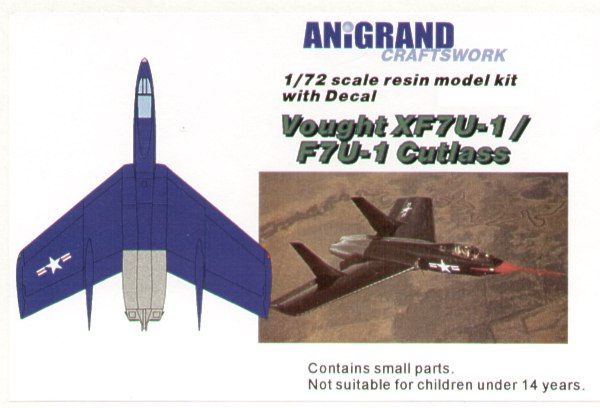
Vought XF7U-1 Cutlass. In June 1945, U.S. Navy launched competition for a fighter able to fly at 600 mph high speed. Vought submitted the Model V-346 design which was based from German Arado's tailless fighter documents. Vought's engineers believed that deleting the tailplane would solve aerodynamic problem to increase maximum speed. In June 1946, Navy chose Vought's design as the winner and ordered three prototypes, designate...
Convair XP-81 In 1943, USAAF issued a specification for a long-range jet powered fighter which could be flight across the Pacific to escort bombers to Japan. Consolidated Vultee Aircraft (Convair) responded with the new design which was powered by a combination of the turboprop and jet engine units, while Navy was also working on the same theory with the Curtiss XF15C-1 and the Ryan FR-1. The configuration was a nose mounted t...
Douglas XA2D-1 Skyshark. In June 1945, with the success of the high performance AD Skyraider, Navy asked Douglas to design a new version of the AD with turboprop power, and selected Allison to design the power-plant. Allison proposed to install a pair of nose mounted engines to drive a pair of contra-rotating propellers. In cruise flight, one of the engine and prop could be shut down to increase its flight range. In 1947, two ...
Beech XA-38 Grizzly. In 1942, USAAF requested for a new heavy armored ground attack airplane as a replacement of the Douglas A-20 Havoc. Beech Aircraft Corp had already started work on the design of the Model 28 "Destroyer' which specification met to the requirement. So a contract was awarded to Beech for two prototypes that designated XA-38 and re-named 'Grizzly' with competition in Hughes XA-37 (later changed to XF-11). For ...
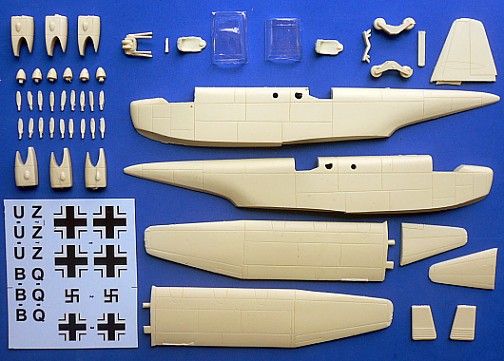
Blohm-und-Voss FG.227 flying boat/seaplane. In 1941, after success of the giant BV.222, Blohm-und-Voss was commissioned to design a larger and more capable flying boat, the BV.238. As it was the largest flying boat ever constructed at that time, Blohm-und-Voss engineers could not determined its aerodynamic and hydrodynamic abilities. In order to avoid the risks taken with a full sized BV.238 prototype, it was decided to constr...
Hughes XF-11. In 1939, Hughes Aircraft used a special wooden structure which strength comparable to steel for a proposal of bomber design, the model D-2. The project interested USAAF because metal material was becoming a scare by the war. In 1942, the D-2 was ordered under an attack aircraft designation XA-37. Later it was considered as a night fighter XP-73. In 1943, the wooden D-2 prototype was lost by fire accident in Hughe...
North-American YF-93A. In 1946, USAF recognized all the early jet fighters were lacked sufficient range to escort bombers to the target. So the proposal for a penetration fighter were requested. In 1947, North-American responded with the proposal for a revised version of North-American F-86A, which the fuselage size was enlarged for bigger internal fuel tanks to increase its range. The extra fuel increased weight so the more p...
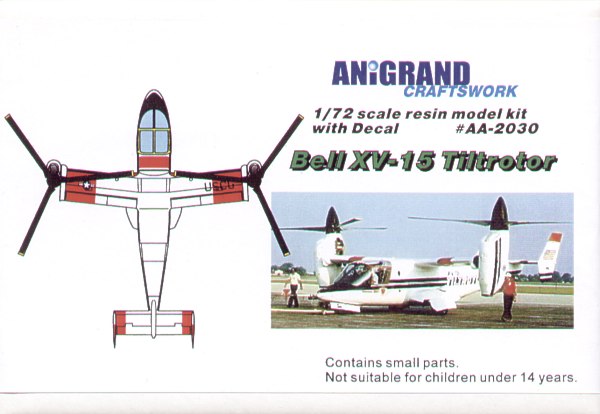
Bell XV-15 Tiltrotor. In 1965, U.S. Army issued a proposal request for an aircraft that would have both helicopter and airplane characteristics to replace the Boeing CH-47 helicopter and C-7 transport. Bell submitted the tilt-rotor design but the request was dropped in 1968. Bell decided to continue the development as the civil VTOL transport. In 1970, a full size rotor and rotating mechanisms were tested at the NASA wind tunn...
Vought XF8U-3 Crusader III. In 1955, with the success of the F8U-1 and -2, Vought started to conceive a more powerful fighter design, the XF8U-3. Although it was similar to the F8Us and carried F8 designation, the aircraft was entirely a new design that installed larger fuselage to accommodate the new powerful J75 engine. The U.S. Navy was interested in the design and signed contract to Vought for five prototypes in competitio...
Ling-Temco-Vought XC-142 Largest tilting-wing VTOL transport prototype. In 1950's, many V/STOL aircraft were built and evaluated by the US Military services. Few of the concepts were deemed to have the operational capabilities. Base on these prototypes experiences, the new V/STOL assault transport program was announced. In 1961, a request for proposal of the large cargo airplane was released by Tri-services. Ling-Temco-Vought ...
Rockwell International XFV-12A U.S. Navy VTOL fighter. In 1972, U.S. Navy issued a request for the proposals of the next generation V/STOL close-support fighter on alternate the McDonnell-Douglas AV-8A. It was requested with supersonic speed capability, and enables to operate from small ships. Rockwell International responded with the 'thrust-augmented wing' design. This concept led to Navy's interest and was fully funded for ...




 Advanced Search