Cookies are small text files that are placed on your computer by
websites that you visit. They are widely used in order to make
websites work, or work more efficiently, as well as to provide
information to the owners of the site.
Here is a list of cookies this site uses:
Cookie name
Description
existing_user
Stores the email address used to previously log into the site, used to prefill forms like on the reset password screen
authchallenge
Authentication security checks
hcart
Stores the anonymous customer\'s cart token. If items are added to the card while not logged in, if you log in the items will be added to the customer\'s existing cart
hannants
Stores the session information while you remain on the site
pricer
Stores if the export or eu prices is selected on the catalogue page
hidefilter
Stores if the search filter panel is hidden or shown
AWSELB
Stores which server you\'re connected to so to access the same server while you navigate around the site
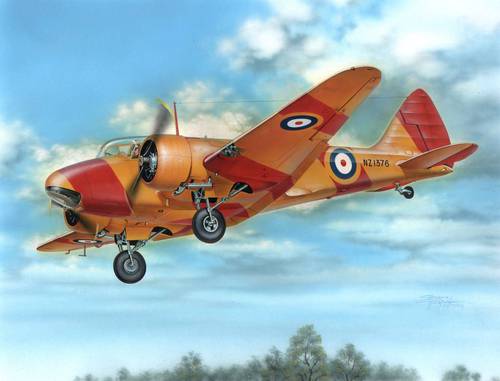
Commonwealth Trainers (8) Airspeed Oxford (3) 3583 ex BG365 24 Air School, Standard Beam Approach Flight, Nigel, Gauteng, South Africa 1945; PG943/T Fighter Command Instrument Training Flight, RAF Tangmere 1948; A5680/64 35th Elementary Flying Training School, Neepawa, Manitoba, Canada 1942; North-American Harvard IIa 7470 ex EX821 62 Air School (Central Flying School) Bloemspruit, South Africa 1945; Avro Anson Mk.I 6065/K nO ...
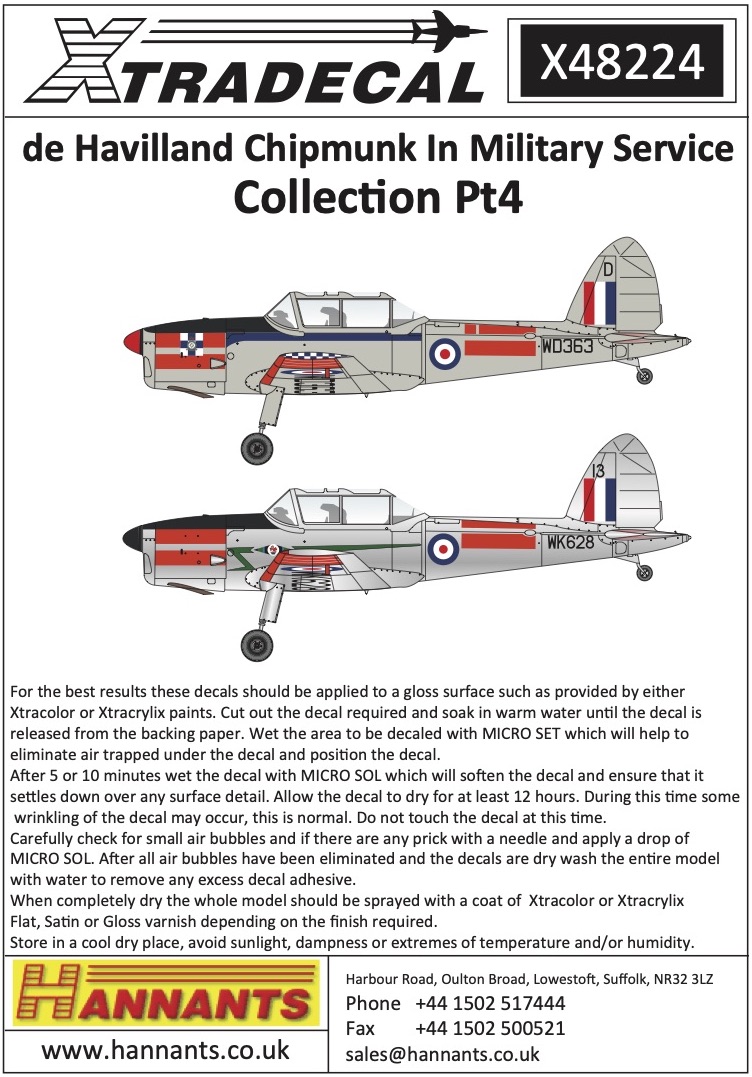
de Havilland Chipmunk In Military Service Part 4 (8)
de Havilland Chipmunk T.10, WP970, 'J', of 12 Air Experience Flight, Royal Air Force Volunteer Reserve, based at RAF Turnhouse, UK, 8 September, 1968.
de Havilland Chipmunk T.10, WD365, of Liverpool University Air Squadron, Royal Air Force Volunteer Reserve, based at RAF Woodvale, UK, 1960s.
de Havilland Chipmunk T.10, WZ876, 'J', of London University Air Squadron, Royal ...
de Havilland Chipmunk In Military Service Part 3 (10)
de Havilland Chipmunk T.10, WD325/'N', of Army Air Corps, British Army, based at Middle Wallop, UK, 1994.
de Havilland Chipmunk T.10, WG459, of Aberdeen University Air Squadron, Royal Air Force Volunteer Reserve, based at RAF Dyce, UK, 1969.
de Havilland Chipmunk T.10, WZ862, of RAF Gatow Station Flight, Royal Air Force, based at RAF Gatow, West Germany, 1983.
de Havill...
Airspeed Oxford and Consul By William Harrison
52 pages
With more than 8,750 built the Oxford was a well thought-out design that was based on their Airspeed Envoy, a similar shaped twin-engine executive aircraft that was used in the early 1930s but the more advanced design of the Oxford suited the military requirement for a three-seat training aircraft. The Oxford was a low-wing cantilever monoplane of advanced design and ...
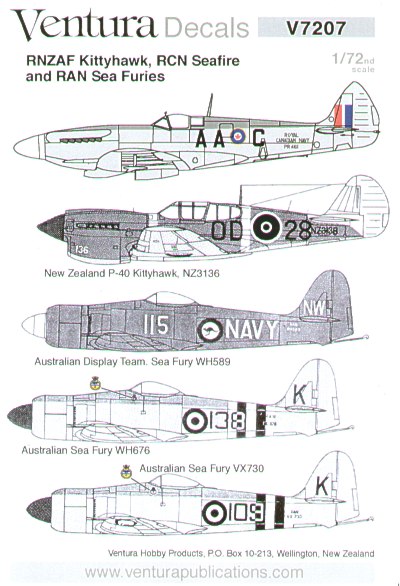
Revised and Re-printed! Curtiss P-40 Kittyhawk, Supermarine Seafire Mk.XV, Hawker Sea Fury FB.11 (5) Curtiss P-40 NZ3136 OD-28 4 OTU NZ 1945; Supermarine Seafire Mk.XV PR434 AA-C 833 Sqn R Canadian Navy; Sea Furies RAN WH589 No 115 Australian Display Team overall Oxford blue; WH676 138/K; VX730 109/K. Both 805 Sqn HMAS Sydney Korea
Airspeed Oxford Mk.I 'Gunner Trainer' The Airspeed Oxford was a British aeroplane developed early in the war and mainly used in training of multi-engine aircraft crews " pilots, navigators, gunners. The Oxfords saw service with the RAF as well as with air forces of other Commonwealth countries (RNZAF, RCAF, RAAF and SAAF). In the post war years, many Oxfords were also delivered to even more other countries. The Mk.I version of...
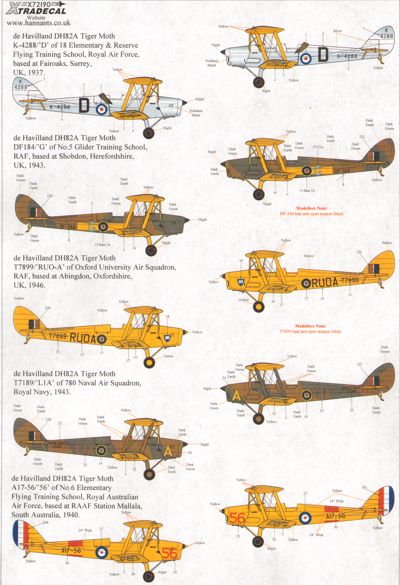
de Havilland Tiger Moth Part 1
1. de Havilland D.H.82A Tiger Moth, N6919/26, probably of No 1 EFTS, RAF, 1940. Dark Earth/Dark Green upper surfaces with Light Earth/Light Green top of lower wings; Yellow undersides. Serial in Night, repeated below both lower wings. Blue/ Red national markings above top wings. Light blue 36 on engine cowling. Note 'Mustard Gas Warning Patch' above rear fuselage decking. Blue/ Red national mark...
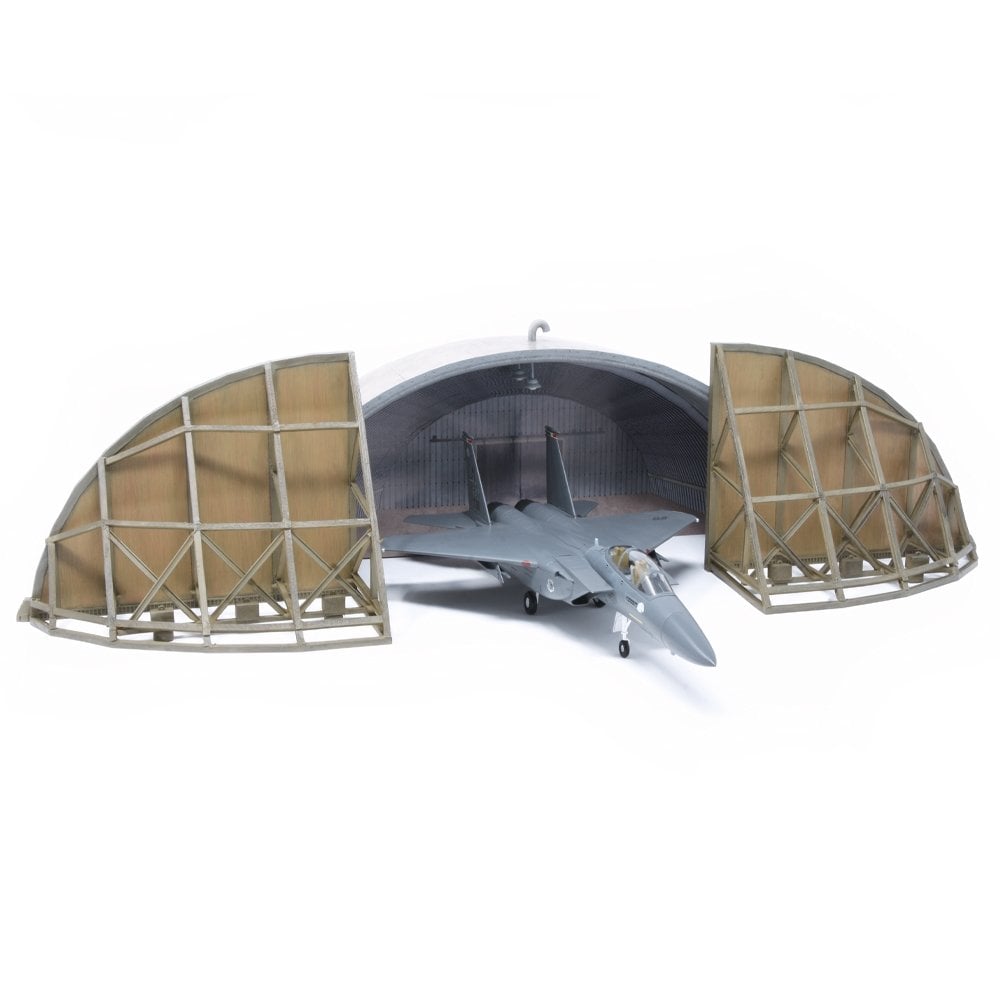
BACK IN STOCK!!! Low Relief Hardened Aircraft Shelter. Pre-painted and Assembled Resin Model
his highly detailed and scaled low relief model is based on the Cold War HASs at former RAF Upper Heyford, Oxfordshire, UK, where the structures are protected scheduled monuments of national and international importance.
HASs can still be seen on active and former RAF airbases including Coningsby, Lossiemouth and Marham, Honington,...
Hawker-Siddeley HS.748/HAL-748/C-91 'VIP Service' (RAF, Indian AF, Brazilian AF)
The HS.748 was a British short/medium-range twin-engined airliner designed during the late 1950s. It was originally developed and initially produced by A.V. Roe & Co., then after its dissolution by Hawker Siddeley Aviation and later by its successor, British Aerospace.
The 748 was a remarkably successful aeroplaneé and an effective DC-3 repla...
Pratt & Whitney R-985 Wasp Junior Set contains resin parts to build 1 engine.
Other Applications: Airspeed Oxford (AS.46 Oxford V), Air Tractor AT-300, Avro Anson (Mk V), Barkley-Grow T8P-1, Beechcraft Model 18 and military derivatives, Beechcraft Staggerwing D17S, D17W, G17S, Bell XV-3, Bellanca 300-W, Berliner-Joyce OJ, Boeing-Stearman Model 75, Bratukhin G-3, CAC Winjeel, de_Havilland_Canada DHC-2 Beaver and L-20/U-6 mil...
'Marston Mat' Pierced Steel Plank (PSP). 450mm(W) x 450mm(H) 17inches(W) x 17inches(H).
'Marston Mat', was a very common covering used for makeshift runways, parking areas and other military uses where rough ground was prevalent. Each panel measured 1 ft 7.5 in by 11 ft 9.75 in, and interlocked with its neighbour by a series of flat 'T' hooks and slots along each of the longest sides, which allowed a degree of flexibility o...
'Marston Mat' Pierced Steel Plank (PSP).675mm(W) x 675mm(H) 26inches(W) x 26inches(H).
'Marston Mat', was a very common covering used for makeshift runways, parking areas and other military uses where rough ground was prevalent. Each panel measured 1 ft 7.5 in by 11 ft 9.75 in, and interlocked with its neighbour by a series of flat 'T' hooks and slots along each of the longest sides, which allowed a degree of flexibility of...
'Marston Mat' Pierced Steel Plank (PSP). 225mm(W) x 225mm(H) 9inches(W) x 9inches(H)
'Marston Mat', was a very common covering used for makeshift runways, parking areas and other military uses where rough ground was prevalent. Each panel measured 1 ft 7.5 in by 11 ft 9.75 in, and interlocked with its neighbour by a series of flat 'T' hooks and slots along each of the longest sides, which allowed a degree of flexibility of m...




 Advanced Search