Cookies are small text files that are placed on your computer by
websites that you visit. They are widely used in order to make
websites work, or work more efficiently, as well as to provide
information to the owners of the site.
Here is a list of cookies this site uses:
Cookie name
Description
existing_user
Stores the email address used to previously log into the site, used to prefill forms like on the reset password screen
authchallenge
Authentication security checks
hcart
Stores the anonymous customer\'s cart token. If items are added to the card while not logged in, if you log in the items will be added to the customer\'s existing cart
hannants
Stores the session information while you remain on the site
pricer
Stores if the export or eu prices is selected on the catalogue page
hidefilter
Stores if the search filter panel is hidden or shown
AWSELB
Stores which server you\'re connected to so to access the same server while you navigate around the site
Lockheed C-5B Galaxy. In 1963, the USAF began to study very large logistic jet-powered transports. After reviewing several airframe designs, they eventually choose one similar to that of the C-141A Starlifter featuring a high-set wing, four underwing jet engines and a T-tail. The design competition was between Boeing Model 747, Douglas CX-4 and Lockheed L-500. Lockheed won the contract in 1965 with a design that was an extensi...
Martin-Boeing XMS-1. Original Dyna-Soar configuration. In 1945, millions of German military documents were confiscated by USAAF. One of the concept was the Sanger aerospace bomber. During post-war years, Bell was selected for further studies on rocket-bomber which named BoMi. In 1956, the USAF channeled Bell's development to a reconnaissance, bombardment vehicle. A competition for a prototype was opened. In 1959, Boeing won th...
Molniya Buran OK-1.01 space shuttle. In 1974, after failure of the N-1 Lunar rocket, the Soviet military preferred a new family of modular following the loss of space race to America. In 1976, the Ministers of the USSR launched the program of the reusable spacecraft system. The former OKB-1 bureau was restructured to NPO Energia enterprise that in charge of the program development. The U.S. shuttle design was studied by Soviet...
NPO Energia Rocket. In 1974, after failure of the N-1 Lunar rocket, the Soviet military preferred a new family of modular following the loss of space race to America. In 1976, the Ministers of the USSR launched the program of the reusable spacecraft system. The former OKB-1 bureau was restructured to NPO Energia enterprise that in charge of the program development. The U.S. shuttle design was studied by Soviet rocket scientist...
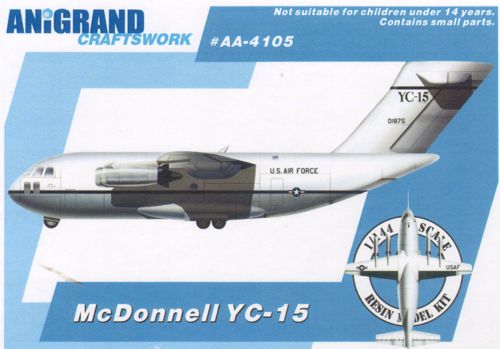
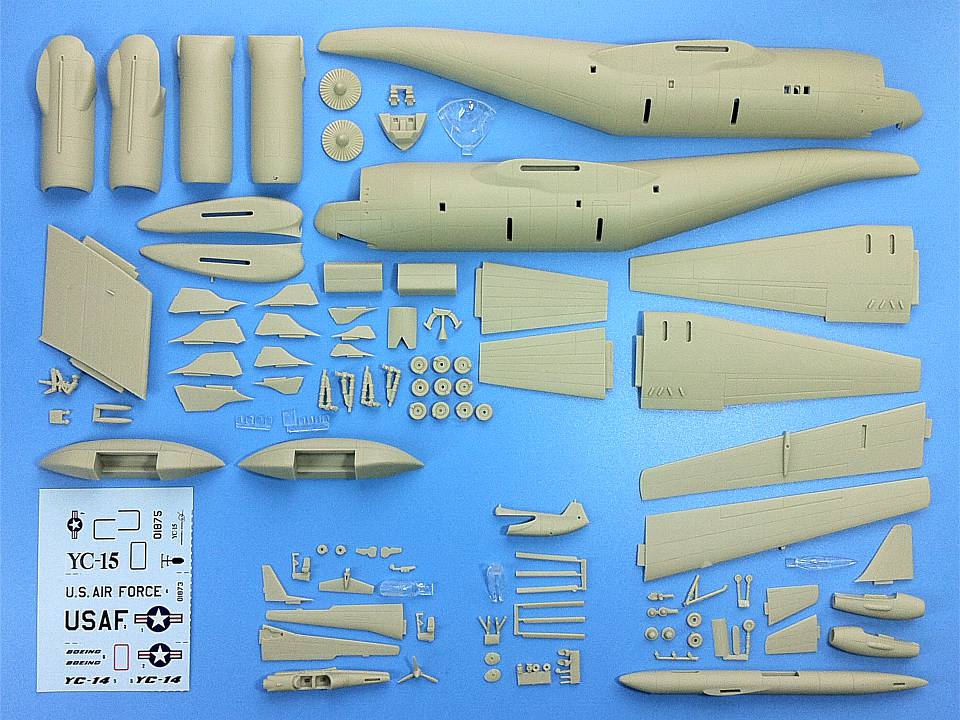
Boeing YC-14 STOL prototype to replace the C-130 Hercules. (includes these BONUS kits Bell X-16, McCulloch YH-30 and Lockheed YO-3A) In 1972, the U.S. Air Force issued the Advanced transport STOL transport program for a new medium airlifter that capable of operations into battle zones with short, temporary airfields. Two proposals were accepted for construction as the Boeing YC-14 and McDonnell-Douglas YC-15 prototypes. The Bo...
Martin P6M-2 SeaMaster production (Anigrand code is AA144-099) (see the picture for the 3 bonus kits! North-American FJ-1, 1/144 Sikorsky HOS-1 Hoverfly II and Columbia XJL-1
Lockheed SR-95 Penetrator plus bonus kits: Lockheed Have Blue, Lockheed Hopeless Diamond and Northrop XST. Beginning in the mid-1980s, the U.S. Air Force and NASA have supported a number of studies of aircraft that are consistent with accounts of the Aurora reconnaissance aircraft project, the proposed successor to the SR-71 Blackbird which would retired in 1999. While various sources disclosed that Lockheed's secret Skunk Wor...
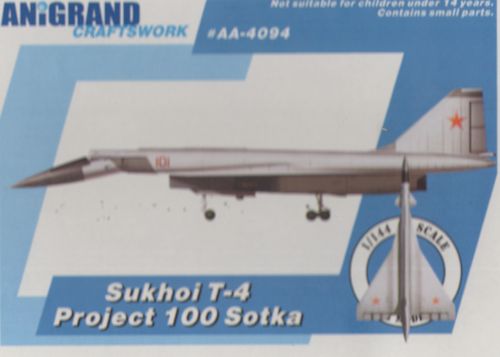
Sukhoi T-4 Sotka Soviet supersonic bomber
In 1963, the Soviet government issues a requirement for developing an aircraft analogous to the North-American XB-70 Valkyrie. Sukhoi, Tupolev and Yakovlev competed with the T-4, Tu-135 and Yak-33. The Sukhoi design, with its high cruise speed of 3,200 km/h was favored over the other two designs. In 1964, the building of a prototype was authorized. The first T-4, designated '101', fi...
Lockheed SR-91 Aurora (with bonus kits: Lockheed F-19A, Northrop X-49, U.S. Marine LHX Stingbat) Beginning in the mid-1980s, the U.S. Air Force and NASA have supported a number of studies of aircraft that are consistent with accounts of the Aurora reconnaissance aircraft project, the proposed successor to the SR-71 Blackbird which would retired in 1999. While various sources disclosed that Lockheed-Martin was developing a Mach...
Short SC.5 Belfast RAF Heavy transport. Includes these BONUS kits Scott Aviation Bulldog T.1, Saunders-Roe SR.177 and Supermarine Type 545. In 1959, Royal Air Force issued operational requirement, ASR.371 for a heavy freighter capable of carrying a wide range of military loads over long ranges. Short proposed the SC.5/10 design which was based on company studies from 1950s. The project started with the designation Belfast C.1....
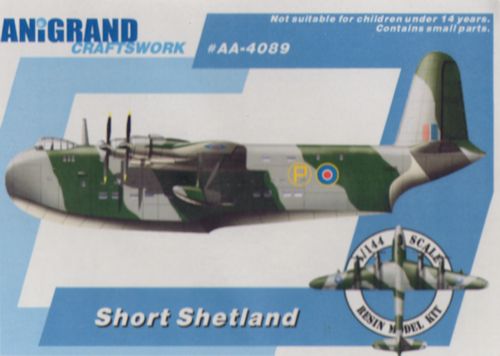
Short Shetland flying boat with bonus kits: G.A.L. Twin Hotspur, Miles Magister with Articulated trailer wing & Martin-Baker MB.5). In 1941, the Bristish Air Ministry issued an requirement for a heavy defensive armament, long range flying boat that intended to replace the Short Sunderland. Saunders-Roe propsed S.41 to the Air Ministry, and was asked to combine the project with Short's proposal. The detailed design was performe...
Handley-Page Halifax B Mk.I. Includes BONUS kits of the GAL.56/04, Miles M.30 X-Minor and Avro Rota. Main RAF heavy bomber other than Lancaster. In 1936, when the British Air Ministry issued Specification B.12/36 which called for a conventional design which could operate from existing airfields but have a range of not less than 3,000 miles and carry a bomb load in excess of 8,000 lbs. In all 19 aircraft manufacturers were advi...
Tupolev TB-3. The world's first 4-engined monplane bomber. Includes BONUS kits of the Polikarpov I-16, Polikarpov I-5 and Grigorovich I-Z. In 1925, the Soviet Air Force approached the Central Aerohydrodynamic Institute with a requirement for a heavy bomber with total engine output of 1,970hp. Tupolev OKB was selected to start design work in 1926. The mock-up was approved in 1929, and was given military designation TB-3 and civ...
Alexejev KM Ekranoplan Caspian Sea monster. Includes BONUS aircraft of the Yakovlev Yak-15 Feather, Yurjev KIT-1 and SSAKTB SL-2P Twin Blanik. In early 1960s, the Soviet Navy command was urgently needed a fast military transport capable of carrying a large payload on the shore of Caspian Sea and Black Sea. The Minister of Defense recognized a Wing-In-Ground effect vehicle which basically allowed for a greater weight aircraft t...
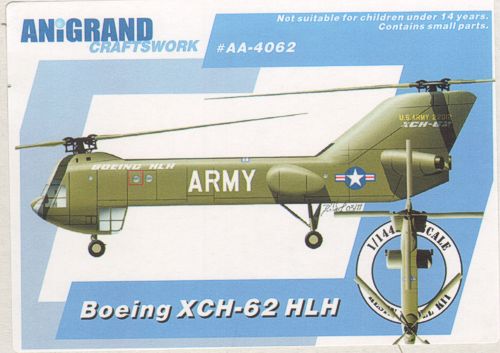
Boeing XCH-62 HLH Heavy lift helicopter program. Includes BONUS aircraft of the Sikorsky CH-54A Skycrane, Fairchild VZ-5 Fledgling and Cessna YH-41 Seneca. In 1967, the Soviet Mil V-12 helicopter made its first lift-off successfully. The U.S. military had an urge to match or top this heavy-lift helicopter. In early 1970, a joint Army and Navy working committee was formed to study the development of a heavy lift helicopter. The...
Nakajima G8N-1 Renzan. Includes bonus kits of the Kokusai Ta-go, Rikugan Ki-202 Shusui-kai, Nakajima Ki-115 Tsurugi, and Kawasaki Ki-119. In 1943, the Imperial Japan Navy issued a long-range land-based attack bomber specification. Nakajima aircraft company was selected to design a four-engine bomber capable of meeting an specification for a plane with maximum speed of 590 km/h able to carry 4,000 kg bomb-load. Nakajima's desig...
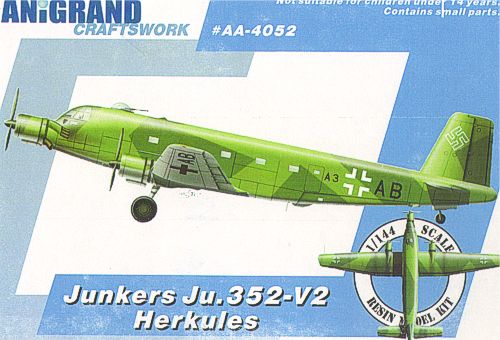
Junkers Ju-352V-2 Herkules. Includes bonus kits of the Flettner Fl-265, Blohm-und-Voss Bv-141B, Messerschmitt Me-609, Focke-Wulf Fw-226 Flitzer. In 1942, due to the worsening war situation and a critical shortage of metal materials, Reich Air Ministry instructed Junkers to redesign the structure of the Junkers Ju.252 transport airplane. Junkers proposed the Ju.352 Herkules, itself developed in an attempt to replace the Ju.52/3...
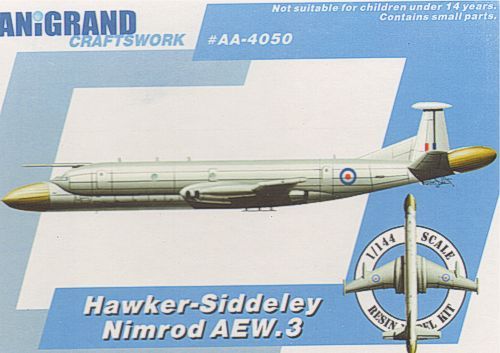
BAe Nimrod AEW.3. Includes BONUS aircraft of the Hawker P.1121, Fairey Gannet AEW.3, Cierva W.11 Air Horse. In 1973, the RAF had begun to examine the options for replacing the Airborne Early Warning (AEW) variant of the Avro Shackleton. Boeing offered the E-3A Sentry, but the over water performance of its radar was judged to be poor. It was announced that a specialized version of the Hawker-Siddeley Nimrod, the AEW.3 would be ...
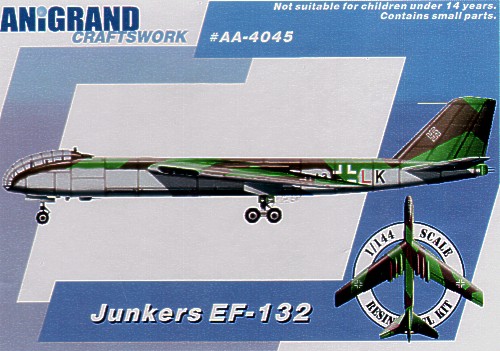
Junkers EF-132 . Final jet bomber captured by Russian. Includes BONUS kits of the Lippisch Li.P12 Entwurf III, Focke-Wulf P.0310251-1006 Victoria tail, Messerschmitt Me.P1106 and Heinkel WESPE. In the autumn of 1944 Reichsmarschall Goring instructed the Junkers and Messerschmitt works to design and produce the very long-range bombers which would be capable of delivering 4000kg bomb load, at high speeds and over extreme distanc...
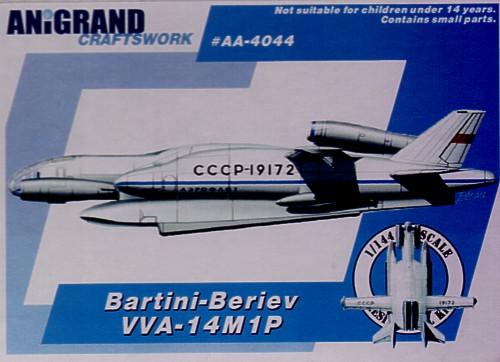
Bartini-Beriev VVA-14M1P Soviet coastlines sea monster. Includes BONUS kits of the IL-28 Beagle, Yak-25RV Mandrake and Mi-4 Hound. In late 1950s, the U.S. Navy started the Polaris program which was to arm the submarines with ballistic missiles. The USSR quickly issued requirement to industries for the Anti-Submarine-Warfare system. A vehicle was initially seen as urgently needed to destroy Polaris-missile submarines. The Minis...
Short SA.4 Sperrin. Includes BONUS kits of the Gloster Javelin, Hawker P.1127 and Short SB.5. After the end of the second World War, the British military felt there was a need for an independent strategic bombing capability that they should not be reliant upon the U.S. Strategic Air Command. In 1947, Air Ministry issued a request in the form of Specification B.35/46 for an advanced jet bomber capable of carrying a nuclear bomb...
Beriev A-40 Mermaid. Also includes BONUS kits of the Beriev R-1, Moskalyov SAM-29 and Kamov Ka-29 Helix-B. In 1976, after the success of the Be-12, the Beriev bureau began to research the feasibility of designing a next generation / jet-powered anti-submarine seaplane. The design drew the attention of Soviet Navy. In 1983, Soviet Government chief Designer AK Konstantinov with the support of Navy, issued an order to Beriev to p...




 Advanced Search