



 Advanced Search
 « Go back« Go backPrevious Product (ACE72550)Next Product (ACE72544)
Ace ACE72548


- Description:
- Italian light military vehicle 508 CM Coloniale
- Manufacturer:
- Ace
- Code Number:
- ACE72548
- Scale:
- 1:72
- Item type:
- Military vehicle kits (injection)
- Price:
- £7.83 (Put this on Backorder and save 10%!)
- Order Quantity:
- Quantity In Stock:
 0
0
- Availability:
- This has sold out but will be back in stock again soon
- Wish List:
- Department:
- Catalogue
Here are some books and decals you might find useful for this kit
Found 8 related products
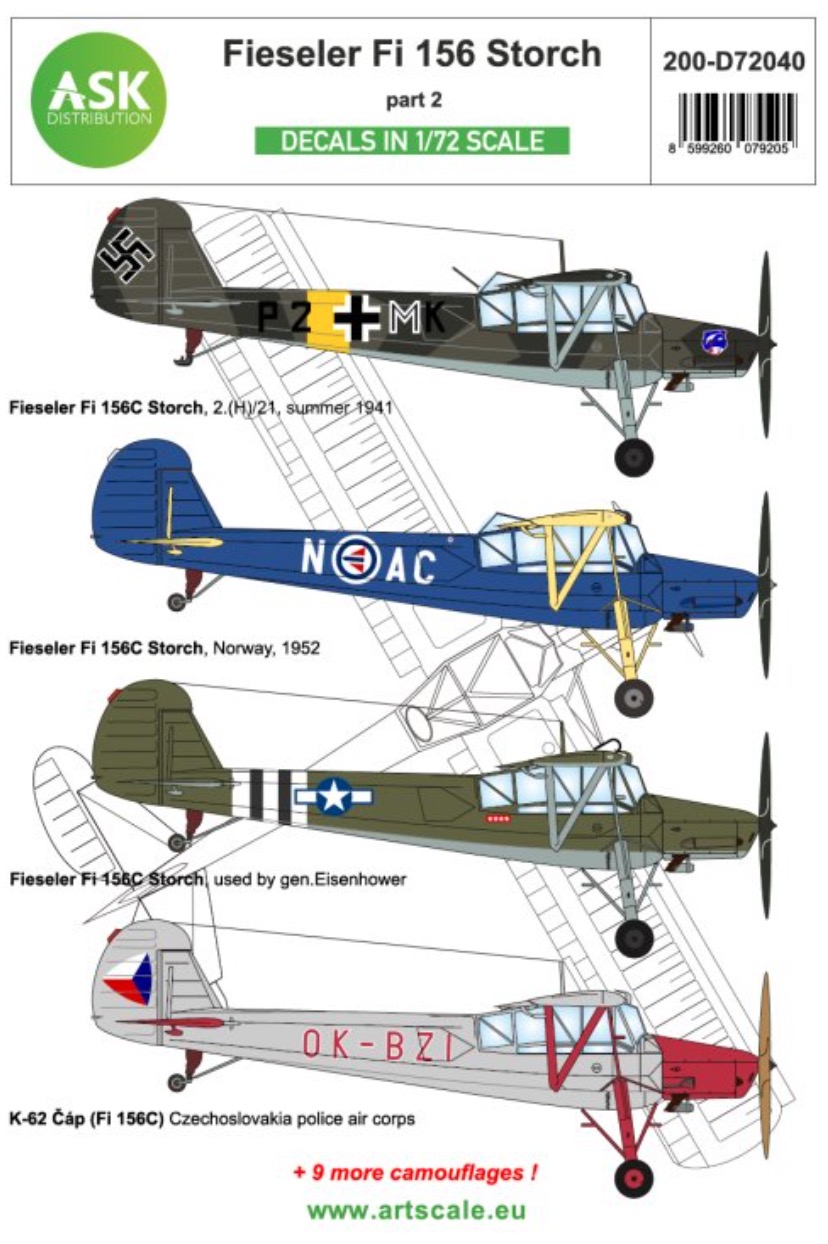 | Art Scale - 200-D72040 - 1:72 | Fieseler Fi 156 Storch part 2 - Around WWII Europe and Foreign services. The decal sheet contains the following markings: Fieseler Fi 156C Storch, 3.(H)31, Poland, May 1941 Fieseler Fi 156C Storch used by gen. Eisenhower Fieseler Fi 156C, 2.(H)21, Eastern front, summer 1941 Fieseler Fi 156C Storch, 6.(H)/31, I.-II.Q 1941 Fieseler Fi 156C Storch, 3./JG27, Libya 1942 K-62 ?ip (Fi 156C) Czechoslvak police air corps, Czechoslovakia 1950's Fieseler Fi 156K-1 Storch, Malmi AB, Helsinki, Finland, 1950 Fieseler Fi 156C Storch, Stab III./JG54, Russia, Januar 1941 Fieseler Fi 156C Storch, 9.SELL (Independent Liason Aviation Flight), Poland, 1948 Fieseler Fi 156C-7 Storch, RAF, Farnborough 1952 Fieseler Fi 156 Storch, Royal Romanian Air Force, Bessarabia, Autumn 1942 Fieseler Fi 156C Storch, Italian Armed Forces at Slovenia-Dalmatia area, Mostar 1942 Fieseler Fi 156C Storch, Norway, 1952 More | Aircraft decals (military) | Catalogue | £13.99 | |
 | MA Publications - MAE05 - No Scale | Building The Harrier. Model Aircraft Extra #5 Building the Harrier The iconic Hawker-Siddeley Harrier was the first of the so- called Harrier 'Jump Jet' series. It was developed in the 1960s as the first operational close-support and reconnaissance fighter aircraft with vertical/short take-off and landing (V/STOL) capabilities, and the only truly successful V/STOL design of the many that arose in that era, and at its heart was the innovative Rolls-Royce Pegasus engine with its thrust vectoring nozzles. The Harrier was developed directly from the Hawker Siddeley Kestrel prototype aircraft, following the cancellation of a more advanced supersonic Hawker Siddeley P.1154. Originally said to be 'unable to carry more than a matchbox over a football field' the Harrier matured into one of the most potent warplanes of its generation. The RAF ordered the Harrier GR.1 and GR.3 variants in the late 1960s, as well as T.4 trainers versions, and it was also exported to the United States as the AV-8A and TAV-8A, for use by the US Marine Corps as well as the Spanish Navy in the 1970s. Spain sold seven single-seat and two twin-seat Harriers to Thailand in 1998. The Sea Harrier FRS.1, which shot to fame during the Falklands War, was designed to fill the strike, reconnaissance and fighter roles for the Royal Navy, and the innovative use of a 'ski jump' allowed the aircraft to take-off from a short flight deck with a heavier loadout than otherwise possible. After the Falklands War, the Sea Harrier was upgraded to the F/A2 standard and featured the Blue Vixen radar and carried the AIM-120 AMRAAM missile. The Indian Navy was the only other user of the Sea Harrier aboard their aircraft carriers INS Vikrant and INS Viraat. The BAe/McDonnell Douglas Harrier II was a second-generation of V/STOL aircraft designed for use by the US Marne Corps, RAF and the Royal Navy and continues in service with the USMC as the McDonnell-Douglas AV-8B and TA-V8B trainer and is also in service with the Spanish and Italian Navies. For the RAF, initial deliveries of the Harrier II were designated as Harrier GR.5 and subsequent upgraded airframes were redesignated accordingly as GR.7 and GR.9. The RAF Harriers saw action over Bosnia and Afghanistan before being retired in 2011. Most of the original US Marine Corps McDonnell-Douglas AV-8B 'day attack' aircraft were upgraded to either the FLIR equipped 'Night Attack Harrier' or the more capable radar equipped 'Harrier II Plus' and have participated in support of Operation 'Southern Watch', Operation 'Allied Force'. USMC McDonnell-Douglas AV-8Bs also took part in Operation 'Enduring Freedom' in Afghanistan from 2001, and the aircraft also participated in the Iraq War in 2003, acting primarily in support of USMC ground units, and in 2011, they flew in support of Operation 'Odyssey Dawn', enforcing the UN no-fly zone over Libya. This fourth book in the MA Extra Series contains fourteen model builds, colour profiles and scale plans, and will be a must for the Harrier aficionado! More | Aircraft books | Limited Availability | £14.99 | |
 | Print Scale - PSL72114 - 1:72 | Fiat CR.32 1.Fiat CR.32 (154-4) was a flight demonstration aircraft assigned to 154 Squadriglia,4 Stormo 'Diavoli Rossi' in 1936.The fuselage fasces and the House of Savoia emblem on the rudder were standard markings on Italian military aircraft. 2. Fiat C.R. 32, 410 Sq., Diredaua and Addis Addis Ababa, Abyssinia, 1940-1941. 3. Fiat CR.32, Part 19 Escuadrilla, Grupo XXIII AS 'de Bastos'No. 3-12 (435) 4. Fiat CR.32 Part: X Grupo Autonomo de Caza Baleari No. 8. 5. Fiat CR.32 bis details: Air Force Institute of the USSR. 3-6 ex (s/n 431) This aircraft was tested at the Air Force Institute in 1937 . Summer of 1937 the aircraft was captured. 6. Fiat CR.32 bis Part: I / JG 138, No. 179 (?) Aspern, Vienna, Austria. September, 1938. 7. Fiat CR.32 Part: X Grupo de Caza Basado No. 9 Majorca. Plane without camouflage. 8.Fiat CR.32, No. 801 One of the 16 fighters , ordered by China in 1933. 9. Fiat CR.32, Part: Escuadrilla 'Gamba di Ferro' No. 3-7. More | Aircraft decals (military) | Limited Availability | £17.30 | |
 | Print Scale - PSL72122 - 1:72 | Vought OS2U Kingfisher 1. Vought Sikorsky OS2U-3 (Kingfisher) flown Lt J.G. John A. Burns who rescued nine downed pilots from Truk Lagoon in April 1944. 2. OS2U-3 Unit: Northern Fleet, No. 1 Two Kingfisher were served in Soviet Union. In Spring 1944 USSR temporary got ex-Italian light cruiser Milwaukee. It delivered on 24th August 1944 to Northern Fleet and renamed Murmansk. Onboard it carried 2 OS2U-3 Kingfisher, they still wore American White/Grey painting and re-coded '1' and used as trainers and liaisons. 3. OS2U-3,Unit: Fuerza Aerea de Chile No. 308,View of the OS2U-3 Kingfisher showing the Nr. 308, first FACH plane flew over the national Antarctic territory in 1947. Note: Chilean Kingfishers wore telescopic sights only for a brief time after its arrival to Chile. 4. Kingfisher Mk.I, Unit: 765 NAS, FAA ,No. Fn678 Sandbanks, England,1943. Seaplane pilot training unit. 5. OS2U-3 Unit: 107 Sqn, RAAF,Serial: JE-T, A48-18 (BuNo.5983) The RAAF Kingfisher in lightened and bare metal markings of 107 Squadron. The Light Grey codes were later all changed to Black. 6. OS2U-3 part: the RAAF Antarctic Flight number: A48-13 (BuNo. 5977) in 1947, the aircraft in the Antarctic wing Australian air force, was operated by the Australian Antarctic expedition and was used for reconnaissance flights around the Australian Antarctic base. 7. U.S. Navy NAVAL air base 100: Corpus Christi, Texas, 1942. 8. OS2U-2 Part: VS-5D4. US Navy: 5D4-S-3 (BuNo. 2190) NAVAL Base, Cape May New Jersey, 1942. 9. OS2U-2: PW-2, U.S. Navy BuNo. number: 2216 seaplane tender AV-8 USS Tangier, Pearl Harbor, Hawaii, 1941. 10. Voughi OS2U-2 of VS-2D1 (First Naval District - Inshore Patrol Squadron), NAS Quonset Point R.I.. soring 1941. Overall Aluminium Varnish with upper wing surfaces in Orange-Yellow. Cowl, Fusalago and pontoon stripes are insignia Red. 11. Vought O2SU-1 of VO-1 on the USS Pennsylvania (BB-38), October 1940. Overall Aluminum varnish, Orange-Yellow upper wing surfaces. True Blue cowling and fuselage stripes, and Insignia Red tail surfaces. More | Aircraft decals (military) | Catalogue | £15.99 | |
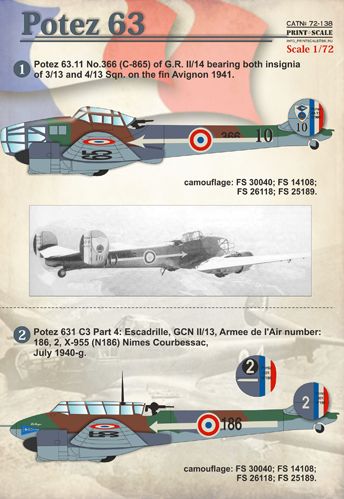 | Print Scale - PSL72138 - 1:72 | Potez 63 1. Potez 63.11 No.366 (C-865) of G.R. II/14 bearing both insignia of 3/13 and 4/13 Sqn. on the fin Avignon 1941. 2. Potez 631 C3 Part 4: Escadrille, GCN II/13, Armee de l'Air number: 186, 2, X-955 (N186) Nimes Courbessac, July 1940-g. 3. Potez 63.11 Part 2: Escadrille, GR I/52 No. 4 (N357), 1940. 4. Potez 63.11 part: GAO I/583 number: 1 (N?) Aleppo, Syria early 1941. 5. Potez 63.11 Free French Fighter Flight No.2, RAF Serial: Ax673 Haifa, December 1940. 6. Potez 63-11 Part: not available number: G-717 Aircraft was used as a training (for advanced training) in 1943, the 'G 'Prefix in a side room means 'Gyarkori 'camp. 1943 g. like many other aircraft, it was used as an auxiliary. 7. Potez 63-11 part: Reggia Aeronautica Room: no data 1943 g. Note that typically Italian aircraft were not under the wings of white boxes under the markings. Apparently in this case, they are closing the OZ the previous owners. This type of aircraft was used only for training and usually carried two white strips on the wings-belonging of flight school. More | Aircraft decals (military) | Limited Availability | £15.99 | |
 | Print Scale - PSL72148 - 1:72 | Seversky P-35 1. Seversky P-35 Unit: 94th PS, 1st PG, USAAC Serial: Pa70 Pilot - CO (note the Red band in rear fuselage) Maj.H.H.George, Selfridge Field, Michigan, 1938-1939. 2. Seversky P-35A Unit: 1st PG, USAAC Serial: Pa1 This aircraft was flown by Colonel Henry Clagett during this tour as Group Commander. The 1st Pursuit Group was based at Selfridge Field during 1938. 3. Seversky P-35 Unit: 39th PS, A Flight, USAAC Serial: 80/31P This P-35 was assigned to the leader of A Flight at Selfridge Field during 1940. 4. Seversky P-35 Unit: 94th PS, 1st PG, USAAC Serial: 95 This P-35 was painted in temporary camouflage colours for the 1940 War Games at Pope Field, North Carolina. 5. Seversky P-35 Unit: 27th PS, USAAC Serial: 51 This P-35 was painted in temporary camouflage colours for the 1940 War Games. 6. P-35A Unit: 17th PS, 24th PG, USAAC Serial: 17/4MP Pilot - Lt. Boyd Wagner, commander of the 17th Pursuit Squadron. Nichols Field, Luzon Island, Philippines, June 1941. P-35A - embargoed Swedish aircraft. 7. Seversky P-35A Unit: 34th PS, 4th CG, USAAF Serial: 23 Del Carmen Field, Philippines, December 1941. 8. Seversky P-35A Unit: 24th PG, USAAC Serial: 125/24P Philippines, December 1941. 9. 2PA-B3 (A8V1) Unit: 12nd kokutai Serial: 3-57 China, 1939. The Seversky 2PA-B3 is two seat fighter: one of 22 sold to Japan in the late 1930's. They briefly saw action in the second Sino-Japanese war) but they had passed out of service by Pearl Harbour. Their Allied code name was Dick. 10. J-9 (EP-1-106) Unit: F8 Flygflottilj Serial: 16/8 (c/n.2104) This J-9 carries an 'Italian' style camouflage of Sand and Green adopted during 1943. 11. F 8s 3.division. The closest J 9s is yellow N 9 (2144). Colour scheme introduced in 1944. 12. J-9 (EP-1) Unit: F8 Flygflottilj Serial: 53/3 (c/n.2134) Barkarby, Sweden, during 1940. 13. Seversky P-35/2PA/AT-12 Guardsman , USA Materiel Division, USAAC AT-12 30/MD. More | Aircraft decals (military) | Catalogue | £15.99 | |
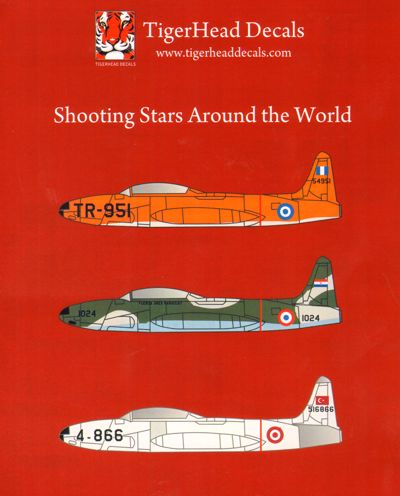 | Tigerhead Models - THD72017 - 1:72 | The Lockheed T-33 Shooting Star (or T-Bird) is an American jet trainer aircraft. It was produced by Lockheed and made its first flight in 1948 piloted by Tony LeVier. The T-33 was developed from the Lockheed P-80/F-80 starting as TP-80C/TF-80C in development, then designated T-33A. It was used by the U.S. Navy initially as TO-2 then TV-2, and after 1962, T-33B. Despite its age, the T-33 remains in service worldwide. - Cuban Air Force - Hellenic Air Force - Italian Air Force - Paraguay Air Force - Turkish Air Force More | Aircraft decals (military) | Limited Availability | £15.99 | |
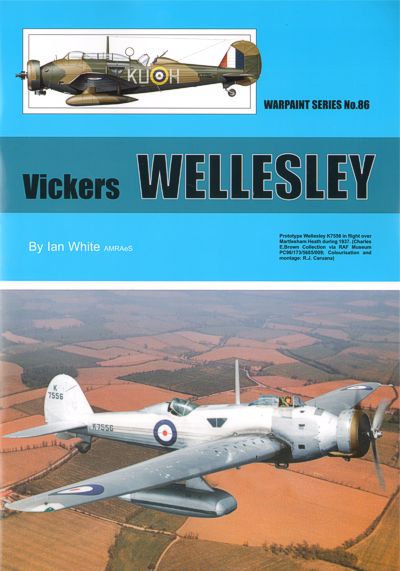 | Warpaint Series - WPS86 - No Scale | Vickers Wellesley by Ian White. Created on the drawing boards of the Vickers (Aviation) Company by Barnes Wallis using the geodetic form of construction he devised for Britain's R.100 airship, the Wellesley was designed to fulfil an Air Ministry specification for a reliable, general purpose bomber and torpedo-bomber, that was required to carry a heavy load over long distances. Originally conceived as a biplane, but converted to an all-metal geodetic monoplane by Barnes Wallis, and powered by the highly reliable Pegasus radial engine, the Wellesley was built in reasonable quantities to begin the re-equipment the embryo Bomber Command in 1937. Following testing at Martlesham Heath, the first production Wellesleys were delivered to the RAF early in 1937 and within one year formed the equipment of six UK squadrons. The Wellesley's flying qualities were such that it was chosen to equip the RAF's Long Range Development Unit, under whose guise it undertook a record breaking flight from Cranwell to the Persian Gulf and back to Ismailia in July 1938 and a second from Ismailia to Darwin, Australia, the following November, when the aircraft covered a distance of 7,157 miles without refuelling. By the outbreak of war the Wellesley was rendered obsolete in the European theatre, but was supplied in large numbers to re-equip the RAF's squadrons in the Middle East and East Africa. It was in the latter theatre that the aircraft showed its true metal. Supported by dedicated ground crews and the ever reliable Pegasus engine, the Wellesleys of Nos.14, 47 and 223 Squadrons battled the Italian Regia Aeronautica and the Italian Army in the Sudan, Abyssinia, Eritrea, Somaliland the Red Sea from June 1940 to November 1942. Despite being decidedly obsolete by the early months of 1943, the Wellesley was employed on transport, anti-submarine and convoy protection duties in the Eastern Mediterranean until March of that year, when the small number that remained were finally retired. More | Aircraft books | Catalogue | £14.00 |
Hannants Search Engine
Convert Currency
Copyright © 2001-2026 H. G. Hannant Limited. All rights reserved. | Website by Dessol
Privacy Policy | Cookie Information | Switch to Mobile Version