



 Advanced Search
 « Go back« Go backPrevious Product (ICMDS7205)Next Product (ICMDS7203)
ICM UA ICMDS7204

- Description:
-
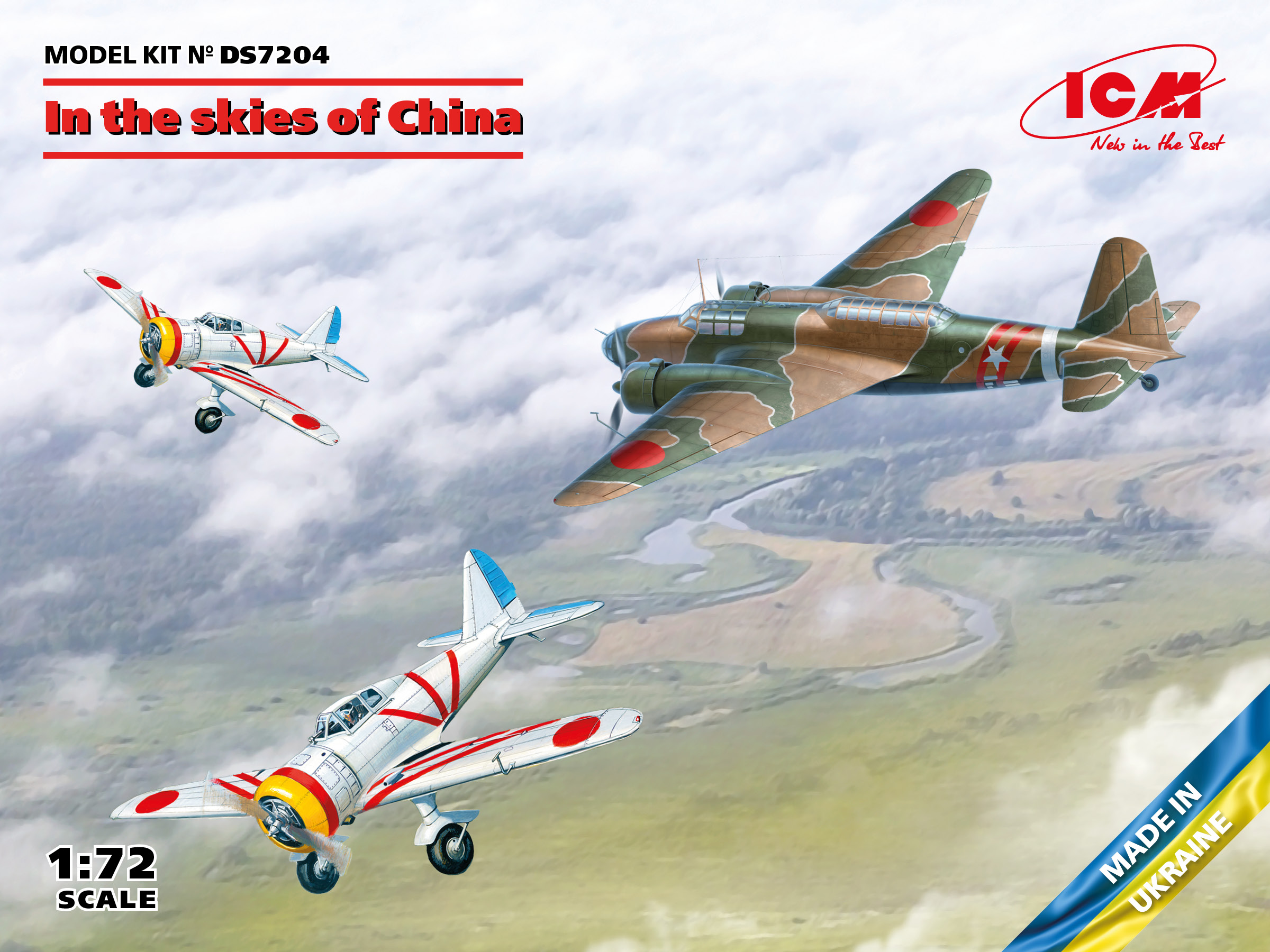
In the skies of China (Mitsubishi Ki-21-Ia, two Ki-27a) Diorama Set On July 7, 1937, the incident on the Lugouqiao Bridge near Beijing started the Second Sino-Japanese War. From the first days of the invasion, the Japanese navy's aircraft held the brunt of the attack, and this forced the army air force to increase its supply of aircraft. In the spring of 1938, the Ki-27a fighter appeared in the skies of China. Its combat qualities, combined with the high training of its personnel, allowed the Japanese air force to gain an advantage over the Chinese Air Force. In air battles, the fighter successfully fought Soviet-made I-15 and I-16 aircraft. Also in 1938, Ki-21-Ia bombers appeared in the Chinese skies, and the 60th Sentai was the first to receive the[+] More...
- Manufacturer:
- ICM UA
- Code Number:
- ICMDS7204
- Scale:
- 1:72
- Item type:
- Aircraft kits (injection)
- Price:
- £38.32
- Order Quantity:
- Quantity In Stock:
 5+
5+
- Availability:
- This will usually be dispatched within 24/48 hours of receiving your order
- Wish List:
- Department:
- Catalogue
Here are some books and decals you might find useful for this kit
Found 6 related products
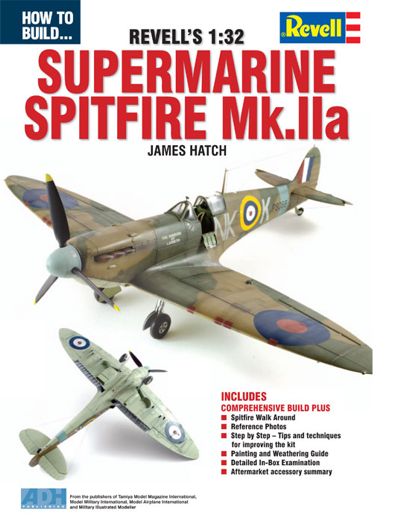 | ADH Publishing - ADH067 - No Scale | How to Build The Revell 1:32 Supermarine Spitfire Mk.IIa (designed to be used with Revell kits) The name Supermarine Spitfire has now become synonymous with an entire island people, and their battle to maintain their freedom in the shadow of the Nazi jackboot. The very shape and sound of the Supermarine Spitfire seems to still invoke and embody the usually reserved pride of the British person. It is probably true to say that Reginald Mitchell's beautiful aircraft design is one of the most easily recognised and much-loved shapes that ever took to the skies. When actual mass production of the Supermarine Spitfire ceased in 1948, over 20,000 machines had been built, and operated by over thirty countries around the world. This iconic series saw service with the RAF right up until the mid-1950s. It also saw service with the Irish Air Corps as late as 1961; a full 26yrs after the flight of the prototype K5054. Revell has now released an all-new 1:32 scale Supermarine Spitfire Mk.IIa. With some minor modifications, this model may also be built as a Mk.I or a Mk.Va. Over the course of five Chapters, James Hatch examines the kit contents in detail, describes construction of the model with lavish illustrations, and points out the areas of the kit that may be improved and corrected. This new book features an exhaustive step-by-step guide to construction; plus a painting and weathering tutorial. A number of essential reference resources are also included. More than 200 photos, a reference guide, and photos of the kit sprues are all included-a must have before you build the model! More | Aircraft books (on modelling aircraft) | Catalogue | £9.95 | |
 | Print Scale - PSL72517 - 1:72 | Supermarine Spitfire Mk.XIV "High Backs" Over Europe Legendary aircraft of World War II: variants of combat vehicles of later modifications that participated in battles in the skies over Europe in 1944-45 are presented. 1/72 scale kit: 1. Spitfire Mk.XIVc NH718/"3W G", flown by Major K. C. Kuhlmann, No .322 "Dutch" Squadron, West Malling , UK, June July 1944. 2. Spitfire Mk.XIVc RM687/"DL K Brunhilde ", flown by Flt Lt H. D. Johnson, No. 91 "Nigeria" Squadron, West Malling , UK, July 1944. 3. Spitfire Mk.XIVc RB159/"DW D", flown by Sqn Ldr R. A. Newbury, No. 610 "County of Chester" Squadron, Friston, Sussex, July 1944. 4. Spitfire Mk. XIVe RM683 /"AE N" of Sqn Ldr W. G. Dodd, No 402 Squadron (RCAF), Hawkinge, UK, August 1944. 5. Spitfire Mk.XIVc RM787/"CG", flown by Wg Cdr Colin Gray, Lympne Wing, Lympne, UK, September 1944. 6. Spitfire Mk.XIVe RM797/"EB E", flown by Flt Lt W. N. Stowe, No. 41 Squadron, Lympne, UK, October 1944. 7. Spitfire Mk.XIVe RM655/"AP S", flown by Plt Off G. Lord, No. 130 "Punjab" Squadron, B.82/Grave, Netherlands, October 1944. 8. Spitfire Mk.XIVe RM738/" AP A Elizabeth IX", flown by Sqn Ldr P. V. K. Tripe, No. 130 "Punjab" Squadron, B.64/ Dienst Schaffen , Belgium, November 1944. 9. Spitfire Mk.XIVe NH689/"MN B", flown by Sqn Ldr T. Spencer, No. 350 "Belgium" Squadron, Y.32/ Ophoven ,Belgium, January 1945. 10. Spitfire FR Mk.XIVe RN114/"RC W", Wg Cdr R.C.A Waddell, No 39 Wing, Eindhoven, Netherlands, January 1945. 11. Spitfire XIV RN119/"AE J", flown by Sqn Ldr Leslie Moore, No 402 Squadron, B.88/ Heesch , Holland, February 1945. 12. Spitfire Mk.XIVe RB155/"MN C", flown by Plt Off D. J. Watkins, No. 350 "Belgium" Squadron, B.118/Celle, Germany, April 1945. More | Aircraft decals (military) | Catalogue | £16.50 | |
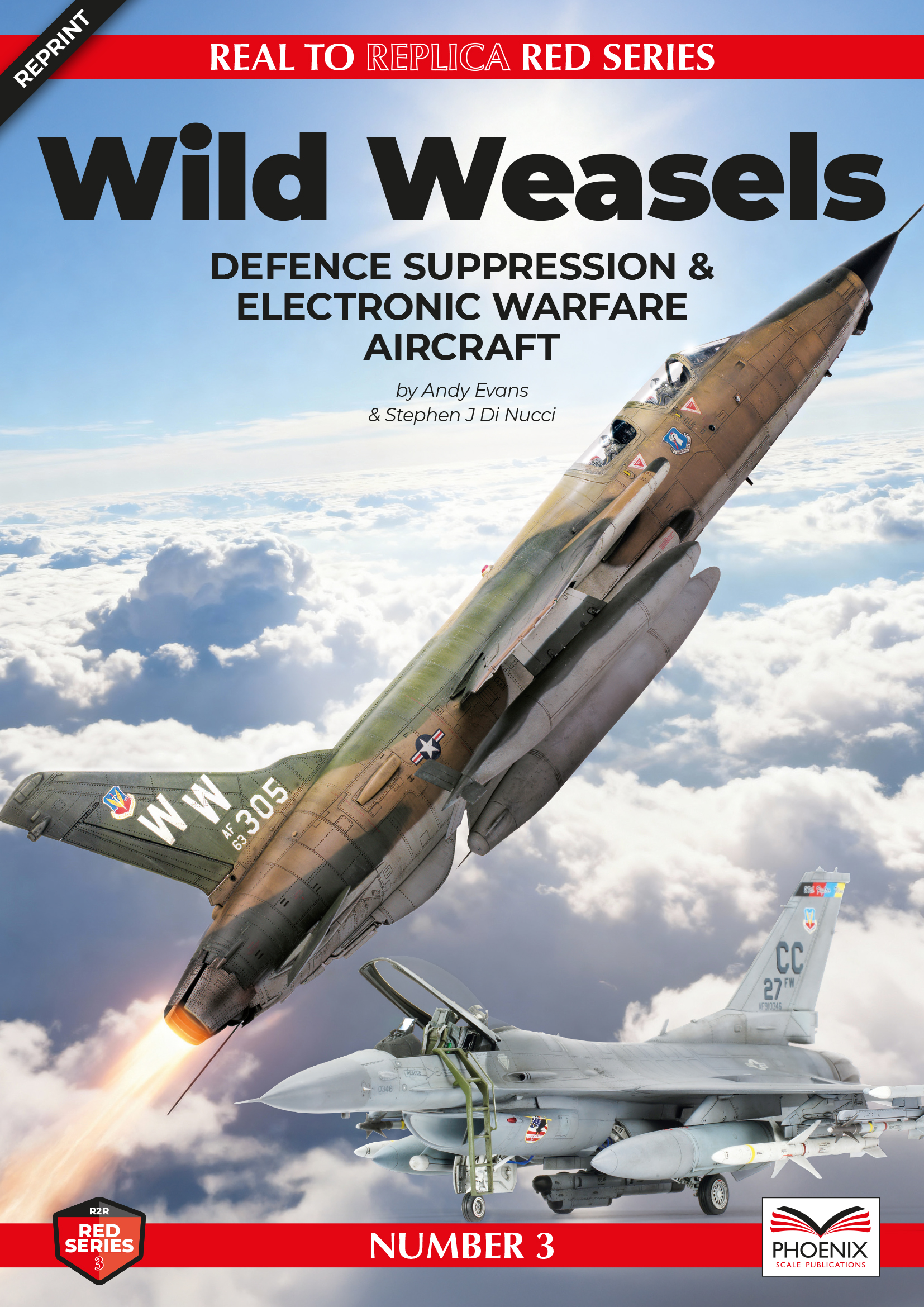 | Phoenix Scale Publications - R2RRED03 - No Scale | LIMITED RE-PRINT! Wild Weasels Defence suppression & electronic warfare aircraft by Andy Evans & Stephen J Di Nucci Real To Replicas Red series Number 3 Suppression of Enemy Air Defences (SEAD) are military actions to subdue enemy surface-based air defences, including not only surface-to-air missiles (SAMs) and anti-aircraft artillery (AAA), but also interrelated systems such as early-warning radar and command, control, and communication (C3) functions, while also marking other targets to be destroyed by an air strike. Suppression can be accomplished both by physically destroying the systems or by disrupting and deceiving them through electronic warfare. In modern warfare SEAD missions can constitute as much as thirty percent of all sorties launched in the first week of combat and continue at a reduced rate through the rest of a campaign. One quarter of American combat sorties in recent conflicts have been SEAD missions. Electronic warfare (EW) on the other hand is any action involving the use of the electromagnetic spectrum (EM spectrum) or directed energy to control the spectrum, attack an enemy, or impede enemy assaults. The purpose of electronic warfare is to deny the opponent the advantage of, and to ensure friendly unimpeded access to the EM spectrum. EW can be applied from air, sea, land, and/or space by manned and unmanned systems, and can target communication, radar, or other military and civilian assets. These airborne roles were in their infancy during World War II and the Korean War but came to prominence during the Vietnam War with the advent of the dedicated 'Wild Weasel' role, a code name given by the United States Air Force to an aircraft, of any type, equipped with anti-radiation missiles and tasked with the SEAD - destroying the radar and surface-to-air missile installations of enemy air defence systems. The 'Wild Weasel' concept was developed by the United States Air Force in 1965, after the introduction of Soviet SAMs and their downing of US strike aircraft over the skies of North Vietnam. 'Wild Weasel' tactics and techniques began their development in 1965 following the commencement of Operation 'Rolling Thunder' and were later adapted by other nations The term 'Wild Weasel' derives from Project 'Wild Weasel', the USAF development program for a dedicated SAM-detection and suppression aircraft. The technique was also called an 'Iron Hand' mission, though technically this term referred only to the suppression attack before the main strike. Originally named 'Project Ferret', denoting a predatory animal that goes into its prey's den to kill it, the name was changed to differentiate it from the code-name 'Ferret' that had been used during World War II for radar counter-measures bombers. In brief, the task of a Wild Weasel aircraft is to bait enemy anti-aircraft defences into targeting it with their radars, whereupon the radar waves are traced back to their source, allowing the Weasel or its teammates to precisely target it for destruction. Since then, SEAD and EW has been used in the Gulf Wars an in NATO operations over Bosnia and Kosovo. The unofficial motto of the Wild Weasel crews is 'YGBSM' " 'You Gotta Be Shittin' Me'. This appears prominently on the logo patch of some squadrons. As the story goes, this was the response of Jack Donovan, a former B-52 EWO (Electronic Warfare Officer), whereupon learning that he was to fly back seat to a self-absorbed fighter pilot while acting as flypaper for enemy SAMs, his exact words were: 'I'm gonna fly with you, and we're gonna shoot a SAM site before it shoots us? You gotta be shittin' me'. In this book we examine the background of these specialised roles from World War II, through Vietnam to modern day, and look at the aircraft that undertake them More | Aircraft books | Catalogue | £27.99 | |
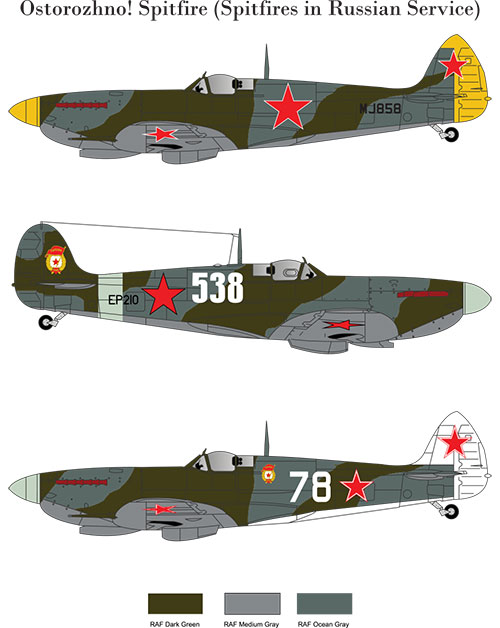 | Tigerhead Models - THD72018 - 1:72 | Supermarine Spitfires in Soviet Service. Along with British Hurricanes, the Soviet Air Force (voyenno-vozdushnyye sily"VVS) also managed to fly another aircraft of the Royal Air Force as a front-line fighter"the Supermarine Spitfire Mk. Vb. In the West this airplane is feted as the winner of the Battle of Britain, and is also a national symbol of World War II. In the skies of Russia these fighters became participants in 1943 of the bloodiest battles over the Kuban. Two front-line fighter aviation regiments of the Soviet VVS"57th Guards Fighter Aviation Regiment (GIAP) and 821st Fighter Aviation Regiment (IAP)"were re-equipped with the Supermarine Spitfire Mk. Vb. It was the 57th GIAP that first entered combat with the enemy in these fighters, in May 1943. Earlier the regiment was known as the 36th IAP, and was formed in Baku in 1938. Pilots flew the regiment's first combat sortie under the command of Major Aleksandr Alekseevich Osipov on 27 November 1941 as part of the 72d Fighter Aviation Division (IAD) (later the regiment was subordinated to the 237th IAD). The regiment fought in the Southern, Crimean, and North Caucasus fronts until 15 November 1942. It is possible to make 3 full profiles. - Supermarine Spitfire Mk.Vb 57 GIAP Kuban 1943 - Supermarine Spitfire Mk.IXe 26 GIAP Leningrad 1944-1945 - Supermarine Spitfire Mk.IXc MJ858 More | Aircraft decals (military) | Catalogue | £13.99 | |
 | Warpaint Series - WPS105 - No Scale | Sopwith Pup by Matthew Willis (Hall Park Books Limited) By Matthew Willis The Sopwith Pup, as it is unofficially but universally known, was one of the first true British fighter aircraft, and one of the most significant of the First World War. It played a key part in maintaining control of the skies over the Western Front during and after the RFC's toughest period, Bloody April, 1917. Its superb flying qualities kept it competitive as ever-faster and more powerful opposition appeared, and it played an unglamorous but important role in the defence of the UK against zeppelin and heavy bomber attacks, and was fundamental to the development of ship-based aviation. With the very well-established categories of military aircraft that are familiar today, it is hard to comprehend the world in which the Pup was born, where these clear delineations did not exist. Certainly the idea of the fast, agile single-seat fighter was barely thought of when the Pup's outline was first chalked on the floor of the experimental workshop at Sopwith's Kingston-upon-Thames premises in 1915. The new aircraft was known as the 'Sparrow', was powered by a 50hp Gnome rotary. Test pilot Harry Hawker took the aircraft to Brooklands and amazed trainee RFC pilots by flying it under the bridge across the Byfleet Banking. It was fully aerobatic and capable of a speed just shy of 85mph despite the low engine power. It is unclear whether Sopwith intended the machine to form the basis of a military aircraft but in any event, its performance and handling, even on such low power, must have recommended it for that purpose. The 'Sparrow' therefore became the progenitor of the aircraft that would become the 'Pup'. It was around the time of the prototype's first appearance that the Pup seems to have gained its popular name. Brigadier-General SeftonBrancker, then the RFC's Director of Air Organisation, is reputed to have remarked, on seeing the prototype Scout beside its larger sibling at Brooklands, 'Your 1 Strutter has had a pup!' For all its value as a front line fighting aeroplane, the Pup had a potentially even greater impact on the development of naval aviation; in particular, the sometimes tortuous path of launching aircraft from, and returning them safely to, ships at sea. Moreover, the Pup became one of the more successful operational aircraft in this fledgling area of combat. This is the first WWI title in the series and includes all the usual Warpaint features historical text, modellers glossary, colour artwork by Richard Caruana and a three page colour walkaround by author Matthew Willis. More | Aircraft books | Catalogue | £14.00 | |
 | Warpaint Series - WPS77 - No Scale | Curtiss P-40. Derived from the earlier Curtiss 75 Hawk the P-40 Warhawk was an attempt to update the original design for more modern warfare. Unfortunately the aircraft that first emerged was seriously underpowered, undergunned and suffering from stability problems. Although not an auspicious start for a fighter design the Curtiss engineers and those of Allison, the engine builders, finally resulted in an aircraft that was worthy of the appellation fighter. While the P-40 would never really gain the fame of other aircraft destined to play their roles in the forthcoming global conflict it would carve out a niches for itself in the deserts of Arabia, the icy Arctic and across the Pacific. Thus in the hands of experienced pilots determined to wring the best out of tools to hand the P-40 was more than able to match the best that the enemy could throw at it. The first claim to fame for the P-40 was with the American Volunteer Group better known as the Flying Tigers created to support the Chinese Government in repulsing the Japanese invaders. Sporting shark mouths on the nose panels these early aircraft, sometimes working in desperate conditions, repulsed the invaders with great skill and held them at bay until America joined the war. With the air forces of other countries the P-40 made its mark. In the desert with the RAF and RAAF, across the Pacific with the RAAF and the RNZAF and in the frozen north with the RCAF the Curtiss roamed the skies. The P-40 saw service in other air forces with Brazil, Turkey and Russia operating the type with some success. . Written by Kev Darling this latest Warpaint covers all versions of this unique naval aircraft and is illustrated in colour by Richard J.Caruana. Unique 1:72nd scale plans are also included as well as a list of operators plus production details. [P-40B P-40C P-40E P-40M P-40N] More | Aircraft books | Catalogue | £13.50 |
Hannants Search Engine
Convert Currency
Copyright © 2001-2026 H. G. Hannant Limited. All rights reserved. | Website by Dessol
Privacy Policy | Cookie Information | Switch to Mobile Version