



 Advanced Search
 ICM UK ICMDS7208
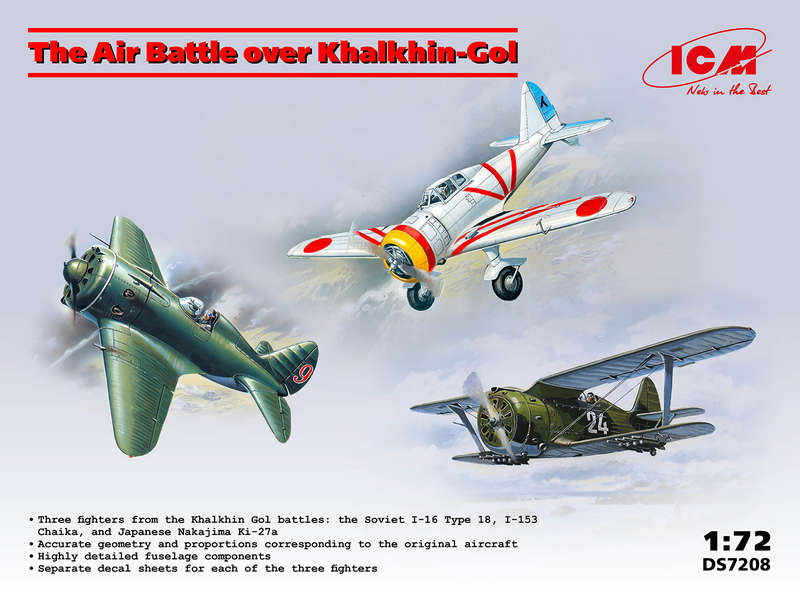

- Description:
- The Air Battle over Khalkhin-Gol. Includes Polikarpov I-16 Type 18, I-153 Chaika and Nakajima Ki-27a
- Manufacturer:
- ICM UK
- Code Number:
- ICMDS7208
- Scale:
- 1:72
- Item type:
- Military vehicle kits (injection)
- Price:
- £24.99 (Put this on Backorder and save 10%!)
- Order Quantity:
- Availability:
- 0
- Wish List:
- Department:
- Future Releases
Here are some books and decals you might find useful for this kit
Found 200 related products
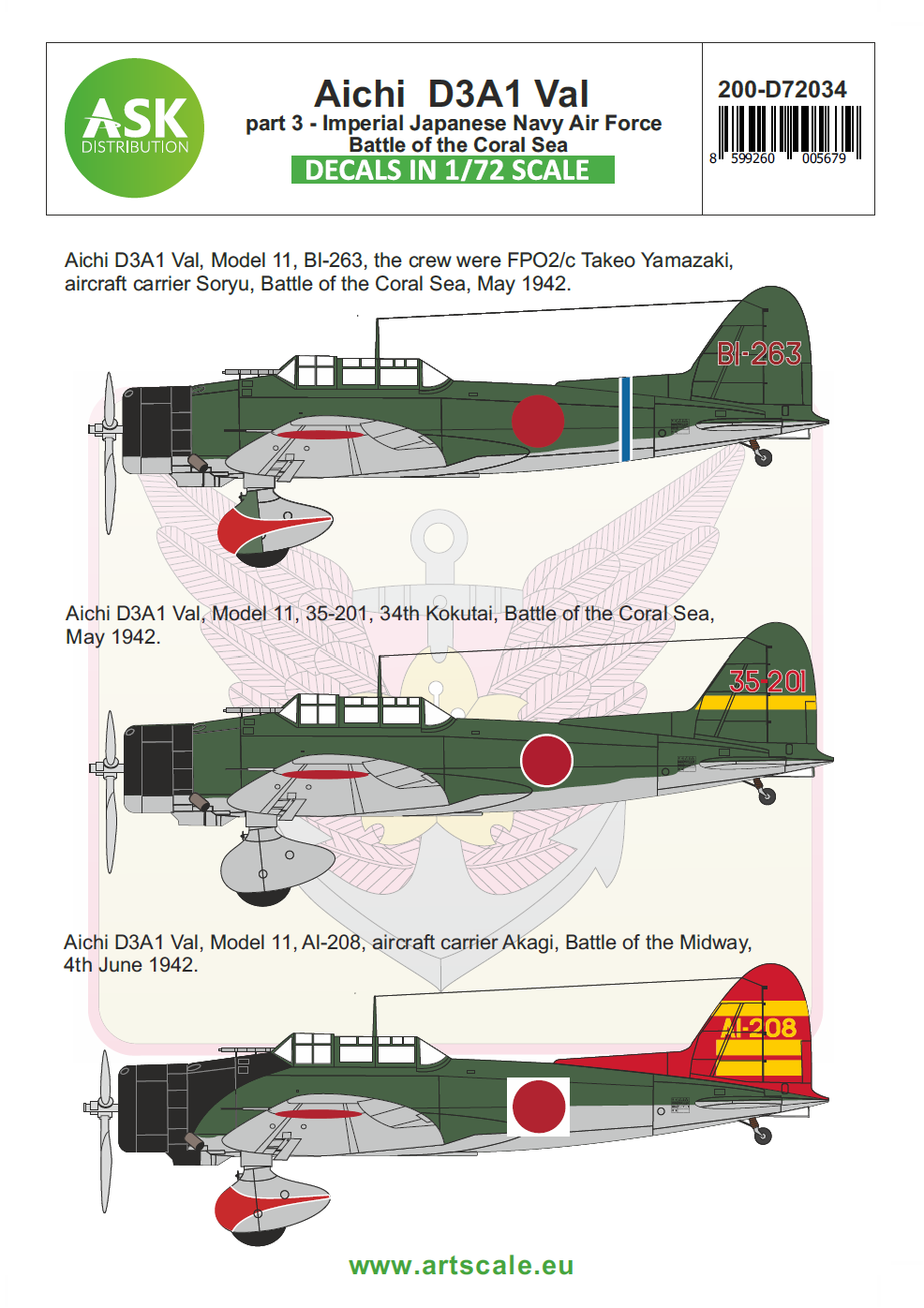 | Art Scale - 200-D72034 - 1:72 | Aichi D3A1 Val part 3 - Imperial Japanese Navy Air Force, Battle of the Coral Sea The decal sheet contain follow markings: - Aichi D3A1 Val, Model 11, Bl-263, the crew were FPO2/c Takeo Yamazaki, aircraft carrier Soryu, Battle of the Coral Sea, May 1942. - Aichi D3A1 Val, Model 11, 35-201, 34th Kokutai, Battle of the Coral Sea, May 1942. - Aichi D3A1 Val, Model 11, Al-208, aircraft carrier Akagi, Battle of the Midway, 4th June 1942. More | Aircraft decals (military) | Catalogue | £13.99 | |
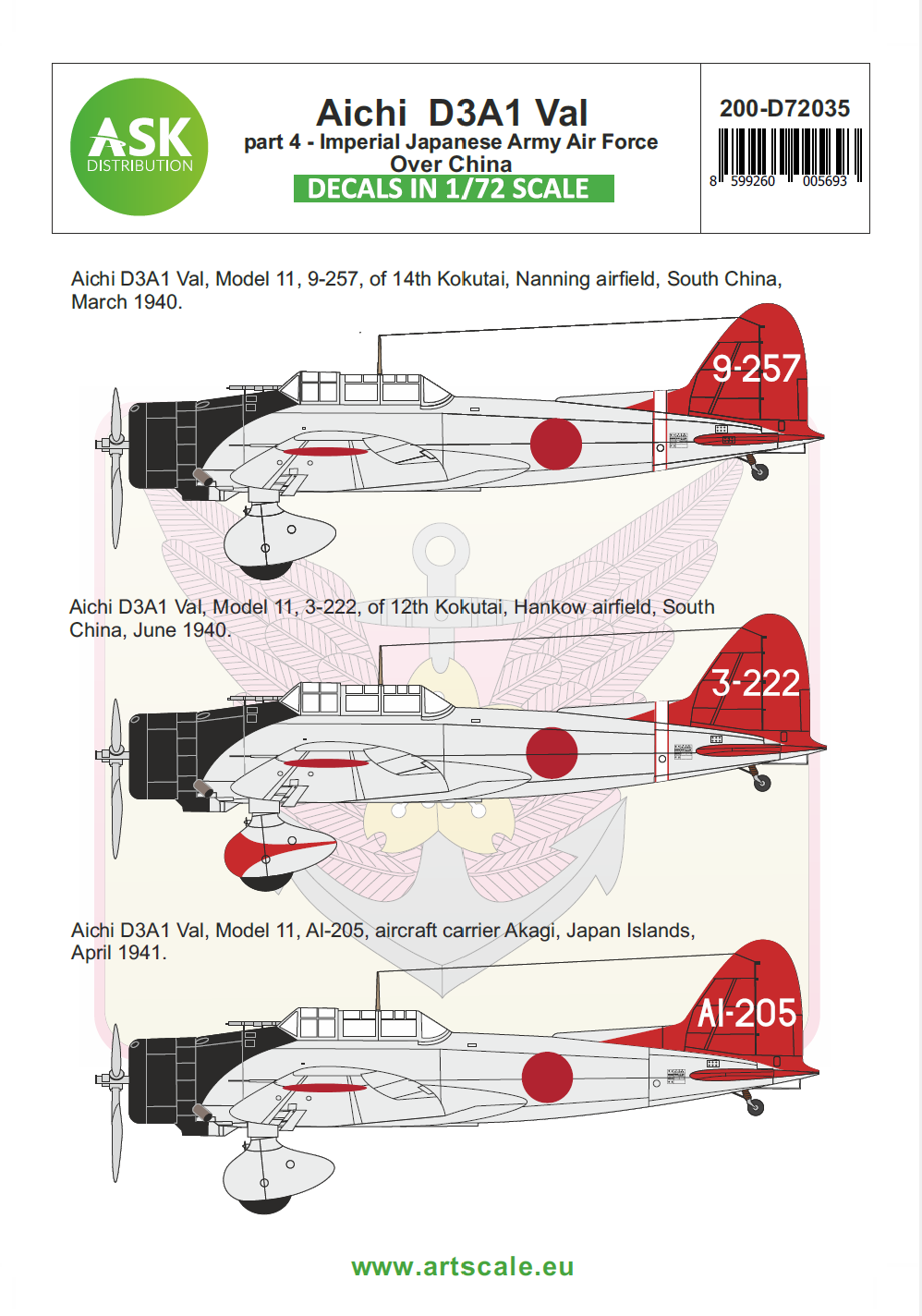 | Art Scale - 200-D72035 - 1:72 | Aichi D3A1 Val part 4 - Imperial Japanese Army Air Force Over China, The decal sheet contain follow markings: - Aichi D3A1 Val, Model 11, 9-257, of 14th Kokutai, Nanning airfield, South China, March 1940. - Aichi D3A1 Val, Model 11, 3-222, of 12th Kokutai, Hankow airfield, South China, June 1940. - Aichi D3A1 Val, Model 11, Al-205, aircraft carrier Akagi, Japan Islands, April 1941. More | Aircraft decals (military) | Catalogue | £13.99 | |
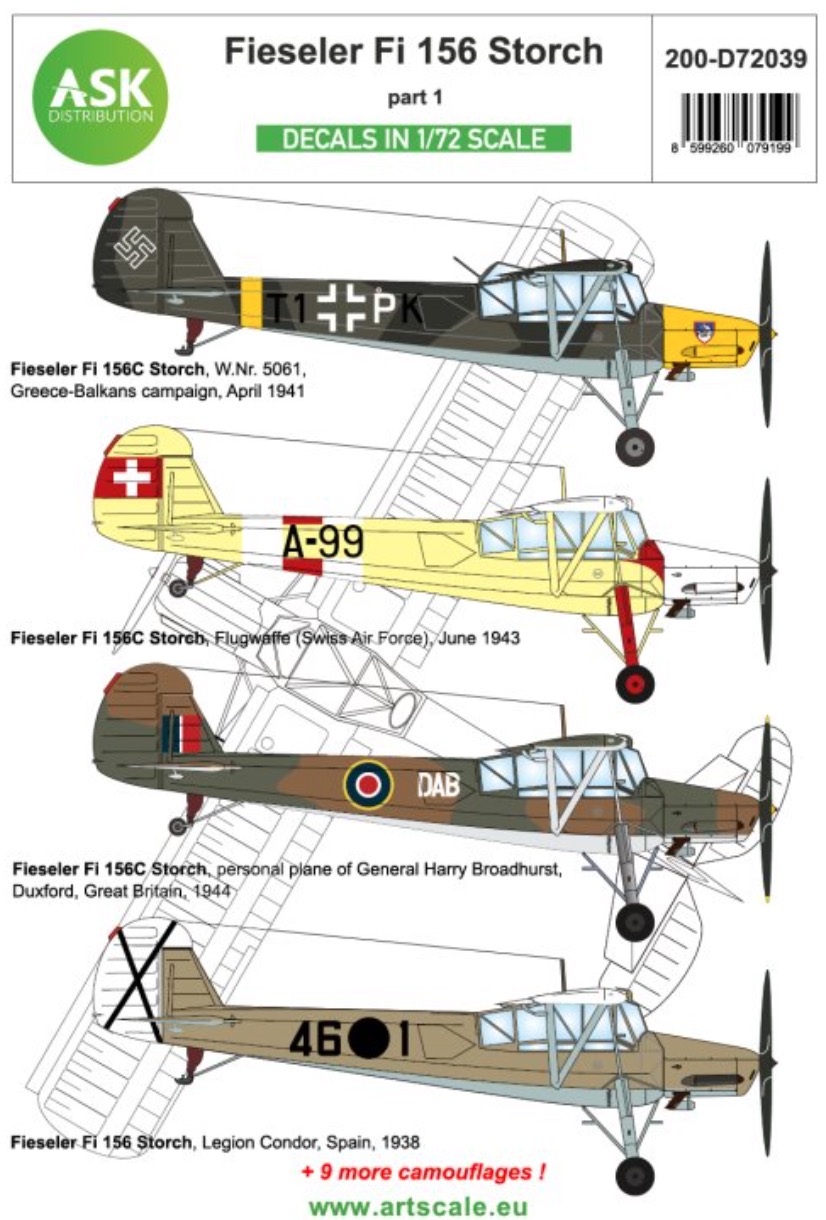 | Art Scale - 200-D72039 - 1:72 | Fieseler Fi-156C Storch part 1 - Around WWII Europe and Foreign servicesThe decal sheet contains the following markings: Fieseler Fi 156C Storch, W.Nr. 5061, Greece-Balkans campaign, April 1941 Fieseler Fi 156C Storch, Flugwaffe (Swiss Air Force), June 1943 Fieseler Fi 156C Storch, personal plane of General Harry Broadhurst, Duxford, Great Britain, 1944 Fieseler Fi 156 Storch, Legion Condor, Spain, 1938 Fieseler Fi 156C Storch, 1.(H)Pz/14, Yugoslavia 1941 Fieseler Fi 156C Storch, 1.(F)/120, Eastern front, cca. 1943 MS-500 Criquet, French Air Force, Indochina, 1947 Morane-Saulnier MS.500 Criquet (Fieseler Fi.156 Storch) c/n 2027 Spain Air Force Fieseler Fi 156C, Otto Skorzeny, Mussolini rescue operation, Gran Sasso, Italy, September 12, 1943 Fieseler Fi 156C Storch, 2./NAGr.2, Poland, summer 1944 Fieseler Fi 156C Storch, 403rd sqd. RCAF, Cairo 1944 Fieseler Fi 156C Storch, Flugwaffe (Swiss Air Force), June 1943 Fieseler Fi 156C Storch, personal plane of Generaloberst Busch, Poland & Russia, 1941-43 More | Aircraft decals (military) | Catalogue | £13.99 | |
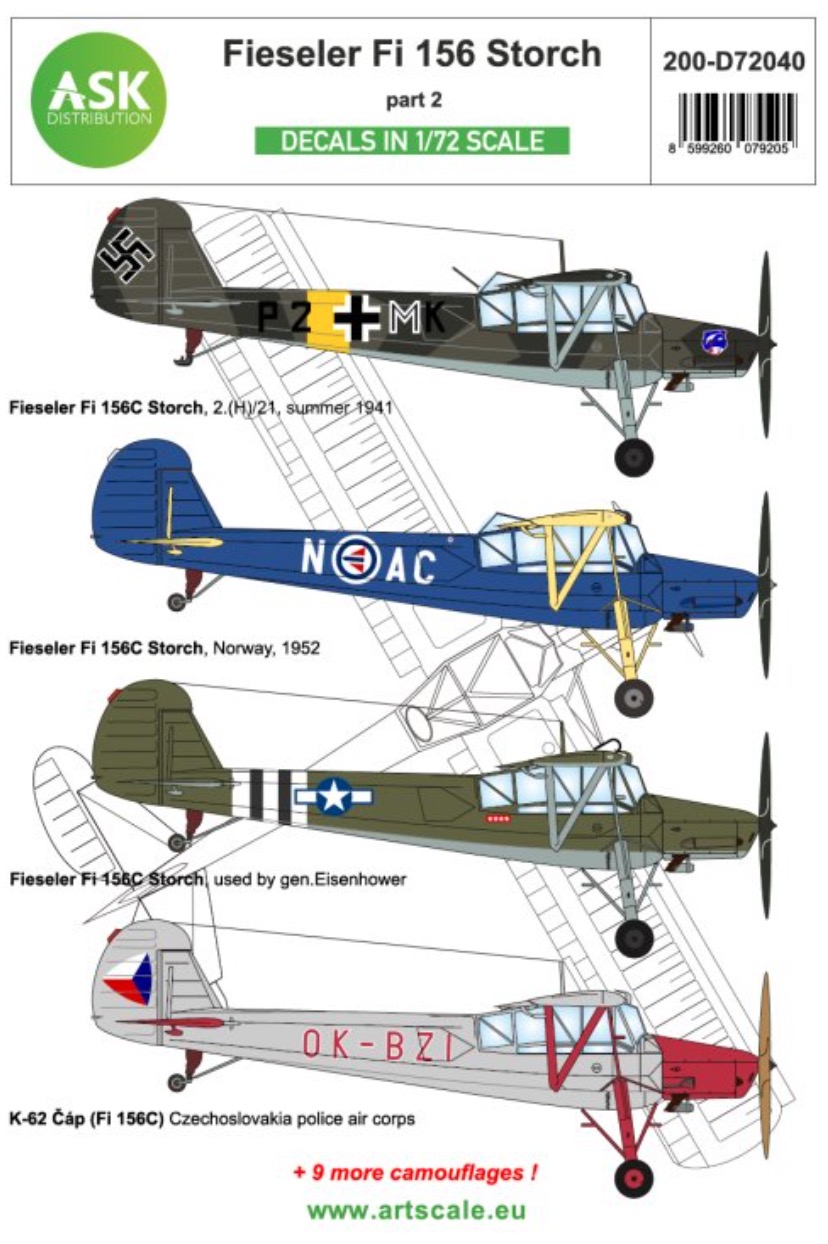 | Art Scale - 200-D72040 - 1:72 | Fieseler Fi 156 Storch part 2 - Around WWII Europe and Foreign services. The decal sheet contains the following markings: Fieseler Fi 156C Storch, 3.(H)31, Poland, May 1941 Fieseler Fi 156C Storch used by gen. Eisenhower Fieseler Fi 156C, 2.(H)21, Eastern front, summer 1941 Fieseler Fi 156C Storch, 6.(H)/31, I.-II.Q 1941 Fieseler Fi 156C Storch, 3./JG27, Libya 1942 K-62 ?ip (Fi 156C) Czechoslvak police air corps, Czechoslovakia 1950's Fieseler Fi 156K-1 Storch, Malmi AB, Helsinki, Finland, 1950 Fieseler Fi 156C Storch, Stab III./JG54, Russia, Januar 1941 Fieseler Fi 156C Storch, 9.SELL (Independent Liason Aviation Flight), Poland, 1948 Fieseler Fi 156C-7 Storch, RAF, Farnborough 1952 Fieseler Fi 156 Storch, Royal Romanian Air Force, Bessarabia, Autumn 1942 Fieseler Fi 156C Storch, Italian Armed Forces at Slovenia-Dalmatia area, Mostar 1942 Fieseler Fi 156C Storch, Norway, 1952 More | Aircraft decals (military) | Catalogue | £13.99 | |
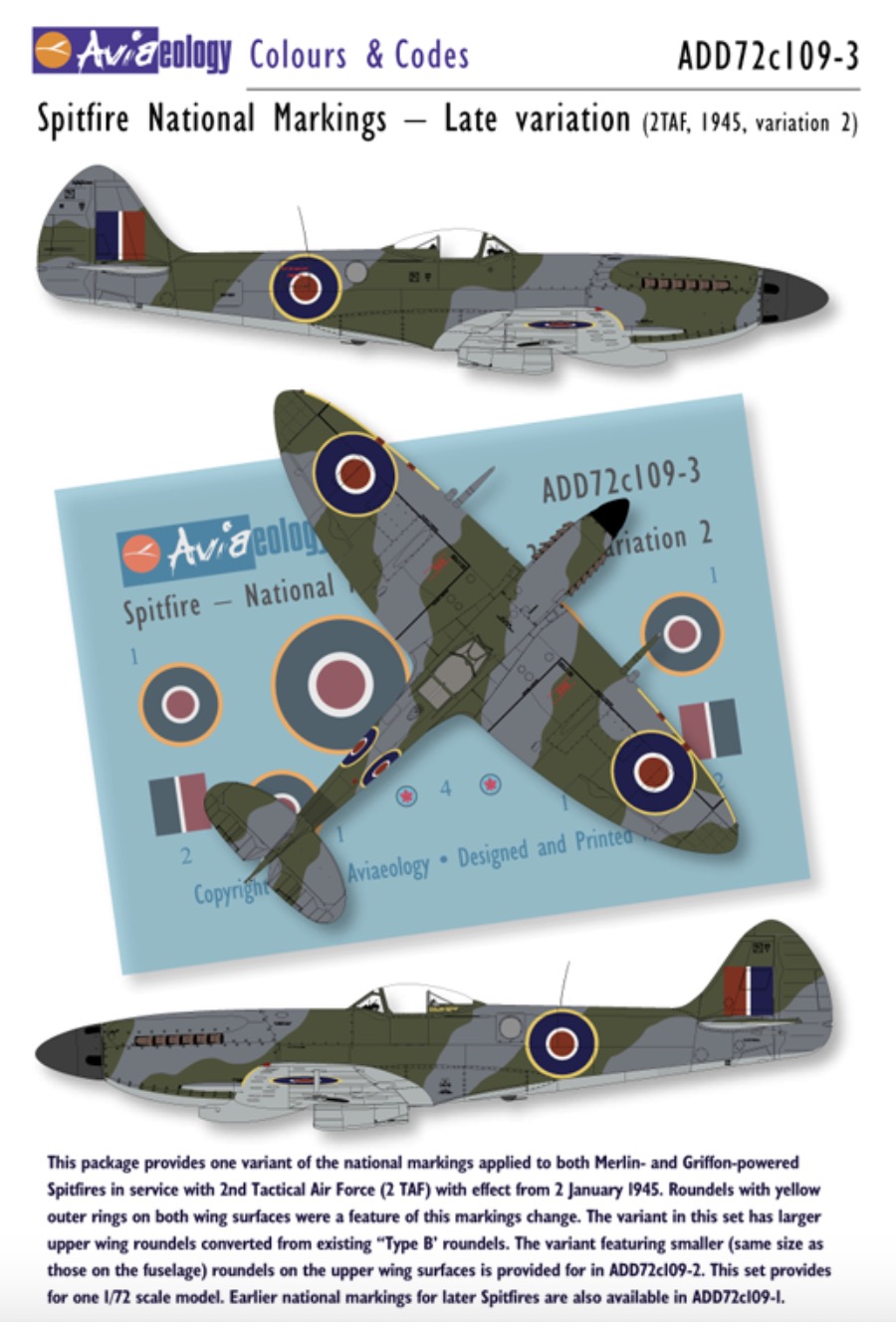 | Aviaeology - ADD72C109-3 - 1:72 | Supermarine Spitfire National Markings-Late variants (2TAF, 1945, variation 2. large upper wing roundels) This package provides one variant of the national markings applied to both Merlin- and Griffon-powered Spitfires in service with 2nd Tactical Air Force (2 TAF) with effect from 2 January 1945. Roundels with yellow outer rings on both wing surfaces were a feature of this markings change. The variant in this set has the larger upper wing roundels which were a simple conversion of existing "Type B" or "Type C" roundels. (see Aviaeology ADD72c109-2 for the smaller 2TAF 1945 variant). Standard national markings with National Markings II ("Type B" roundels) for later Spitfires are also available in ADD72c109-1. This set provides for one 1/72 scale model. - Available as a Basic set or as a Combo set with the Spitfire airframe stencil data markings set (sold separately as ADD72s109) included. The Combo results in a discount over buying these separately. More | Aircraft decals (military) | New Arrivals | £3.50 | |
 | ADH Publishing - ADH016 - No Scale | How to Build Tamiya's Aircraft, is the latest addition to this popular series of modelling titles and as such, offers the enthusiast plenty of inspirational builds, hints, tips and techniques to enjoy. Within the book's 84 pages you will find features on the de Havilland Mosquito, McDonnell F-4 Phantom, Focke-Wulf Fw-190, Heinkel He-162, Bristol Beaufighter, Ilyushin IL-2, Vought F4U Corsair and Supermarine Spitfire, features created by expert modellers, keen to show you what is possible from Tamiya's range of excellent kits. 'How To Build Tamiya's Aircraft' The perfect addition to your library and your workbench! (designed to be used with Tamiya kits) [Fw-190A-3 Fw-190A-8 Fw-190A-8R2 Fw-190D-9 Fw-190F-8 Fw-190F-9 / Mk.VI NF Mk.II Mk.IV PR Mk.IV NF Mk.XIII Mk.XVII F4U-1 F4U-1D F4U F4U-1A F4U-1/2 F4U-1D Heinkel He-162A-2 F-4E F-4J Il-2 Mk.VI TF Mk.X Mk.IXc. Mk.VIII Mk.XVIe Mk.I Mk.V Mk.Vb][ADH code ADH058] More | Aircraft books (on modelling aircraft) | Catalogue | £12.95 | |
 | ADH Publishing - ADH063 - No Scale | REVISED How to Build The Airfix 1:24 Typhoon MK.IB inc. Car Door and Bubbletop Versions.The complete guide to building the amazing Airfix 1:24 scale Hawker Typhoon, written by Brett Green of HyperScale and Model Military fame. This new book features an exhaustive step-by-step guide to construction with modelling contributions by James Hatch, Brett, Marcus Nicholls and Chris Wauchop. Detailed analysis of the 1:72 Airfix Typhoon and 1:48 scale kits on the market is also included. Hundreds of construction photos, reference images, a museum walk around, and how to get the very best from your big Typhoon kit a must have before you build the model! More | Aircraft books (on modelling aircraft) | Catalogue | £14.95 | |
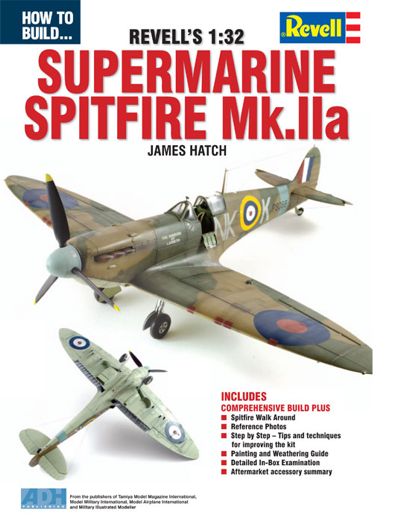 | ADH Publishing - ADH067 - No Scale | How to Build The Revell 1:32 Supermarine Spitfire Mk.IIa (designed to be used with Revell kits) The name Supermarine Spitfire has now become synonymous with an entire island people, and their battle to maintain their freedom in the shadow of the Nazi jackboot. The very shape and sound of the Supermarine Spitfire seems to still invoke and embody the usually reserved pride of the British person. It is probably true to say that Reginald Mitchell's beautiful aircraft design is one of the most easily recognised and much-loved shapes that ever took to the skies. When actual mass production of the Supermarine Spitfire ceased in 1948, over 20,000 machines had been built, and operated by over thirty countries around the world. This iconic series saw service with the RAF right up until the mid-1950s. It also saw service with the Irish Air Corps as late as 1961; a full 26yrs after the flight of the prototype K5054. Revell has now released an all-new 1:32 scale Supermarine Spitfire Mk.IIa. With some minor modifications, this model may also be built as a Mk.I or a Mk.Va. Over the course of five Chapters, James Hatch examines the kit contents in detail, describes construction of the model with lavish illustrations, and points out the areas of the kit that may be improved and corrected. This new book features an exhaustive step-by-step guide to construction; plus a painting and weathering tutorial. A number of essential reference resources are also included. More than 200 photos, a reference guide, and photos of the kit sprues are all included-a must have before you build the model! More | Aircraft books (on modelling aircraft) | Catalogue | £9.95 | |
 | Air-Graphic Models - AIR72-002 - 1:72 | Operation Enduring Freedom 'Coalition Air Power over Afghanistan Part 1 Boeing CH-47D Chinook, 147202/202 'The Magic Bus', CHF, Canadian Air Force at Kandahar 2009 Boeing CH-47D Chinook, 147203/203, CHF, Canadian Air Force at Kandahar 2009 Boeing CH-47D Chinook, 147201/201 'Miss Behavin', CHF, Canadian Air Force at Kandahar 2009 Panavia Tornado IDS, MM55007, 102 Gruppo/6 Stormo, Italian Air Force Mazar-e-Sharif 2009 McDonnell-Douglas AV-8B Harrier Plus, MM.7224/1-19, Giuseppe Garibaldi Italian Navy, North Arabian Sea 2002 McDonnell-Douglas AV-8B Plus, 165421 'WE/01', VM-214 'Blacksheep' USMC (MAG-40, 2nd MEB) Kandahar 2009. (Black tail and drop tanks) McDonnell-Douglas AV-8B Plus, 165572 'CF/01', VMA-211 'Wake Island Avengers', USMC (MAG-13, 3rd MAW) Camp Bastion 2012 Grumman F-14D Tomcat, 164348 'NH/100', VF-231 'Blacklions' USS Carl Vinson CVW-11, USN, North Arabian Sea 2001 (Coloured Lion on fin) Grumman F-14D Tomcat, 164603 'NH/101', VF-231 'Blacklions' USS Carl Vinson CVW-11 USN, North Arabian Sea 2001 Fairchild A-10C Thunderbolt II, 79-0154 'BD', 47th EFS/455th AEW, USAF Bagram 2012 Fairchild A-10C Thunderbolt II, 79-0145 'BD', 107th EFS/451st AEW, USAF Bagram 2011 McDonnell F-15E Strike Eagle, 89-0487 'SJ', 335th FS (Chiefs)/4th FW, 4th Operations Group, USAF Bagram 2011 Eurocopter Tigre HAP, ET-703, 1st Attack Helicopter Battalion, Spanish Army, Herat 2013 Westland Lynx AH.7, XZ645, 672 Squadron, AAC Operation Herrick Kandahar 2007 More | Aircraft decals (military) | Catalogue | £21.99 | |
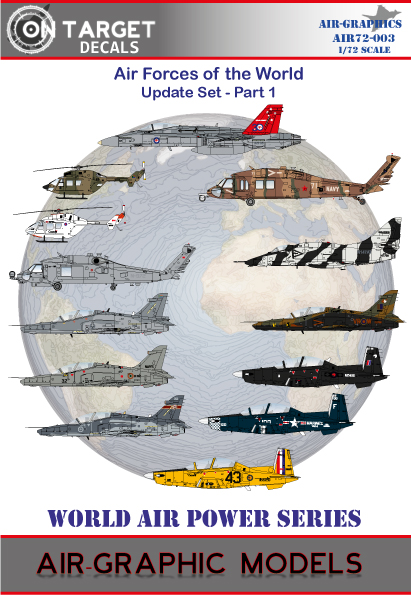 | Air-Graphic Models - AIR72-003 - 1:72 | Air Forces of the World Update Set Part 1 McDonnell-Douglas F/A-18A HUG Hornet, A21-35, 75 Squadron RAAF Tindal 2015 (Red tailed special) Bae Hawk 127 LIFT, A27-23 of 79 Squadron RAAF Pearce 2017 (Revised colour scheme) Bae Hawk 127 LIFT, A27-03 of 79 Squadron RAAF Pearce 2012 in Dark Grey trials scheme Bae Hawk 127 LIFT, A27-10 of 76 Squadron RAAF Williamtown 2007 in original scheme Bae Hawk 132, IN032/32 of 551 Squadron 'The Phantoms', Indian Navy 2017 Bae Hawk 120, 268/68 of 85 Combat Flying School, SAAF 2017 Bae Hawk 115/CT-155, 155217 'KB799/VR-W' 'City of Kamloops' Squadron, Canadian Air Force (NFTC) in WWII Bomber Command scheme MBB CH-143 (BK-117A), 143106 of AETU, Canadian Air Force Cold Lake 2000 MBB MK 117, 381 of C Flight, 15 Squadron SAAF, Durban 2016 Sikorski MH-60S Nighthawk, 167938/71 of RWWS/NSAWC NAS Fallon, USN 2010 Sikorsky MH-60R Seahawk, N-972 of Esk 723 Royal Danish Navy 2017 Douglas A-4L Skyhawk, 147768 of DRAKEN International 2012 Beechcraft T-6A Texan II, 165966/100, '00/F', TAW 6/VT-10 'Wildcats' NAS Pensacola USN 2011 (WWII Gloss Sea Blue Special) Beechcraft T-6C Texan II, NZ1406, 14 Squadron RNZAF Ohakea 2018 Beechcraft CT-156 Harvard II (T-6A), 156120/43 of 2 Canadian Flying Training School (NFTC), 15 Wing Moose Jaw 2016 (In WWII Trainer Yellow scheme) More | Aircraft decals (military) | Catalogue | £21.99 | |
 | Air-Graphic Models - AIR72-006 - 1:72 | RE_PRINTED!!! Operation Desert Storm - Part 1 Westland Gazelle AH.1 XX437 'C' 4 Regiment AAC Westland Gazelle AH.1 ZB691 'Y' 4 Regiment AAC Panavia Tornado GR.1 ZA447/EA 'Mig Eater', XV Squadron RAF Based at Tabuk Panavia Tornado F3, ZE986/DJ, 11 Squadron RAF Based at Dharan Sikorsky S-70B-2 Seahawk, N24-004/73, SITU (HS-816), RAN aboard HMAS Sydney Boeing CF-188A Hornet, 188741, 441 Squadron 'The Desert Cats', Canadian Armed Forces, (CAF) Qatar CH-124A Sea King, 12412, 443 Squadron, CAF, Operation Friction SH-3G Sea King, 15139/742, HC-2 'Desert Duck Airlines', USN McDD AV-8B Harrier II, 163673/00, VMA-231 'Ace of Spades', USMC Based at Al Jubail McDD F-4G Phantom, 69-7212/SP, 81st TFS/52 TFW 'Wild Weasels' USAF Based at Sheikh Isa McDD RF-4C Phantom, 65-0886/, 192 TRS/152 TRG 'High Rollers', USAF Based at Sheikh Isa Douglas A-4KU Skyhawk, 801 of 9/21 Squadron Free Kuwait Air Force, Dhahran Dassault_Mirage 2000C 5-OP/74 of Escadron de Chasse 2/5 'lle-de-France' French Air Force Based at Al Asha (Desert camouflage Scheme) Dassault_Mirage F1CR 33-CG/629 of Escasron de Reconnaissance 1/33 'Belfort' French Air Force Based at Al Ahsa (Desert camouflage Scheme) Aerospatiale SA-330 Puma ADE 164, Escadrille d'Helicopteres de Manoeuvre (EHM 6/1) 'Buffalo 16' Armee de Terre (French Army) Aerospatiale SA-341M Gazelle BPD '82' of 5e Regiment d'Helicopteres de combat (5e RHC) Armee de Terre (French Army) More | Aircraft decals (military) | New Arrivals | £21.99 | |
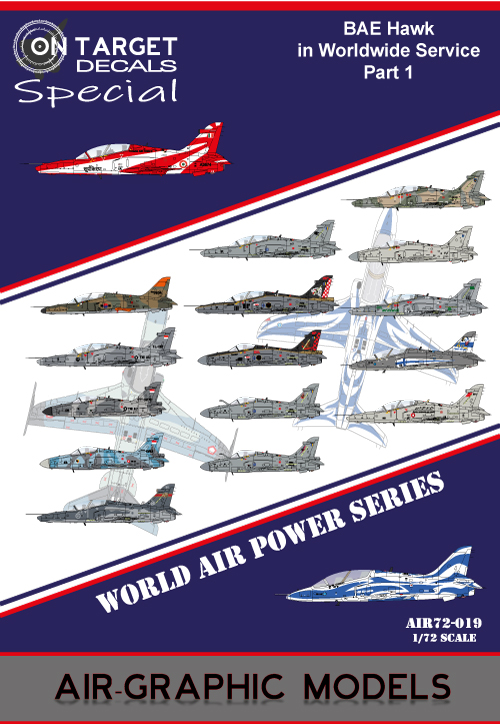 | Air-Graphic Models - AIR72-019 - 1:72 | The BAe Hawk special Royal Air Force of Oman. Hawk 166; A/C 161 of 6 Squadron 2020 Royal Air Force of Oman. Hawk 203; A/C 131 of 6 Squadron 2019 RAAF. Hawk 127; A/C A27-31 76/79 Sqn in Special 100 Years Anniversary Tail markings 2021 Finish Air Force. Hawk 51; A/C HW-340 of Training Squadron '40th Anniversary Special Blue and White scheme' 2020 Finish Air Force. Hawk 51A; A/C HW-353 of Training Squadron '40th Anniversary Standard scheme' 2020 ROKAF (South Korean). T-59 Hawk Mk.67; A/C 67-504 of Training Academy 2014 Royal Saudi Air Force. Hawk 165; A/C 161 of 21/79 Squadron 2020 Indian Air Force. Hawk 132; A/C A3674 'Suryakiran' Aerobatic Display Team 2020 RMAF (TUDM). Hawk 208; A/C M40-21 of 15 Squadron 1997 RMAF (TUDM). Hawk 208; A/C M40-32 of 6 Squadron '25th Anniversary Scheme' 2019 RMAF (TUDM). Hawk 208; A/C M40-32 of 6 Squadron 1995 RMAF (TUDM). Hawk 108; A/C M40-01 of 14 Squadron '25th Anniversary Scheme' 2019 RMAF (TUDM). Hawk 108; A/C M40-106 of 9 Squadron 1999 Royal Bahraini Air Force. Hawk 129; A/C 501 of 5 Squadron 2020 Indonesian Air Force. Hawk 209; A/C TT-0213 of 12 Squadron '3 tone Blue/Grey scheme' 2019 Indonesian Air Force. Hawk 209; A/C TT-0209 of 12 Squadron '2 tone Grey scheme' 2014 Indonesian Air Force. Hawk 109; A/C TL-0111 of 1 Squadron '2 tone Grey scheme' 2019 More | Aircraft decals (military) | Catalogue | £29.60 | |
 | Air-Graphic Models - AIR72-027 - 1:72 | BACK IN STOCK!!! 1994 - 50th Anniversary of D-Day Schemes The first in our Retro Series, features 3 decal sheets covering: Grumman F-14B Tomcat VF-143 Pukin Dogs, USS George Washington Grumman A-6E Intruder VA-34 Blue Blasters wearing D-Day stripes, USS George Washington Sikorsky SH-60B Seahawk HSL-42 Proud Warriors wearing D-Day Stripes, USS Normandy Sikorsky SH-60B Seahawk HSL-44 Swamp Foxes Det 5, wearing 'The Clowns' artwork, USS Thomas S. Gates F-4E Phantom 338 Mira, Greek Air Force wearing Greek Flag on intake F-111C Aardvark, 1 and 6 Squadron RAAF, wearing both Squadron markings on either side of the fin. Boeing CF-18 Hornet 188723, 410 Squadron Canadian Armed Forces wearing 70th Anniversary tail markings CF-18 Hornet 188781 of 441 Squadron Canadian Armed Forces wearing D-Day stripes Bell CH-135 Twin Huey KH-T of 403 City of Calgary Squadron, Canadian Armed Forces, wearing D-Day stripes (Middle Wallop Air Show 1994) Bell CH-136 Kiowa KH-E of 403 Squadron Canadian Armed Forces wearing D-Day stripes (Middle Wallop Air Show 1994) Bell CH-136 KiowaG9-M of 430 'City of Sudbury' Squadron, Canadian Air Force wearing D-Day stripes (Middle Wallop Air Show 1994) Canadair CT-114 Tutor 114188 '1' of the Snowbirds Aerobatic Team, Canadian Armed Forces and wearing D-Day strips. The set includes our unique Colour Conversion Card and 20 page instruction booklet Decals by Fantasy Printshop This really is a stunning decal sheet by Jon Freeman More | Aircraft decals (military) | Catalogue | £29.99 | |
 | Didier Palix Editions - AIRFIX-72 - No Scale | Airfix Box Art - The Golden Ages 1955-1982 More | Modelling books | Catalogue | £29.99 | |
 | Almark - AKS17 - 1:72 | Boeing B-52 Stratofortress Trials Aircraft (4) Boeing B-52A 52-001 used for flight test of Boeing B-52G tail and engines 1958; Boeing B-52A 52-003 `The High and Mighty One' Edwards 1960 X-15 Mothership; Boeing B-52E 60632 Flight Dynamics Lab 1975; Boeing B-52H 58-0182 Cruise Missile test, Flight Test Centre More | Aircraft decals (military) | Limited Availability | £3.99 | |
 | AOA Decals - AOA72001 - 1:72 | Grumman Intruders from the Beach - USMC Grumman A-6A Intruders in the Vietnam War This extensive and comprehensive decal sheet covers the three land based USMC A-6 Intruder squadrons during the Vietnam War (VMA(AW)-225, -242, and -533); allowing the option to represent one of many possible Intruders from any timeframe for each squadron. For Fujimi 1/72 A-6A Intruder, but most decals are non-kit specific and can also be used for any kit (Revell, Hasegawa, Italeri, upcoming Hobby Boss/Trumpeter, etc) 64 Marking Options (45 Aircraft) Included: 7 options (5 aircraft) for VMA(AW)-225 Vikings while at Da Nang Air Base, South Vietnam, from 1969-71 19 options (17 aircraft) for VMA(AW)-242 Batmen while at Da Nang Air Base, South Vietnam, from 1966-70 19 options (13 aircraft) for VMA(AW)-533 Hawks while at Chu Lai Air Base, South Vietnam, from 1967-69; 19 options (10 aircraft) while at Royal Thai Air Base Nam Phong (aka "The Rose Garden"), Thailand, from 1972-73 Accurate stencils provided for up to two Intruders; this includes complete airframe stencils. Decals also included for MER/TER numbers (various types), crew helmets, and fuel tanks. 80+ Page Instructions (on full size CD) Containing: Introduction Fujimi kit modification information Possible A-6A configuration information Marking notes Typical ordnance loadout charts for the three squadrons Stencil placement Single page for each marking option (3 view) Reviews: Cybermodeler - Hampton Roads Scale Modelers IPMS/USA - Modeling Madness NOTE Instructions are only provided on CD! (Adobe pdf file) More | Aircraft decals (military) | Limited Availability | £18.99 | |
 | AOA Decals - AOA72006 - 1:72 | Re-printed! USAF/VNAF Fairchild AC-119G Shadows & AC-119K Stingers in the Vietnam War. This 1/72 decal sheet includes marking options for AC-119G Shadow and AC-119K Stinger gunships in the Vietnam War as operated by the United States Air Force (USAF) and the South Vietnam Air Force (VNAF). Although the AC-119G Shadow variant is not available in kit form, the Shadow can be easily represented by relatively basic modifications to the Italeri/Testors AC-119K Stinger kit. 14 Marking Options Included: Six USAF AC-119G Shadows covering 71st Special Operations Squadron (SOS) and 17th SOS: The Devil's Advocate, City of Columbus Indiana, The Charlotte Representative, Burks Law, and two Charlie Chasers marked aircraft (all options provided also carried a variation of the Shadow III insignia). Six USAF AC-119K Stingers covering 18th SOS: Montezuma's Revenge, Fly United, Good Grief! The Pea-nut Special, The Super Sow, The Polish Cannon, and Black Killer Duck. Two VNAF AC-119G Shadows covering 819th Attack Squadron. NOTE: No specific VNAF AC-119K Stingers from 821st Attack Squadron are provided. However, other than the addition of the the Vietnamese fin flash on the tail, the VNAF Stingers did not appear to have any other unique markings after inheriting the aircraft from 18th SOS. All of the USAF AC-119K aircraft on this sheet were transferred to the VNAF in 1972/73 (minus the nose art), and as such, the Vietnamese fin flashes provided could be used with the AC-119K tail codes to represent a VNAF AC-119K Stinger if desired. Data/stencil sets provided for at least TWO aircraft with variations of certain markings also provided as options. Also included are decals for both the original AeroProducts 4-bladed propellers and the later Hamilton Standard 3-bladed propellers (used by both VNAF options and also Black Killer Duck). Additionally, decals provided for the flare launcher's compressed air/nitrogen bottles' markings and as well as the illuminator's various placards/warnings. More | Aircraft decals (military) | Catalogue | £16.99 | |
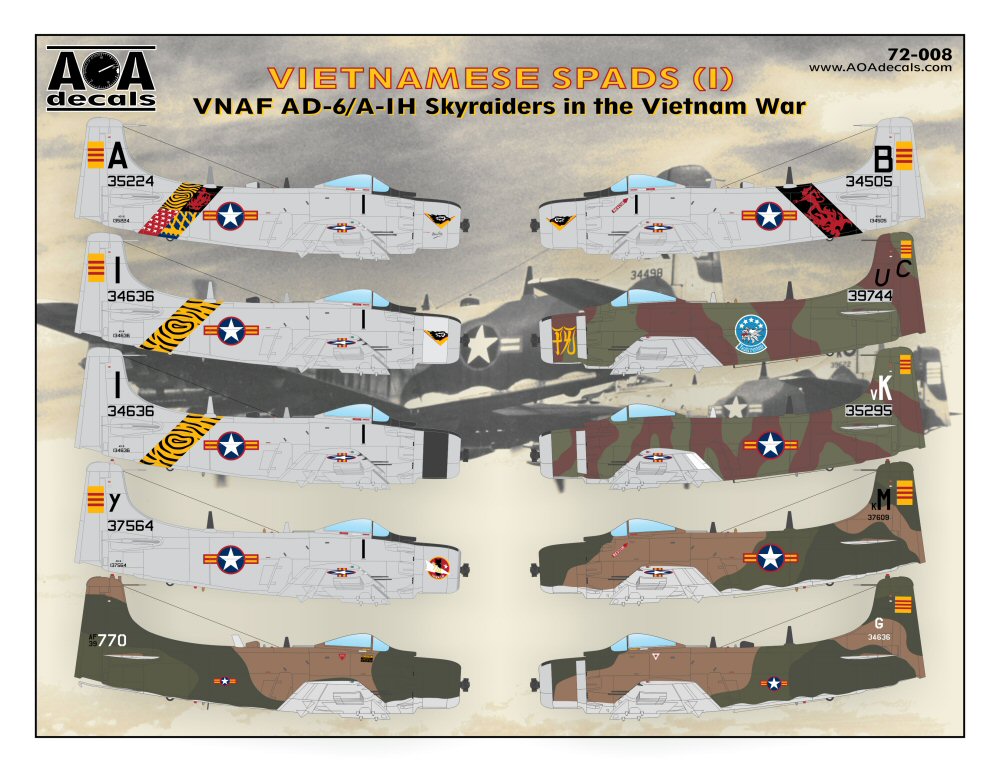 | AOA Decals - AOA72008 - 1:72 | VIETNAMESE SPADS (1) VNAF Douglas AD-6/A-1H Skyraiders in the Vietnam War [Decals released __ 2018] For Hasegawa 1/72 A-1H/A-1J Skyraider Part 1 of the South Vietnam Air Force (VNAF) Skyraider coverage, this 1/72 decal sheet includes 10 marking options (depicting 8 aircraft) for 1st, 514th, 518th, 520th, 522nd (83rd SOG), 524th, and 530th Fighter Squadrons. The markings provided span from the early 1960s to the early 1970s, and also includes two Skyraiders that were retrofitted with the Yankee extraction system. Enough common markings are provided to cover at least two aircraft. NOTE: Although the Hasegawa kit was used as a basis for these decals, the fuselage bands have excess length on the bottom to potentially allow their usage on the other Skyraider kits. More | Aircraft decals (military) | Catalogue | £15.99 | |
 | AOA Decals - AOA72009 - 1:72 | VIETNAMESE SPADS (2) VNAF Douglas AD-6/A-1H Skyraiders in the Vietnam War [Decals released __ 2018] For Hasegawa 1/72 A-1H/A-1J Skyraider Part 2 of the South Vietnam Air Force (VNAF) Skyraider coverage, this 1/72 decal sheet includes 11 marking options (depicting 10 aircraft) for 1st, 514th, 516th, and 518th Fighter Squadrons. The markings provided span from the early 1960s to 1970, and also includes two Skyraiders that were retrofitted with the Yankee extraction system. Enough common markings are provided to cover at least two aircraft. NOTE: Although the Hasegawa kit was used as a basis for these decals, the fuselage bands have excess length on the bottom to potentially allow their usage on the other Skyraider kits. More | Aircraft decals (military) | Catalogue | £15.99 | |
 | Aviaeology - AOD72019 - 1:72 | Eagle Squadron Supermarine Spitfire Mk.V Eagle Squadron Spitfire Mk.VBs: The American Volunteers of Nos. 71, 121, & 133 Squadrons - Small series screen-printed production - Available in 1/72 (AOD72019), 1/48 (AOD48019) , 1/32 (AOD32019 stock availability TBA) , & 1/24 (AOD24019 stock availability TBA) scale versions - The 1/72 and 1/48 scale editions include decals to model at least 2 (if subjects featuring each variant of national markings are chosen) of 10 photo-documented subjects, based on carefully interpreted graphic reconstructions. - The larger 1/32 and 1/24 scale coverage is split into two independent part-sets each, divvied up according to the type of national markings used AOD32019.1 and '24019.1 features aircraft with early war 'type A' fuselage, underwing, and tail national markings while AOD32019.2 and '24019.2 features aircraft with 'type C' fuselage, underwing, and tail markings. The (pt.1) and (pt.2) labels in the subject list below indicate the subject aircraft featured in each of these larger sets. - Six 8.5 x 11 in. pages of illustrated documentation* *Black and white laser prints are supplied in the package, and a high resolution, home/office-printable, colour PDF version is made available via email after purchase (automatically sent for direct-purchase customers). Documentation includes subject specific (i.e. not generic) decal placement and comprehensive painting instructions compete with multi-view colour depictions clarifying propeller, exhaust, and canopy variations for all subject aircraft. Aircraft covered in this set: 71 Squadron - AB875 / XR-X, Martlesham Heath, February 1942 aircraft nicknamed 'Little Joe' with Eagle Squadron motif nose art, P/O Joe Kelly. (pt.1) - AB908 / XR-Y, Kirton-in-Lindsey, November 1941 P/O Carrol 'Red' McCoplin. (pt.1) - AD196 / XR-Q, Martlesham Heath, February 1942 aircraft nicknamed 'Miss North Dallas' with Victor France originated nose art, various pilots. (pt.1) - BL287 / XR-C, Martlesham Heath, March 1942 'Sioux Chief' nose art, P/O Leo Nomis. Choice of three (white as printed, or Sky or light blue as overlays) background colour interpretations are provided for. (pt.1) 121 Squadron - W3711 / AV-H, Kirton-in-Lindsey, December 1941 P/O Richard Patterson (features neat dice gambler-themed 'tail art' adjacent to serial number on port side). (pt.1) - BM405 / AV-J, Southend, June 1942 aircraft nicknamed 'Barry', P/O 'Barry' Mahon. (pt.2) - BM581 / AV-P, Southend, July 1942 Uncle Sam's Hat + 13 stars nose art, P/O Bill Kelly. (pt.2) - BM590 / AV-R, Southend, July 1942 aircraft nicknamed 'Olga', P/O Gilbert Halsey. (pt.2) 133 Squadron - BM263 / MD-A, Kirton-in-Lindsey, April 1942 'Mine's a Bitter' nose art with Squadron Leader's rank pennant, S/L Eric Thomas. (pt.2) - EN951 / MD-U, Biggin Hill, late summer 1942 P/O DonBlakeslee. (pt.2) More | Aircraft decals (military) | Catalogue | £8.40 | |
 | Barracuda Studios - BC-72009 - 1:72 | North-American P-51D Mustangs of the 8th Air Force (5) 44-63684 SX-B 352FS 353FG Lt.Col.William B.Bailey 'Double Trouble Two' Black/Yellow check nose RAF Raydon; 44-14985 CY-G 343FS 55FG Maj. Edward Giller 'The Millie G' Yellow/Green check nose band RAF Wormingford; 44-14888 B6-Y 363FS 357FG Chuck Jaeger 'Amourous Len III' 1944 Red/Yellow check nose band RAF Yoxford; 44-13410 E2-C 375FS Lt.Col Thomas Christian KIA 12-8-44 'Lou IV/Athelene' Yellow Nose RAF Bottisham; 44-15092 SX-B 'Alabama Rammer Jammer' Black/yellow nose band RAF Raydon. More | Aircraft decals (military) | Catalogue | £10.99 | |
 | Barracuda Studios - BC-72165 - 1:72 | de Havilland Mosquito Airframe Stencils - Expanded. This set is the result of new research based on the superb Mosquito restorations being done by Avspecs in NZ. The external stencils are extensive, and we include new instrument faces for the instrument panel, a few cockpit placards and even some decals for the radios. Printed by Cartograf, these are a real upgrade to all kit stencils in this scale. With complete instructions. [Mk.VI Mk.IV Mk.XII NF.II] More | Aircraft decals (military) | Catalogue | £6.99 | |
 | Barracuda Studios - BC-72227 - 1:72 | Supermarine Spitfire Mk.VIII - Part 1 This sheet contains markings for 6 different Spitfires operated by different air forces in 23 theatres. The sheet is thoroughly researched and beautifully printed by Cartograf. Complete with 2 full sets of stencils including door stencils and bomb markings and full color instructions. Spitfire Mk. VIII, Serial JF349 HL-K 308th Fighter Squadron, 31st Fighter Group, 15th Air Force, USAAF. Pilot - CO of 308th FS. Flown by Lt. Leland P. Molland. Castel Volturno, Italy. February, 1944. Spitfire MK. VIII, MT982 UM-C 152 Squadron RAF. SEAC. Flown by Warrant Officer Eric Clegg. Sinthe Airstrip, Burma, 1945 Spitfire Mk. VIII, A58-517 (RAF serial MT594) UP-F 79 Squadron RAAF. Flown by Flt. Lt. Norman Turnbull (surname legally changed in August to Smithells). Based at Morotai, Indonesia. Late Spring, 1945. Spitfire Mk. VIII, JF476 QJ-D 92 Squadron RAF. Desert Air Force. Pilot unknown. Based at Taranto, Italy. September, 1943. Spitfire Mk. VIII, JF835 UM-T 152 Squadron RAF. SEAC. Flown by Flying Officer Paul Gus Ardeline. Sinthe Airstrip, Burma, 1945 More | Aircraft decals (military) | Catalogue | £10.99 | |
 | Barracuda Studios - BC-72376 - 1:72 | Focke-Wulf Fw-190A, Fw-190F, Fw-190D Airframe stencils. This set consists of two complete sets of stencils for just about any variant of the Fw-190 family. These are very thin and beautifully printed by Cartograf, and replace the often thick stencils with hard to hide clear film found in all kits of the Fw-190 in 1/72 scale. A simple upgrade with a big payoff for your latest Wurger project. More | Aircraft decals (military) | Catalogue | £7.99 | |
 | Barracuda Studios - BC-72378 - 1:72 | Supermarine Spitfire Later Marks Airframe Stencils. This set consists of two complete sets of stencils for Spitfires Mk.VII through Mk.22/24 and Seafires Mk.XV through 47. Some factories retained the older stencil style into later marks. Includes cockpit door stencils and bomb markings. These are very thin and beautifully printed by Cartograf, and replace the often thick stencils with hard to hide clear film found in all kits of the marks listed above in 1/72 scale. A simple upgrade with a big payoff for your latest Spitfire build project. More | Aircraft decals (military) | Catalogue | £7.99 | |
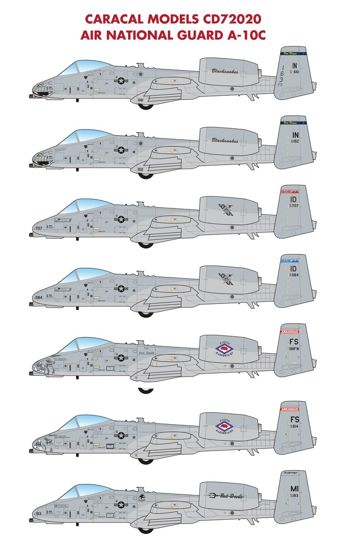 | Caracal Models - CD72020 - 1:72 | RE-PRINTED!!! Air National Guard Fairchild A-10C Thunderbolt II : This sheet provides marking options for A-10C Warthogs from Indiana, Idaho, Arkansas and Michigan Air National Guard units - just in time for the new 1/72 A-10C kit from Hasegawa. Designed with the new Hasegawa A-10C kit in mind, this decal sheet provides 7 current/recent USAF marking options for the upgraded A-10C version of the Warthog. The options on this sheet are: A-10C 82-0661, 163 FS, Indiana ANG (commander's aircraft) A-10C 80-0152, 163 FS, Indiana ANG A-10C 78-0707, 190 FS, Idaho ANG A-10C 79-0084, 190 FS, Idaho ANG A-10C 80-0188, 188 FW, Arkansas ANG (commander's aircraft) A-10C 78-0614, 188 FW, Arkansas ANG A-10C 79-0193, 127 FW, Michigan ANG More | Aircraft decals (military) | Catalogue | £14.99 | |
 | Caracal Models - CD72023 - 1:72 | RE-PRINTED!!! Air National Guard McDonnell F-4C/D Phantom. This decal sheet provides accurate, high quality markings for Air National Guard Phantoms from early 1980s, when the Phantom was the primary fighter in Guard service. The eight colorful options on this sheet are:: F-4C 64-0888 ("8-Ball"), 114 FIS, Oregon ANG F-4D 66-5648, 179 FIS, Minnesota ANG F-4C 63-7591, 111 FIS, Texas ANG F-4D 66-7457, 171 FIS, Michigan ANG F-4C 63-7576, 171 FIS, Michigan ANG F-4C 64-0658, 123 FIS, Oregon ANG F-4D 64-0949, 178 FIS, North Dakota ANG F-4C 64-0914, 199 FIS, Hawaii ANG National insignia, stencilling and walkways for one aircraft is included. This set was professionally screen printed by Cartograf in Italy. More | Aircraft decals (military) | Catalogue | £14.99 | |
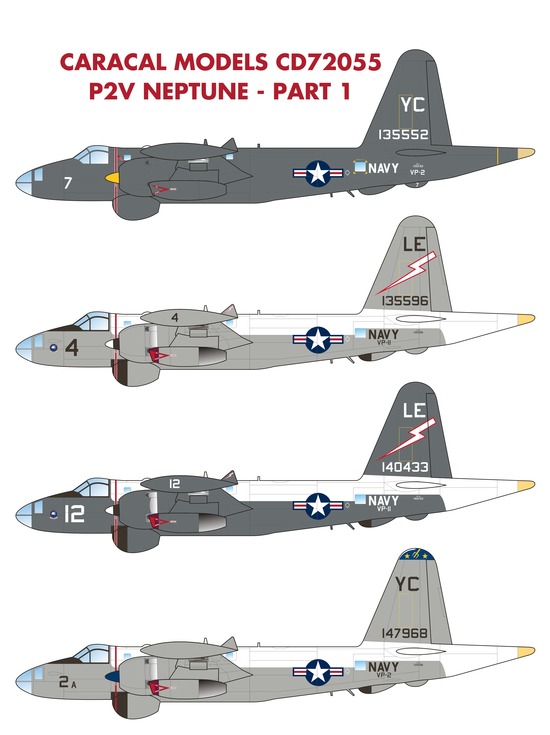 | Caracal Models - CD72055 - 1:72 | Re-printed! Lockheed P2V Neptune Part 1 This decal sheet provides eight new marking options for the Hasegawa kit of the P2V Neptune anti-submarine patrol aircraft. Several of the options are intended for the earlier P2V-5 (SP-2E) variant, which could be built from the Hasegawa kit using Falcon Vac or Blackbird conversion sets. A second sheet containing high-quality stencils are included. The aircraft depicted on this sheet are: P2V-7 Neptune BuNo. 135552, VP-2, US Navy SP2-H Neptune BuNo. 135596, VP-11, US Navy SP-2H Neptune BuNo. 140433, VP-11, US Navy SP-2H Neptune BuNo. 147968, VP-2, US Navy RB-69A 44037, USAF P2V-5 Neptune BuNo. 131409, Naval Aircraft Torpedo Unit, US Navy DP-2E Neptune BuNo. 128347, VC-1, US Navy P2V-5 Neptune BuNo. 131418, VP-26, US Navy More | Aircraft decals (military) | Catalogue | £14.99 | |
 | Caracal Models - CD72065 - 1:72 | Lockheed U-2A/C "Dragon Lady" Our new 1/72 scale decal sheet for the U-2 spyplane provides 10 marking options for this very important aircraft. We also provide serial number digits in both the early and late style. Combined with the accurate and comprehensive set of stencilling and common markings on the sheet, this should allow you to build almost any early U-2. The options on this decal sheet are: U-2A 56-6701, USAF - Air Force Flight Test Center, USAF U-2A 56-6715, USAF - 4080th SRW, 1960 U-2A 56-6703, USAF - 4080th SRW, 1958 U-2A "N800X", Central Intelligence Agency (CIA) U-2A "N803X", Central Intelligence Agency (CIA) U-2A 56-6682, USAF - 4080th SRW, 1961 U-2F 56-6676, USAF - shot down over Cuba during Cuban Missile Crisis (Maj. Rudolf Anderson's airplane) U-2A 56-6681, USAF - 4080th SRW, U-2A 56-6722, USAF - "Project Hi-Cat", 1967 U-2C 56-6680, USAF - 100th SRW, 1976 More | Aircraft decals (military) | Catalogue | £13.99 | |
 | Caracal Models - CD72093 - 1:72 | Curtiss C-46 Commando.The C-46 Commando was the unsung hero of the China-Burma-India theater during the WWII - many American pilots flew the Commando "over the Hump" to provide critical support to the US war effort. This new 1/72 scale sheet provides a variety of accurate markings for this very important type. Both WWII and postwar options are provided, along with Air America example and a R5C-1 from the US Navy. We also include an accurate and full set of Curtiss factory serial number digits that were specific to the C-46. While this set was designed with the Valom kit in mind, it will also work with the Williams Bros kit. The options on this decal sheet are: C-46 44-77916 with sharkmouth, Dinjan(India), USAAF (WWII) C-46 44-77519 "Operation Varsity", USAAF (WWII) C-46 42-101230 "Penny", USAAF (WWII) C-46 42-96779, USAAF (WWII) C-46 42-107351, USAAF (WWII) C-46 42-96688, USAAF (WWII) R5C-1 BuNo. 39507, US Navy (Blue Angels support aircraft) C-46 44-77952, Troop Carrier Command, USAF C-46 44-78334, 437th TCW, USAF C-46 44-77592, 437th TCW, USAF C-46 44-77715, Pennsylvania ANG C-46 44-77687, Rhode Island ANG C-46 44-77592, 437th TCW, USAF C-46 "B-858" Air America Accurate stencilling and national insignia to build any one of the options is included. All of the sheets in this set were professionally screen printed by Cartograf in Italy. More | Aircraft decals (military) | Catalogue | £15.99 | |
 | Caracal Models - CD72097 - 1:72 | Strategic Air Command Boeing B-52G/H Stratofortress - Part 2 The B-52 Stratofortress has been a significant figure in the United States Air Force (USAF) since the mid-1950s. With its powerful presence and remarkable payload capacity, the B-52 has been a critical player in strategic bombing missions throughout the Cold War and beyond. Despite its lengthy service life, the B-52 still serves as a testament to American engineering ingenuity and continues to operate in various roles across the globe. We are proud to present this comprehensive decal set featuring ten (10) marking options for the Cold War era USAF B-52 Stratofortress bombers, encompassing multiple units that have flown this incredible machine. This set includes a meticulously designed stenciling sheet that embodies the precision and attention to detail you've come to expect from Caracal. The aircraft featured on this sheet are: B-52G 57-6475 "Miami Clipper", 2nd BW B-52G 58-0177 "Petie 3rd", 2nd BW B-52G 58-0195 "Eternal Guardian", 42nd BW B-52G 58-0241 "Pterodactyl Courier", 42nd BW B-52G 58-0168 "Treasure Hunter", 379th BW B-52H 60-0010 "Smaug's Revenge", 7th BW B-52H 60-0048 "Stratofortress Rex", 410th BW B-52H 61-0019 "Jolly Roger", 410th BW B-52G 57-6485 "The Big Stick", 97th BW B-52G 57-6504 "Snake Eyes", 93rd B More | Aircraft decals (military) | Catalogue | £14.99 | |
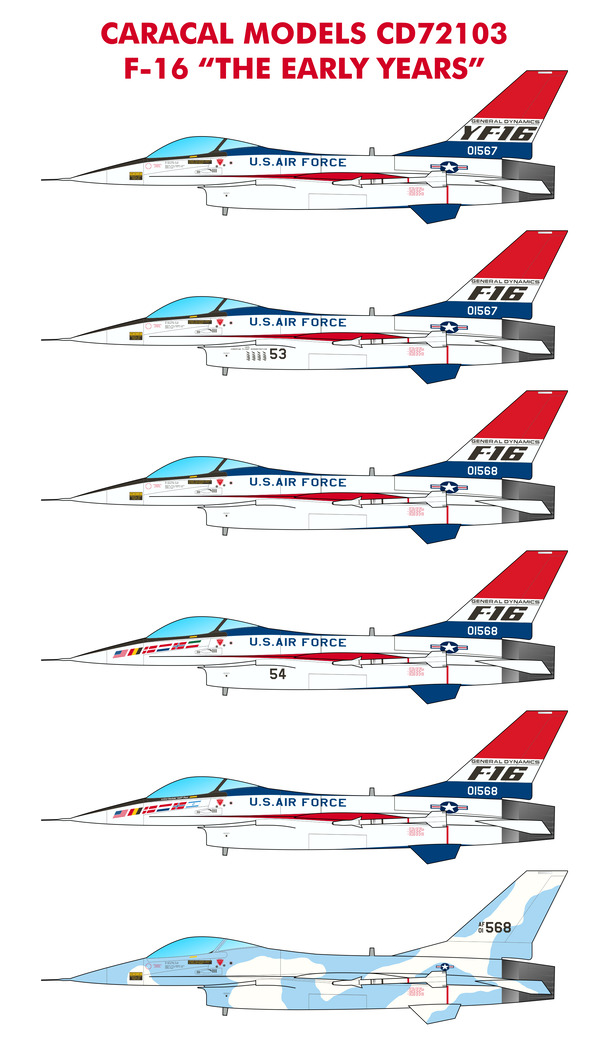 | Caracal Models - CD72103 - 1:72 | RE-PRINTED! General-Dynamics F-16 "Viper" - The Early Years. This 1/72 scale decal sheet in our "The Early Years" series will take you to the humble beginnings of the "Viper" - the modern F-16 multirole fighter operated by more than 20 countries all over the world. We provide several marking options for the two prototypes, the first FSD (full-scale development) jet, the unique F-16 CCV and AFTI/F-16 research jets, and even the F-16/79 and F-16/101 variants. Many long hours of research went into the design of this decal sheet, which includes stencilling to build any one of the options. The options on this decal sheet are: YF-16 72-1567 YF-16 72-1567, 1975 European Flight Demonstration YF-16 72-1568 YF-16 72-1568, prospective operator flags YF-16 72-1568, prospective operator flags w/Israeli flag YF-16 72-1568, "cloud" scheme YF-16 CCV 72-1567, Air Force Fight Dynamics Laboratory F-16A 75-0745 (First FSD jet) F-16/79 75-0752 (GE J79 engine) F-16/101 75-0745 (GE F101 engine) AFTI/F-16 (Phase I/II) More | Aircraft decals (military) | Catalogue | £15.99 | |
 | Caracal Models - CD72105 - 1:72 | McDonnell F-4 Phantom Edwards Test Phantoms. Multiple marking options for USAF F-4D, NF-4E and RF-4C operated by the Air Force Flight Test Center at Edwards AFB over the years. This decal sheet features markings for some of the aircraft in the Phantom fleet operated by the Air Force Flight Test Center at Edwards AFB. These Phantoms were used not only for evaluating F-4 improvements, but also many kinds of weapons and equipment testing. The options on this decal sheet are: NF-4D 66-7716 NF-4E 66-0289 YF-4E 65-0713 "Glamourous Glennis" (Chuck Yeager's final USAF flight) YF-4E 65-0713, later sharkmouth scheme NF-4E 66-0289, ALCM chase aircraft NF-4E 66-0319 NRF-4C 65-0850 NRF-4C 63-7744 More | Aircraft decals (military) | Catalogue | £13.99 | |
 | Caracal Models - CD72107 - 1:72 | Lockheed-Martin F-35A Joint Strike Fighter This 1/72 scale sheet for the F-35A features markings for most USAF and foreign current operators of the F-35A as of early 2020. The options on this decal sheet are: F-35A "A35-001", Royal Australian Air Force F-35A "A35-003", Royal Australian Air Force F-35A "902" 140th Sqn., Israeli Air Force F-35A "907" 116th Sqn., Israeli Air Force F-35A "32-01", Italian Air Force F-35A "32-05", Italian Air Force F-35A "69-8701", Japanese Air Self Defense Force F-35A "18-001", Republic of Korea Air Force F-35A "F-001", Royal Netherlands Air Force F-35A "F-002", Royal Netherlands Air Force F-35A "F-001" 70th anniversary markings, Royal Netherlands Air Force F-35A "5148", Royal Norwegian Air Force F-35A "5205", Royal Norwegian Air Force F-35A "18-0001", Turkish Air Force markings F-35A 11-5023, USAF F-35A 12-5049, USAF F-35A 14-5100, USAF F-35A 12-5050, USAF F-35A 13-5072, 388th FW, USAF F-35A 10-5011, USAF F-35A 18-5352, 354th FW, USAF F-35A 17-5266, Vermont ANG, USAF More | Aircraft decals (military) | Catalogue | £13.99 | |
 | Caracal Models - CD72112 - 1:72 | USAF Fairchild A-10A "Cold War Hogs" Twelve marking options for Cold War era A-10 Warthogs in Euro 1 camouflage scheme. This very comprehensive decal set provides markings for A-10A Thunderbolts in the "European One" camouflage scheme that the type wore during the height of the Cold War and the first Gulf War that followed. With this sheet, you finally can build an accurate, high-quality model representing what the iconic A-10 looked like during most of the 1980s and early 1990s. Many of the options on CD72112 feature colorful, intricate nose art and period-accurate unit markings. The options on this decal sheet are: A-10A 78-0670 138th TFS, New York Air National Guard A-10A 78-0685 138th TFS, New York Air National Guard A-10A 81-0979 509th TFS, RAF Alconbury A-10A 81-0967 "Brothers in Arms", 511st TFS, RAF Alconbury A-10A 80-0206 92nd TFS, RAF Bentwaters A-10A 81-0952 510th TFS, RAF Bentwaters A-10A 81-0962 91st TFS, RAF Bentwaters A-10A 81-0950 78th TFS, RAF Bentwaters A-10A 78-0599 "Bird of Prey", 355th TFS, Operation Desert Storm A-10A 79-0099 "Fang", 355th TFS, Operation Desert Storm A-10A 79-0112 "Here Comes The Judge", 355th TFS, Operation Desert Storm A-10A 78-0724 "Leslie the Seminole Warrior", 355th TFS, Operation Desert Storm More | Aircraft decals (military) | Catalogue | £13.99 | |
 | Caracal Models - CD72113 - 1:72 | Strategic Air Command Rockwell B-1B Lancer This 1/72 scale set for the B-1B Lancer features markings for aircraft from the early Strategic Air Command years of the B-1B operations. We provide options for 14 (fourteen) camouflaged Lancers, each with unique and colorful nose art. The aircraft featured on this sheet are: B-1B 86-0095 "Mystique", 28th BW, Ellsworth AFB B-1B 83-0070 "7 Wishes", 96th BW, Dyess AFB B-1B 85-0079 "Classy Lady", 28th BW, Ellsworth AFB B-1B 85-0080 "Screamin Demon", 384th BW, McConnell AFB B-1B 85-0081 "Equalizer", 28th BW, Ellsworth AFB B-1B 85-0082 "Gunsmoke", 28th BW, Ellsworth AFB B-1B 85-0092 "Enforcer", 28th BW, Ellsworth AFB B-1B 86-0096 "Thunder Child", 28th BW, Ellsworth AFB B-1B 86-0110 "Sunrise Surprise", 319th BW, Grand Forks AFB B-1B 86-0119 "Christine", 319th BW, Grand Forks AFB B-1B 86-0097 "Iron Eagle", 28th BW, Ellsworth AFB B-1B 86-0109 "Spectre", 28th BW, Ellsworth AFB B-1B 85-0085 "America #1", 28th BW, Ellsworth AFB B-1B 85-0059 "Daisy Mae", 96th BW, Dyess AFB Extensive stencilling (printed by Cartograf) and wing walkways are also provided. More | Aircraft decals (military) | Catalogue | £14.99 | |
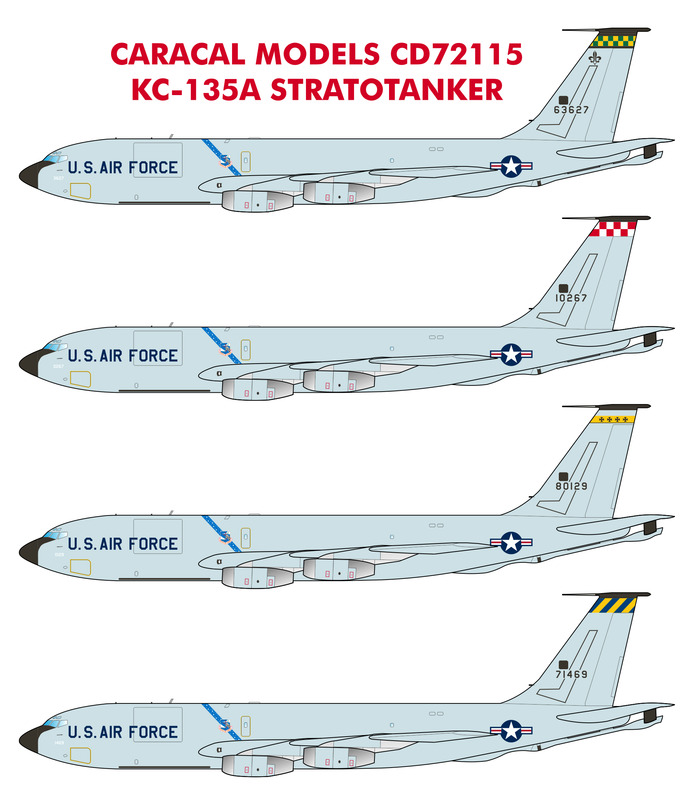 | Caracal Models - CD72115 - 1:72 | Boeing KC-135A Stratotanker. In this decal sheet, we provide markings for eight KC-135A Stratotankers from the SAC (Strategic Air Command) era. The colorful tail markings and intricate unit badges of these hardworking jets were replicated with accuracy and great detail. Limited release of 250 sets only. Please note that this decal sheet does not include national insignia or maintenance stencilling. You can source these markings from our 1/72 scale KC-135 General Markings Set (CD72070) or the kit decals. This sheet is intended to be used with the AMT/ERTL kits. The options on this decal sheet are: KC-135A 56-3627, 2 BW, Barksdale AFB KC-135A 61-0267, 97 BW, Blytheville AFB KC-135Q 58-0129, 9 SRW, Beale AFB KC-135A 57-1469, 42 BW, Loring ANG KC-135A 62-3560, 509 BW, Pease AFB KC-135A 58-0075, 92 BW, Fairchild AFB KC-135Q 62-3545, 380 BW, Plattsburg AFB KC-135A 61-0300, 22 BW, March AFB More | Aircraft decals (military) | Catalogue | £13.99 | |
 | Caracal Models - CD72116 - 1:72 | Boeing KC-135E/R Stratotanker. In this decal sheet, we provide markings for eight KC-135E/R Stratotankers from the SAC (Strategic Air Command) era. The colorful tail markings and intricate unit badges of these hardworking jets were replicated with accuracy and great detail. Limited release of 250 sets only. Please note that this decal sheet does not include national insignia or maintenance stencilling. You can source these markings from our 1/72 scale KC-135 General Markings Set (CD72070) or the kit decals. This sheet is intended to be used with the AMT/ERTL kits. The options on this decal sheet are: KC-135E 57-2603, 336 ARS, March AFB KC-135E 58-0064, 314 ARS, Mather AFB KC-135E 59-1457, 171 ARW, Pennsylvania ANG KC-135E 57-1485, 134 ARW, Tennessee ANG KC-135R 61-0314, 19 ARW, Robins AFB KC-135R 62-3549, 301 ARW, Malmstrom AFB KC-135R 61-4829, 416 BW, Griffiss AFB KC-135R 60-0321, 28 BW, Ellsworth AFB More | Aircraft decals (military) | Catalogue | £13.99 | |
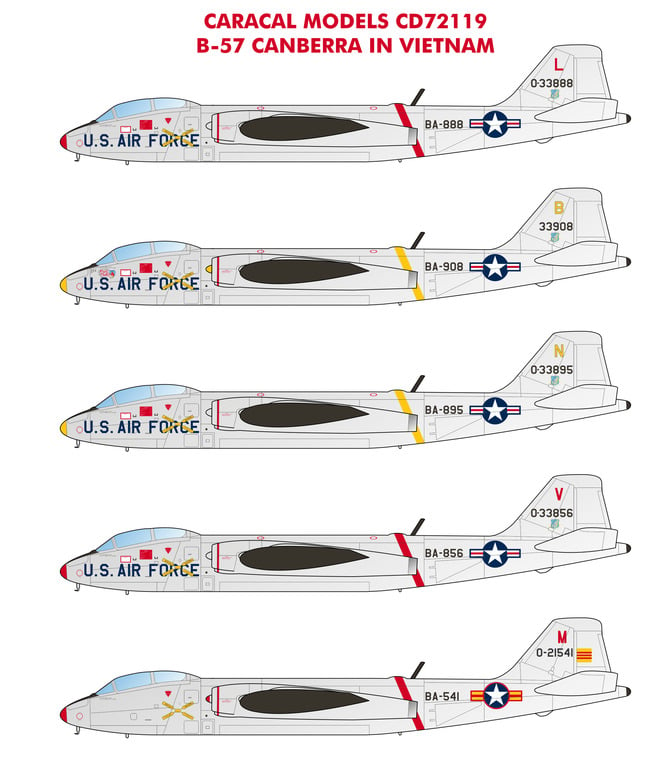 | Caracal Models - CD72119 - 1:72 | Martin B-57 Canberra in Vietnam An American-built version of the famous British Canberra bomber, the B-57 was the first U.S. jet bomber to see combat in the Vietnam conflict. From its role in the earliest strikes to its relentless campaign against the Ho Chi Minh Trail, the B-57 was a tireless workhorse, carrying out missions that defined the air war and cemented its place as a vital, if understated, combat veteran of the war. This new decal set covers the service of the Martin B-57 Canberra during the Vietnam War, featuring a variety of aircraft from the initial deployment of the 8th and 13th Bomb Squadrons to the later period with specialized versions such as the RB-57E "Patricia Lynn" and B-57G "Night Hawk". These decals are designed for the Airfix or Testors/Italeri 1/72 scale kits, and includes accurate period-specific stencilling designed to Caracal's high standards. We believe many of the details in our stencilling and marking options have never been accurately represented in decal form before. The options on this decal set are: B-57B 53-3888, 13th BS (first American jet bomber to drop bombs in combat) B-57B 53-3908 "Miss Mi-Nuki", 8th BS B-57B 53-3895, 8th BS B-57B 53-3856, 13th BS B-57B 52-1541 VNAF B-57B 53-3867, 90th BS B-57B 53-3877 "Hell's Angel", 8th BS B-57B 52-1507, 13th BS B-57B 52-1567, 13th BS B-57E 55-4248, 8th BS RB-57E "Patricia Lynn" 55-4245 RB-57E "Patricia Lynn" 55-4257 RB-57E "Patricia Lynn" 55-4249 B-57G 53-3865 B-57G 53-3929 B-57G 53-3906, 4424th CCTS, 1st TFW (post Vietnam War era) More | Aircraft decals (military) | Catalogue | £17.99 | |
 | Caracal Models - CD72134 - 1:72 | General-Dynamics FB-111A "SIOP" When it entered Strategic Air Command service in the early 1970s, the FB-111A was one of the most modern and important attack jets in the USAF inventory. During these early years, the SAC FB-111A fleet was camouflaged in the unique SIOP (Single Integrated Operational Plan) camouflage scheme. On this set, we provide several colorful marking options for FB-111As in this attractive camouflage. The options on this decal sheet are: FB-111A 67-0162 "Apple 1" (SAC Bombing & Nav. Competition). 380th BW, Plattsburgh AFB 1974 FB-111A 68-0269 "New Hampshire Special", 509th BW, Pease AFB FB-111A 68-0247 NATO Tiger Meet, 509th BW, Pease AFB 1978 FB-111A 68-0254, 6510th Test Wing, Edwards AFB FB-111A 68-0245 "Ready Teddy", 380th BW, Plattsburgh AFB 1983 FB-111A 68-0245 "Spirit of the Seacoast", 509th BW, Pease AFB FB-111A 68-0244 "Lucky Strike", 380th BW, Plattsburgh AFB 1983 FB-111A 69-6510 "Sleepy Time Gal", 380th BW, Plattsburgh AFB 1983 More | Aircraft decals (military) | Catalogue | £13.99 | |
 | Caracal Models - CD72140 - 1:72 | NASA McDonnell-Douglas F-18 Hornet NASA has operated a fleet of F/A-18 "legacy" Hornets for various flight research activities for years. These aircraft play a very important role for exploring new technologies and concepts in aviation - not to mention that they look great in the NASA color scheme! In this 1/72 scale sheet, we provide markings for six NASA Hornets - both single and twin seaters, some with special markings for specific research programs. In addition to all of the options featured on our previous 1/48 scale set, this set also includes bonus options for F-18 HARV research aircraft in 1/48 and 1/72. For the most part these aircraft are regular A & B model legacy Hornets. The instructions clearly explain the additional parts you may require for some of the options (the buddy refueling pod for 847, and optional travel pods). We designed this sheet to fit the Hasegawa kit, but it should work with Academy kits as well as any other dimensionally accurate 1/72 scale F-18A/B kit in the market. The options on this decal sheet are: NASA F-18A "843" NASA F-18B "845" Systems Research Aircraft (SRA) NASA F-18B "846" - Armstrong Flight Research Center NASA F-18A "847" AAR (Automated Aerial Refueling) program markings NASA F-18A "850" NASA F-18B "852" - Dryden Flight Research Center NASA F-18 HARV bonus markings (both in 1/48 and 1/72) More | Aircraft decals (military) | Catalogue | £14.99 | |
 | Caracal Models - CD72141 - 1:72 | US Navy A-4E/F Skyhawk Multiple marking options for US Navy A-4E/F Skyhawks. A workhorse of the US Navy and Marines during the Vietnam War, the A-4 Skyhawk is an iconic and beloved aircraft among aviation enthusiasts who appreciate its unique blend of simplicity, speed, and versatility. This set for the A-4E/F variants of the Skyhawk features markings for several Navy and Marines units, including a camouflaged example that was briefly operated as an adversary aircraft for training. We recommend the Hobby 2000/Fujimi kits in this scale. The options on this decal sheet are: A-4E Bu.No 151059, VMA-322 "Fighting Gamecocks" A-4E Bu.No 151137 VA-216 "Black Diamonds, USS Forrestal 1970 A-4F Bu.No 155022 "Lady Jessie", VA-164, USS Hancock, 1973 A-4F Bu.No 155022 "Lady Jessie", VA-164, USS Hancock, 1974 (after "SuperFox" upgrade) A-4E Bu.No 151030, VMA-131 "Diamondbacks" A-4F Bu.No 154175 Naval Air Test Center, NAS Patuxent River A-4E Bu.No 151064 VF-101 More | Aircraft decals (military) | Catalogue | £14.99 | |
 | Caracal Models - CD72142 - 1:72 | USAF Lockheed F-104A/C Starfighter The F-104 Starfighter served in the United States Air Force (USAF) from the late 1950s to the early 1970s. Known for its sleek design and impressive speed capabilities, the F-104 was used primarily for air defense missions and played a crucial role in the Cold War-era arms race; and later became the backbone of many NATO countries' air arms. Despite its flaws, the F-104 remains a significant part of USAF history and its legacy lives on in the hearts of aviation enthusiasts around the world. This comprehensive decal set features fifteen (15) marking options for Cold War era USAF Starfighters, both from active duty units and the three Guard units selected to fly the type. The set includes a very comprehensive set of stencilling with the attention to detail you expect from Caracal. The options on this decal sheet are: YF-104A 55-2957, 83rd FIS (flown by Howard "Scrappy" Johnson for the world altitude record flight o n May 7, 1958 F-104A 56-0791 "Vociferous Viking", 83rd FIS F-104A 56-0788, 83rd FIS F-104B 57-1294, 83rd FIS F-104A 56-0851, 319th FIS F-104A 56-0821, 331st FIS F-104A 56-0814, 337th FIS F-104B 57-1306, Tennessee Air National Guard, 151st FIS F-104A 56-0840 "Ruler of the Roost", 538th FIS F-104A 56-0795 "Bird Dog II", Arizona Air National Guard, 197th FIS F-104A 56-0863, South Carolina Air National Guard, 157th FIS F-104C 56-0896, 476th TFS F-104C 56-0902, 435th TFS F-104C 57-0912, 436th TFS F-104C 56-0907, 434th TFS More | Aircraft decals (military) | Catalogue | £14.99 | |
 | Caracal Models - CD72146 - 1:72 | USAF CT ANG Lockheed C-130H Hercules "Black Lightning" The Connecticut Air National Guard (CT ANG) holds a storied heritage. Originating in 1923, the CT ANG has been a part of many critical moments in history, from defending the Eastern Seaboard during World War II to engaging in modern operations overseas. In order to commemorate the 100 years of CT ANG, the 103rd Airlift Wing chose to decorate one of their C-130 Hercules aircraft with the historic "Black Lightning" scheme. This decal sheet for the Italeri or Zvezda C-130 kits allows you to model this striking aircraft. Limited edition of 250 sheets only. The aircraft depicted on this sheet is: C-130H 93-1456, Connecticut Air National Guard - 2023 Accurate stencilling and national insignia to build this specific C-130 are included. Both decal sheets in this set were professionally screen printed by Microscale in the US. More | Aircraft decals (military) | Catalogue | £14.99 | |
 | Caracal Models - CD72150 - 1:72 | USAF Lockheed-Martin F-16D Viper Multiple marking options for USAF Lockheed-Martin F-16D twin-seat Vipers. The F-16D, the twin-seat version of the F-16C, has been a mainstay in the United States Air Force (USAF) and air forces of allied nations since the 1980s, showcasing exceptional performance and adaptability. With a blend of swift maneuverability, innovative design, and multifunctional capabilities, the F-16D has excelled in both air-to-air engagements and precision ground strikes. This comprehensive decal set is designed to fit the Hasegawa kits and features seven marking choices for the USAF F-16D Vipers, representing both the hard-hitting active duty wings and the distinguished Guard units that have flown this remarkable machine. One of the options is the special 30th anniversary desert camouflage scheme for 90-0778, the aircraft flown by Lt.Col. Gary "Nordo" North during the mission when he shot down an Iraqi MiG-25 Foxbat in 1992 The seven options on this decal sheet are: F-16D Block 42 90-0778 MiG-25 killer - 30th anniversary special scheme F-16D Block 40 89-2178 510 FS, Aviano AB F-16D Block 52 92-3924 157 FS, South Carolina ANG F-16D Block 52 92-3925 157 FS, South Carolina ANG F-16D Block 30 87-0365 182 FS, Texas ANG F-16D Block 42 90-0793 309 FS, Luke AFB F-16D Block 50 90-0846 148 FW, Minnesota ANG More | Aircraft decals (military) | Catalogue | £14.99 | |
 | Caracal Models - CD72155 - 1:72 | Lockheed F-104 "Test & Drone Zippers" Embark on a journey back to a pivotal era in U.S. Air Force (USAF) history with Caracal's latest 1/72 scale decal set for the F-104 Starfighter, showcasing its less commonly celebrated but equally fascinating roles as a high-speed test aircraft, aerospace trainer, and an unmanned drone! The F-104 Starfighter, with its distinctive slender fuselage and supersonic capabilities, was not only a frontline interceptor but also played a critical role in advancing aeronautical science and flight technologies during its service from the late 1950s through the early 1970s. The missions flown by these "Zippers" were crucial in the development of technologies that shaped the future of aviation and aerial combat, marking the F-104 as a versatile and invaluable asset beyond its combat duties. Featuring seventeen (17) carefully selected and historically accurate marking options, this 1/72 scale set highlights the F-104's involvement in experimental programs, high-speed testing, and its transition into a remotely piloted target drone. We also included markings for NF-104 and JF-104 aerospace trainers. Each option tells a story of innovation, risk, and technological advancement, capturing the essence of an era where the Starfighter was at the forefront of aerospace experimentation. The marking options on this decal sheet are: F-104A 56-0757, US Navy - China Lake F-104A 56-0740, US Navy - China Lake QF-104A 55-2957 QF-104A 56-0741 QF-104A 56-0737 QF-104A 56-0735 F-104A 55-2966, ARDC - Edwards AFB F-104A 55-2965, ARDC - Edwards AFB F-104A 55-2971, ARDC - Edwards AFB F-104D 57-1314, ARDC - Edwards AFB F-104D 57-1315, ARDC - Edwards AFB F-104A "Queenie" 55-2969 F-104A 56-0734, NASA NF-104A 56-0756 NF-104A 56-0760 NF-104A 56-0762 JF-104 55-2961, NASA More | Aircraft decals (military) | Catalogue | £14.99 | |
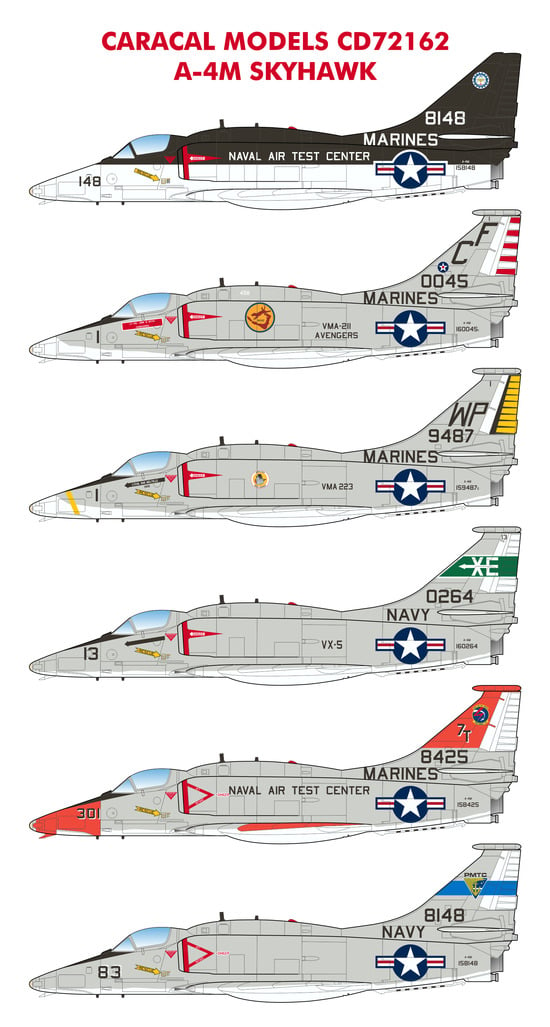 | Caracal Models - CD72162 - 1:72 | Douglas A-4M Skyhawk The A-4M was one of the last Skyhawk versions to see service in the US. This 1/72 scale Skyhawk sheet is designed for the Fujimi and Hobby Boss kits, and provides a mix of markings from both operational and test/evaluation units. The options on this decal sheet are: A-4M BuNo. 158148, Naval Air Test Center A-4M BuNo. 160045, VMA-211 "Wake Island Avengers" A-4M BuNo. 159487, VMA-223 "Bulldogs" A-4M BuNo. 160264, VX-5 A-4M BuNo. 158425, Naval Air Test Center A-4M BuNo. 158148, Pacific Missile Test Center (PMTC) More | Aircraft decals (military) | Catalogue | £14.99 | |
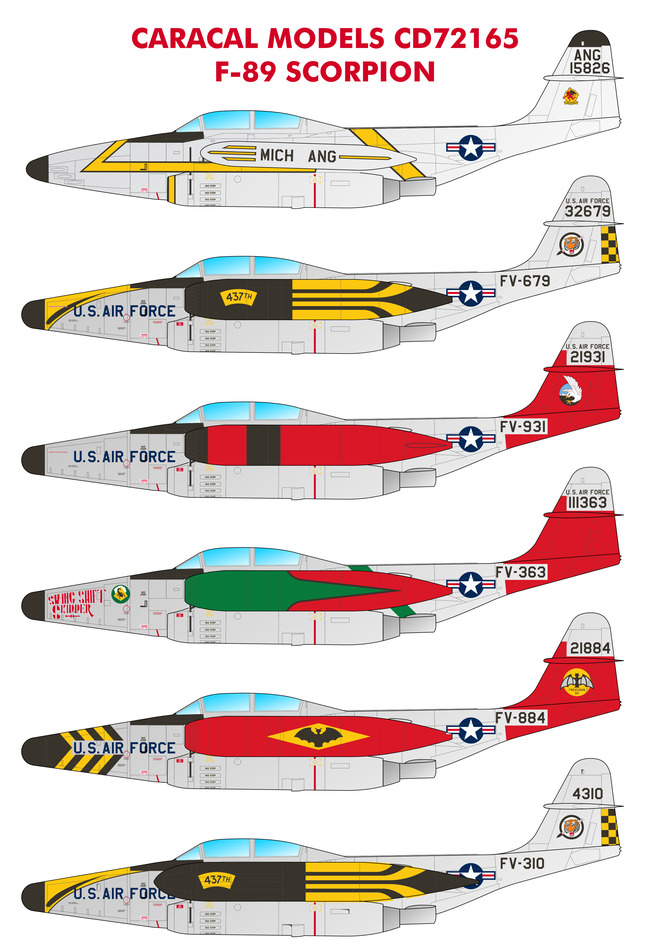 | Caracal Models - CD72165 - 1:72 | McDonnell F-89 Scorpion: A 1/72 version of our recent F-89 Scorpion set. Colorful marking options for one of the most important early jets in USAF history. The F-89 was the first purpose-built, all-weather jet interceptor to enter USAF service. Designed to be used with the 1/72 scale F-89 kits from Academy, Revell, and Hobbycraft, this carefully designed decal set provides twelve different marking options spanning the F-89C, F-89D, F-89H and F-89J variants of this important jet. From the early Arctic defense missions in Alaska to the high-profile Air Defense Command units of the continental US and its Air National Guard career, these markings capture the diverse history of a Cold War workhorse that stood guard against any airborne threat. Distinctive national insignia, colorful unit emblems, and accurate period-specific stencils all combine to help you recreate a great model of this classic on your workbench. We recommend the Revell 1/72 F-89D/J kits. Please note that the F-89H option on the sheet requires the use of Hobbycraft 1/72 F_89H hit or aftermarket AIM-4 Genie / rocket pods. The options on this decal set are: F-89C 51-5826, 107 FIS - Michigan ANG F-89D 53-2679, 437th FIS, Oxnard AFB F-89D 52-1931, 449th FIS, Ladd AFB F-89D 51-11363 "Swing Shift Skipper" F-89D 52-1884, 59th FIS, Goose AB F-89H 54-0310, 437th FIS, Oxnard AFB F-89J 52-2157, Washington ANG F-89J 53-2550, Iowa ANG F-89J 53-2522, Minnesota ANG F-89J 53-2677, Wisconsin ANG F-89J 53-2513, Montana ANG F-89J 53-2468, North Dakota ANG More | Aircraft decals (military) | New Arrivals | £17.99 | |
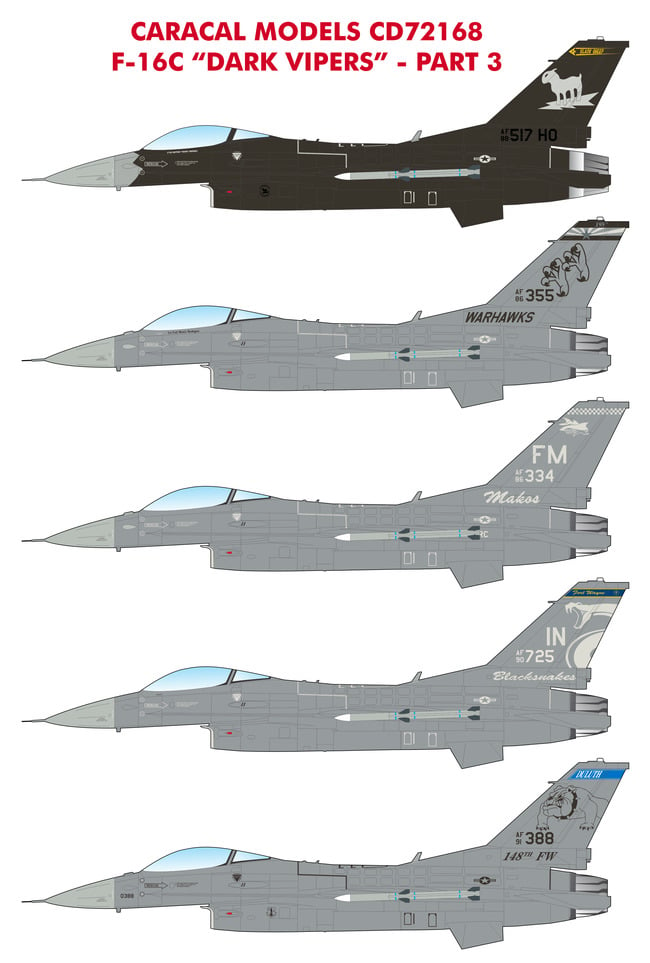 | Caracal Models - CD72168 - 1:72 | USAF Lockheed-Martin F-16C "Dark Vipers" - Part 3 The third 1/72 scale sheet in our best-selling "Dark Vipers" series combines the options from our 1/48 scale Dark Vipers Part 5 (CD48236) and Part 6 (CD48242) sheets into a single scaled-down release, featuring ten marking options for USAF F-16s in the "Have Glass V" paint scheme. The highlight of this set is the 8th Fighter Squadron's stunning F-117 commemorative jet. Painted in a sleek matte black finish to honor the "Black Sheep" squadron's stealth heritage, this aircraft pays tribute to the legendary Nighthawk. Nine operational Have Glass V airframes from active duty, Air National Guard and Reserve units complete the sheet. The ten options on this sheet are: F-16C Block 42 88-0517, 8th FS "Black Sheep" F-16C Block 30 86-0355, 195th FS "Warhawks", Arizona ANG F-16C Block 30 86-0334, 93rd FS "Makos", AFRC, Homestead ARB F-16C Block 40 90-0725, 163rd FS "Blacksnakes", Indiana ANG F-16C Block 50 91-0388, 179th FS, Minnesota Air National Guard F-16C Block 50 98-0003, 55th FS, Shaw AFB F-16C Block 40 87-0359, 555th FS, Aviano AB F-16C Block 40 89-2049, 510th FS, Aviano AB F-16C Block 40 89-2078, 80th FS, Kunsan AB F-16C Block 40 90-0724, 35th FS, Kunsan AB More | Aircraft decals (military) | Future Releases | £17.99 | |
 | Model Maker Decals - D72088 - 1:72 | Archeo Lask Collection. 12 planes and helicopters from 32 Air Tactical Base Poland. A group of soldiers, modelers and aviation enthusiasts who are restoring aircraft once used in the Polish Air Force. The organization is non-profit and all the work is done outside of working hours. The collection currently includes twelve aircraft and helicopters and is located on the premises, and each one has its own unique stories. Many of them in his brilliant years served at the airport in Lask. The idea for this decals created on the fifth edition of the Lask Model Show. when it turned out that the number of models aspiring to the awards for the best model in the colors of the collection is low due to the lack of just a decal for these planes and helicopters. I suggested to solve this problem with set for the whole collection, what has been very favorably received by the Group. From this place, I would like to thank all the members of the groups involved Archeo to help where I would like to personally thank Darek Jakubczak, who became some kind of coordinator of this project. The same thanks belong to the president of the association Archeo , Piotr Polit. Due to the very large volume of material we had to compromise approaches to the chessboards and those that are unified on the size of several aircraft in a set put only once. More | Aircraft decals (military) | Limited Availability | £7.50 | |
 | Dutch Decal - DD72090 - 1:72 | Camouflage and Markings on Aircraft Of The Royal Netherlands Indies Army Air Force More | Aircraft decals (military) | Catalogue | £15.75 | |
 | Duke Hawkins - DH-D72-001 - 1:72 | The sets include 3 schemes: 1. Hawker Hurricane Mk.IIb of the Belgian Air Force, 1947 2. Hawker Hurricane Mk.IIb of the RAF, 174 Squadron, Operation Rutter 1942 3. Hawker Hurricane Mk.IIc of the RAF, 1697 Flight, 1944 More | Aircraft decals (military) | Catalogue | £7.50 | |
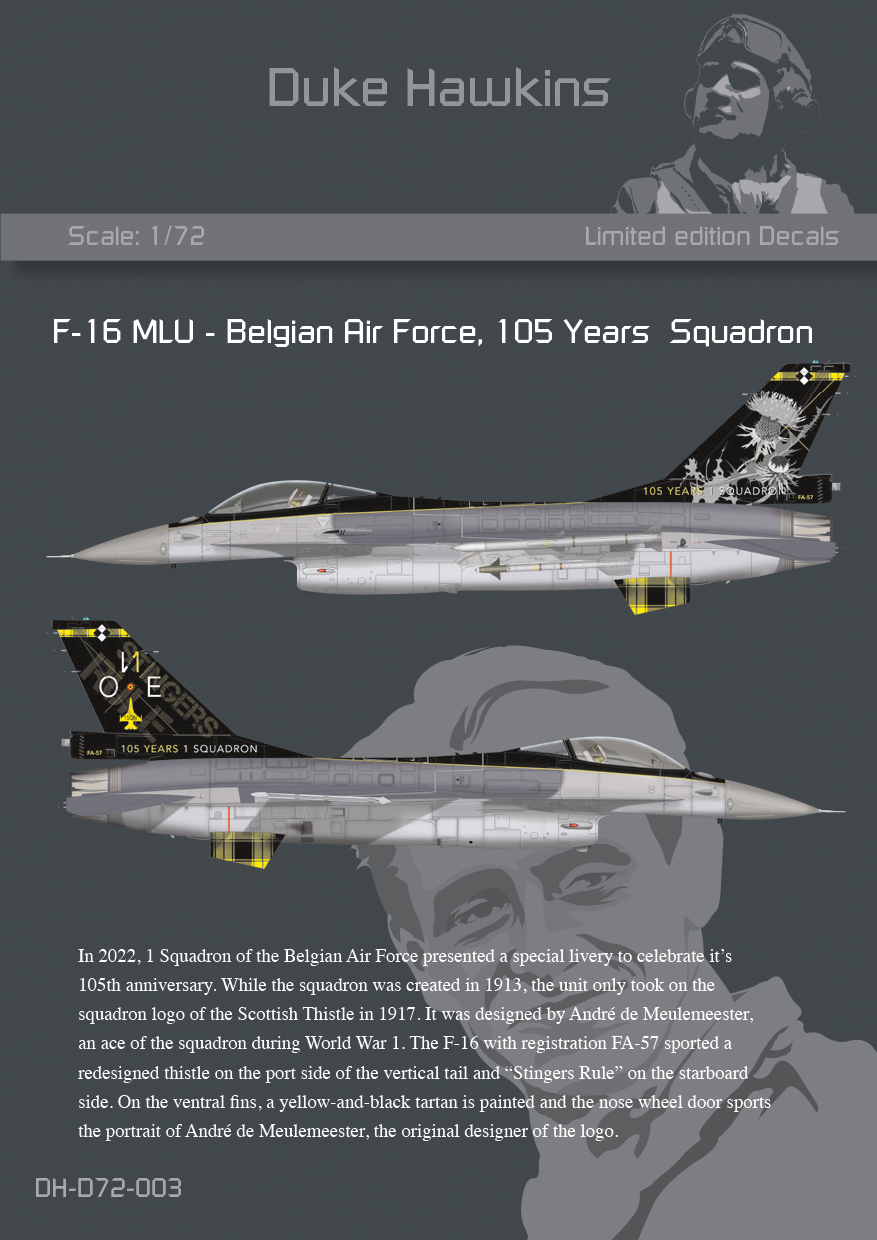 | Duke Hawkins - DH-D72-003 - 1:72 | Lockheed-Martin F-16MLU These decal sets are for the Lockheed-Martin F-16 MLU of 1 Squadron of the Belgian Air Force, presented in 2022 for the 105th anniversary of the unit. 1 Squadron is based at Florennes AB. While the squadron was formed in 1913, it received its unit logo, the Scottish Thistle, only in 1917, during World War 1. These decals are made from the original designs of the aircraft. More | Aircraft decals (military) | Catalogue | £7.50 | |
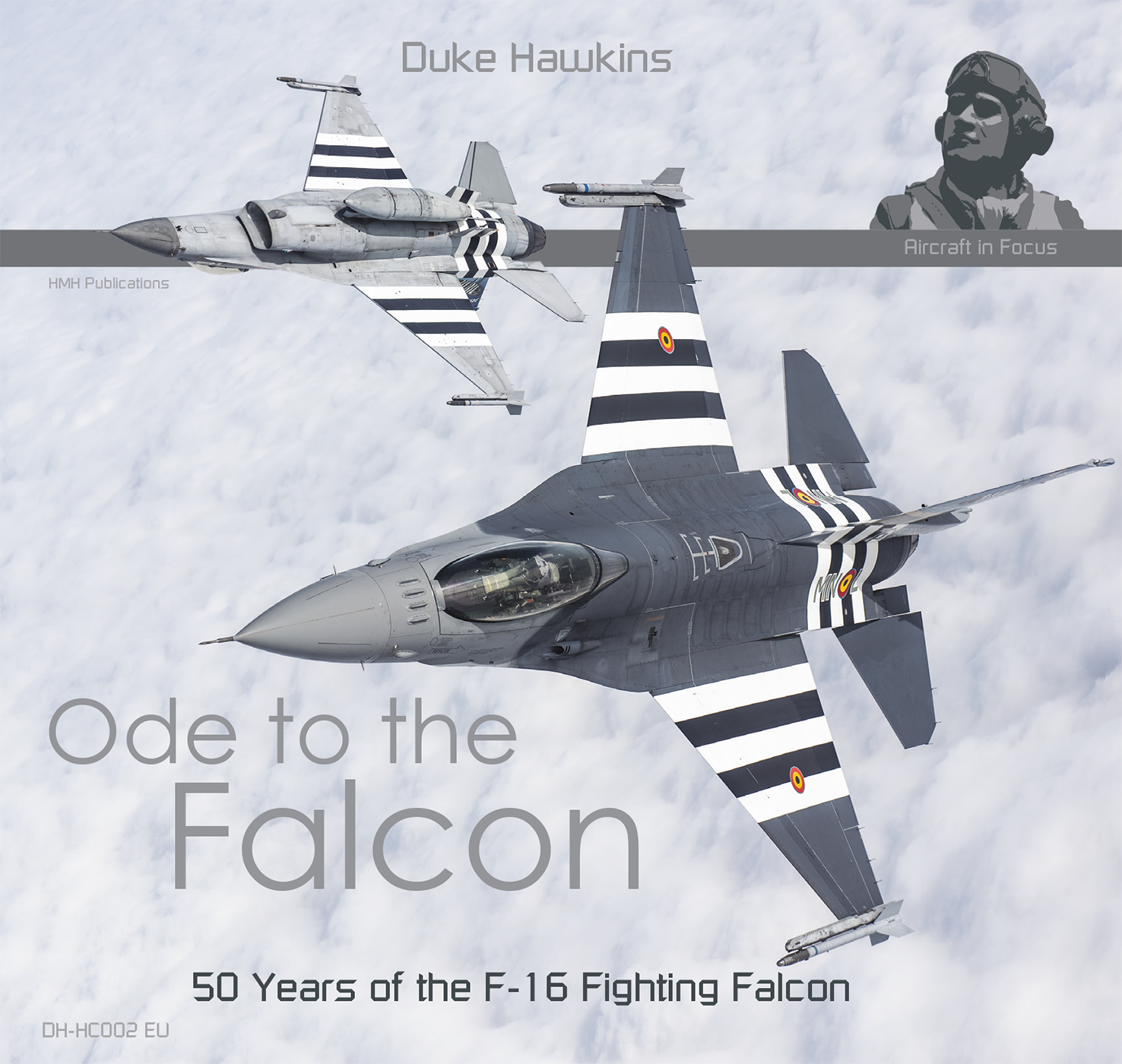 | Duke Hawkins - DH-HC002EU - No Scale | "Ode to the Falcon" is a 404 page hardcover book, called "Ode to the Falcon". Is brings the story on the F-16 in the 21st century in 500+ photos and 54 colour profiles, specifically made for this book. It is limited at 2,000 copies worldwide. The first 130 pages shows the F-16 in use in the US, from the Air Combat Command, to the Air Force Reserve Command, Training Command, Evaluation, Air National Guard, PAcific Command, Europe and Africa Command, and US Navy. Also in separate chapters are the Aggressors, US Thunderbirds and the QF-16 Zombie Viper, used as target drones. The next part of the book shows every air force flying the F-16, 27 countries in all. Each country is shown in 8, 10 or 6 pages. At the end, there's a technical view of the F-16, a look at the ordnance and all the different blocks explained. To conclude, the 54 profiles are listed once more and explained in detail. This book weighs 2,4 kg and is a little larger than the standard books: 278 mm W x 247 mm H. More | Aircraft books | Catalogue | £64.99 | |
 | Mark I Decals - DMF7201 - 1:72 | No.1435 Flt. Panavia Tornado F.3 No.1435 Flt. Tornado F.3 Tornado F.3s, based at RAF Mount Pleasant, provide air defence for the Falkland Islands, South Georgia and the South Sandwich Islands. Decals for the following aircraft are included: ZE812/F ZG780/H ZG751/C ZG798/F ZE889/H ZG799/D ZE736/F ZG778/H ZE834/C ZG797/D These decals were designed to match 1/72 Airfix, Hasegawa, Italeri, Matchbox and Revell kits. More | Aircraft decals (military) | Catalogue | £5.80 | |
 | Mark I Decals - DMF7202 - 1:72 | Unarmed Hawker Hurricanes Mk.I/Mk.IIC Unarmed Hurricanes Decals for the following aircraft are included: Hurricane Mk.I, G-AFKX (ex-L1606), Hawker Aircraft demonstrator & trials a/c Hurricane Mk.IIC(Met), PZ818, 5O-K, No.521 Sq., Royal Air Force Hurricane Mk.IIC, LF363, Fighter Command Communications Sq., Royal Air Force Hurricane Mk.IIC/Trop, 2-13, Training School, Imperial Iranian Air Force These decals were designed to match any 1/72 Hawker Hurricane Mk.I (fabric wing) and Mk.IIC/(Trop) kits. A comprehensive instruction leaflet is included. More | Aircraft decals (military) | Catalogue | £11.40 | |
 | Mark I Decals - DMF7205 - 1:72 | Bristol Brigand (TF.I, B.1, MET.3, T.4, T.5)(designed to be used with Valom kits) Brigand TF Mk.I, RH748, Bristol Aircraft Co. trials a/c, SBAC Air Show, September 1946 Brigand B Mk.1, RH813/H, 'The Bridal Brigand', No.84 Sq., Iraq, June 1949 Brigand B Mk.1, VS855/OB-V, No.45 Sq., British Malaya, 1950-51 Brigand Met Mk.3, VS820/B, No.1301 (Met.) Flt., Ceylon, 1949-51 Brigand T Mk.4, RH758, Airborne Interception School, No.238 OCU, U.K., 1955-56 Brigand T Mk.5, VS837/N, Airborne Interception School, No.238 OCU, U.K., 1954-55 A comprehensive instruction leaflet is included. More | Aircraft decals (military) | Catalogue | £12.85 | |
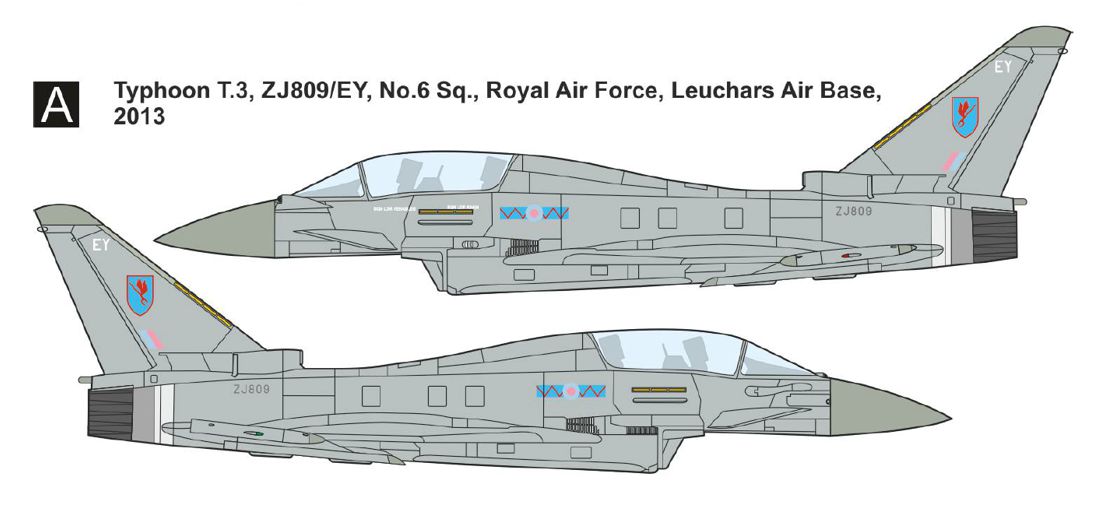 | Mark I Decals - DMF7207 - 1:72 | Typhoon T.3 in RAF designed to be used with 1/72 Hasegawa, Hobby Boss, Italeri and Revell kits Typhoon T.3, ZJ809/EY, No.6 Sq., Royal Air Force, Leuchars Air Base, 2013 Typhoon T.3, ZJ815/EB-H, No.41(R) Test and Evaluation Sq. (TES), Royal Air Force, Coningsby Air Base, 2015 Typhoon T.3, ZK380, No.2 Sq., Royal Air Force, Lossiemouth Air Base, 2016 Typhoon T.3, ZJ812/BK, No.29 Sq., Royal Air Force, Leuchars Air Base, 2016 Typhoon T.3, ZK383/383, No.12(R) Sq. (joint RAF and Qatar Emiri AF training unit), Coningsby Air Base, 2023 These decals were designed to match 1:72 Hasegawa, Hobby Boss, Italeri and Revell kits. More | Aircraft decals (military) | Catalogue | £11.40 | |
 | DP Casper. - DPC72060 - 1:72 | Slovak Air Force. The Slovakian Grey Crosses 2025. Lockheed-Martin F-16C Fighting Falcon x 2 F-16D Fighting Falcon Aero L-39ZAM/L-39Cm, Let L-410UVP-E20 Sikorsky UH-60M x 2 Mikoyan MiG-29UBS More | Aircraft decals (military) | Catalogue | £17.40 | |
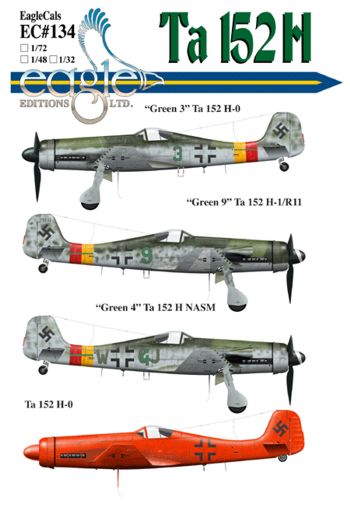 | Eagle Cal - EAG72134 - 1:72 | Focke-Wulf Ta-152 A total of five aircraft markings are provided. 'Green 3' originally 'Yellow 3' photographed at Alteno Airfield, February 1945 assigned to 11./JG 301. This aircraft became 'Green 3' as part of Stab JG 301 on when all Ta-152 aircraft became part of the Stab on 13 March 1945. Flown by Obfw. Josef Keil 10 April 1945 when he shot down a P-47 over Kassel, Germany. This H-0 also flown by Obfw. Walter Loos on 20 April 1945. 'Green 9' Stab JG 301. This Ta-152 H-1/R11 W. Nr. 150168, was equipped with windscreen heating elements which are provided in decal form on this sheet. Flown by Fw. Willi Reschke on 24 April 1945, shot down two Soviet Yakovlev Yak-9s over Berlin. Also flown by Hptm. Roderich Cescotti Technical Officer JG 301 on 7 April 1945. This aircraft was captured by the British who overpainted the markings and JG 301 Red/Yellow bands. The Black spinner with White spiral was repainted to a Red spinner with White spiral, then displayed at Farnborough, England. This is the Ta-152 H test flown by Capt. Eric Brown. 'Green 4' Ta-152 H-0 W. Nr. 150010 originally 'Yellow 4' 11./JG 301, assimilated into Stab JG 301 and flown by Obfw. Walter Loos on 24, 25 and 30 April 1945. This Ta-152 H-0 is the only known survivor and is currently in storage at the National Air and Space Museum. Markings provided for both 'Yellow 4' and 'Green 4'. Orange-Red Ta-152, a striking Ta-152 H flown by the Kommodore of JG 301 Obslt. Fritz Auffhammer on 22 March 1945 to the Luftwaffe proving ground at Rechlin, Germany, returning this aircraft along with complaints of construction problems and unfulfilled delivery dates. The purpose of ths bright Orange-Red color was to prevent trigger-happy German flak gunners from shooting down this unusual Luftwaffe fighter. On this flight Auffhammer was escorted by Hptm. Roderich Cescotti who flew Fw-190D-9 'Green 1'. Recommended FS number 21310 for the Orange-Red color. More | Aircraft decals (military) | Catalogue | £10.99 | |
 | Exito Decals - EXED72007 - 1:72 | 'Yak Attack' and includes markings for three striking Yak-1b fighters: - Yakovlev Yak-1b, flown by Capt. Vladimir P. Pokrovskiy of 2nd GIAP / 6th IAD, Air Force of the Northern Fleet, probably late 1943. - Yakovlev Yak-1b, coded 'White 42', flown by Snr. Lt. Garri A. Merkviladze of 152nd GIAP / 12th GIAD, 1st Ukrainian Front, Germany, spring 1945. - Yakovlev Yak-1b, most likely coded 'White 20', flown by Snr. Lt. Fotiy Y. Morozov of 31st GIAP / 6th GIAD, 4th Ukrainian Front, first half of 1944. None of these marking options have previously been reproduced in decals in an accurate manner. Our instruction sheets include photos of all depicted aircraft, some of which you may have never seen before, or at least not reproduced in this quality. The decal sheet was printed by industry leader, Cartograf of Italy, which ensures top printing quality and ease of application. It is complemented by instructions that differ from the plain market standard. Each subject is presented on an A4-sized sheet, with large side aircraft profiles printed on the front, and the remaining artwork, photos of the actual aircraft and all necessary information laid out on the rear side. This way you not only get some cool decals for your model kit, but also attractive posters to adorn your man cave, at the same time! More | Aircraft decals (military) | Catalogue | £7.80 | |
 | Peewit - FOYA - 1:72 | Fighters over the Adriatic (with English translation) Fighter Aircraft of the Austro-Hungarian Navy in Photographs The subject of Austro-Hungarian naval fighter aircraft has not yet been covered independently in any specialised book. This new publication presents the first comprehensive overview of the development and operational use of the fighter aircraft (referred to at the time as defensive aircraft) of the Austro-Hungarian Naval Air Service. The publication is written in Czech, but almost the entire text is also available in English (there is German and Italian translation produced but we will not be stocking it) in the form of an inserted booklet of smaller format. The introductory chapter clearly explains the origins, development, and operational use of these aircraft. The main part of the publication consists of an extensive photo album covering all aircraft types used in this role, accompanied by detailed captions. The large reproduction format allows details to stand out that often remain unnoticed in ordinary publications. Some photographs are reproduced across two pages, while others are supplemented with enlarged details. The photographs originate from private collections across several countries and are reproduced in the highest possible quality. Most of the aircraft shown are also accompanied by a colour side-view illustration depicting the typical colour scheme of the aircraft. The book also contains extensive tables listing all Austro-Hungarian naval fighter aircraft, summaries of aircraft losses, and" for the first time ever published" a complete list of victories achieved by Austro-Hungarian naval aviators. An unusual bonus consists of inserted colour samples of two camouflage paint shades used on the aircraft. As this is a small-print-run publication, the printing costs alone are approximately twice as high as the retail price of some publications and magazines of similar length. For this reason, the final selling price is unfortunately higher, despite a considerable amount of unpaid work involved in its preparation. The publication further includes a brief biography of the most successful naval aviator, Gottfried Banfield, as well as a final chapter devoted to defensive aircraft pilots who were of Czech nationality or are sometimes incorrectly counted among Czech pilots, together with aviators who were not of Czech origin but later served in the Czechoslovak military air force. These two sections are not translated. Size: A4 (210 x 297 mm) Pages: 68 Photos: 97 Colour profiles: 12 Colour chips: 2 FOYA More | Aircraft books | New Arrivals | £49.99 | |
 | Double Ugly - FT003 - No Scale | Douglas A-4 'Ahit' in IAF Service. The A-4N and TA-4J 'Ahit' in Israeli Air Force Service by Ra'anan Weiss & Yoav Efrati Sized A4 landscape, softcover, English and German text, 120 pages of content, full colour, over 650 images. This walk around details the status of the A-4N and TA-4J, including a short introduction and colur profiles. The content coversf: - avionics - cockpits - landing gear - engines - most recent armament - fuselage details - camouflage schemes An absolute must have for the fans of the IAF version of the 'Scooter' (Fox Two! Colour & Markings (walk around)) More | Aircraft books | Catalogue | £22.70 | |
 | Double Ugly - FTC001 - No Scale | Double Ugly! Books " Fox Two! CAMO: The Modellers' to Aircraft Finish & Markings SUNDOWNER PHANTOMS - The McDonnell F-4B/N in Service with VF-111 1971 to 1977 softcover book More | Aircraft books | Catalogue | £14.99 | |
 | Double Ugly - FTC002 - No Scale | Double Ugly! Books " Fox Two! CAMO: The Modellers' to Aircraft Finish & Markings Republic F-105 Thunderchief: The 'Thud' in U.S. Air Force Service 1958 to 1984 softcover book More | Aircraft books | Catalogue | £29.99 | |
 | Double Ugly - FTC003 - No Scale | McDonnell-Douglas AV-8A/C, AV-8S and TAV-A/S Double Ugly! Books " Fox Two! CAMO: The Modellers' to Aircraft Finish & Markings USMC HARRIERS: The McDonnell-Douglas AV-8A/C, AV-8S and TAV-A/S in World Wide Service 1971 - 2006 (USMC, Armada Espanola and Royal Thai Navy) by Angelo Romano with Michael Grove Sized A-4 landscape, softcover, English text and captions, 108 pages of content, over 190 hitherto unpublished images mainly in colour, 8 colour profiles From the content: " Introduction " VMA-231 'Ace of Spades' " VMA-513 'Flying Nightmares' " VMA-542 'Tigers'VMAT-203 'Hawks' " Naval Air Test center (NATC) " NASA " Armada Espanola " Royal Thai Navy " AV-8A/C Camouflage & Markings [McDonnell-Douglas AV-8] More | Aircraft books | Catalogue | £27.95 | |
 | Double Ugly - FTC005 - No Scale | McDonnell F-4C and RF-4C Double Ugly! Books " Fox Two! CAMO: The Modellers' to Aircraft Finish & Markings Spanish PHANTOMS: The McDonnell F-4C and RF-4C in Service of the Ejercito del Aire Espanol 1971 " 2002 by Salvador Mafe Huertas with Lee R. De Haven Sized A-4 landscape, softcover, perfect bound, English text and captions, 132 pages of content, over 220 images mainly in colour, 8 colour profiles From the content: " Introduction " F-4C/C.12 of Ala 12 in Serial Number Order " RF-4C/CR.12 of Ala 12 in Serial Number Order " EdA F-4 Phantom II Individual Aircraft Histories " F-4C/RF-4C Aircrews & Personal Equipment " F-4C C.12 / RF-4C CR.12 Camouflage and Markings More | Aircraft books | Catalogue | £32.95 | |
 | Double Ugly - FTC006 - No Scale | U.S. ANG PHANTOMS: The F-4D/E in Service with the New Jersey Air National Guard 1980 - 1991 by Don Linn with Barry Roop Sized A-4 landscape, softcover, English text and captions, 144 pages of content, over 220 images mainly in colour, 16 colour profiles ISBN: 978-3-935687-38-6 An amazing book, written by Don Linn, with the immense support by former 141st TFS TSgt. Barry Roop, who provided a multitude of images and slides. " Introduction " F-4D of the 141st TFS in Serial Number Order " F-4E of the 141st TFS in Serial Number Order " NJ ANG F-4 Phantom Roll Call " NJ ANG F-4 Phantom Camouflage and Markings More | Aircraft books | Catalogue | £34.95 | |
 | Guideline Publications - GIA02 - No Scale | Guideline in Action 2 Atlantic Resolve Nato's Show of Strength in Europe 2014 2020. Atlantic Resolve is a response to Russia's actions in Ukraine, mainly the war in Donbass, and is funded under the European Reassurance Initiative. The US took several immediate steps to demonstrate solidarity with NATO, such as augmenting the air, ground and naval presence in the region, and enhancing previously scheduled exercises. The US is taking measures to improve NATO military plans and defence capabilities, and remains committed to maintaining a persistent presence in Central and Eastern Europe. This second Guideline in Action looks at the US Air Force's recent deployments in support of Atlantic Resolve, US Army aviation assets, and multinational training exercises, as well as the transport and logistics efforts behind the maintenance of the front line squadrons. 84 pages perfect bound More | Military vehicle books | Limited Availability | £11.99 | |
 | Guideline Publications - GP565310 - No Scale | Airlift Force RAF Transport Command 1948-1967 By Colin Ovens Consider, for a moment, these three Royal Air Force Command titles:- "Royal Air Force Bomber Command"- a name that, for many, may generate imposing images of Wellingtons, Halifaxs, Stirlings, Lancasters, Mosquitos, Lincolns, BAC/EE Canberra s, and the V-Bombers; "Royal Air Force Fighter Command"- a Command title that readily conjures up exciting images of Hurricanes, Spitfires, Tempests, Meteors, Vampires, Hunters, and Lightnings; "Royal Air Force Coastal Command"- a renowned name that may prompt dramatic over-water images of Sunderlands, Beaufighters, Mosquitos, Catalinas, Liberators, and Shackletons. Now, consider the title "Royal Air Force Transport Command"... to many readers this may prompt images of huge formations of Dakotas, disgorging paratroops over Normandy, Arnhem, or the Rhine; others will have a recollection of the Berlin Airlift. On the other hand, many of us will recall seeing, and ignoring, the occasional Argosy, Beverley, Bristol Britannia , Hastings, Comet, or, perhaps, a VC-10, in the static park at a Battle of Britain Open Day, while they aimed their cameras at the Hunters, Gloster Javelins, Lightnings, V-Bombers, or Shackletons on show- these were the exciting defenders of these isles; and those others..? "They're just superannuated airliners", as a school-friend airily dismissed Transport Command's contribution to a Battle of Britain Open Day, at RAF Biggin Hill in the mid-1960s, when we two were teenagers. 92 pages perfect bound More | Aircraft books | Catalogue | £19.00 | |
 | Guideline Publications - GPSAM06 - No Scale | Camouflage & Markings No.6. The Air Campaign for the freedom of Libya Febuary to October 2011. Operations Odyssey Dawn and Unified Protector More | Aircraft books | Catalogue | £17.99 | |
 | Guideline Publications - GPSAMCC3 - No Scale | Combat Colours 3: The Curtiss P-36 and P-40 in USAAC/USAAF service 1939-1945 The usual detailed 'Scale Aircraft Modelling' treatment of the plane which kept Curtiss at the forefront of fighter design following the success of their biplane line. When re-engined with Allisons the P-36 became the P-40 and served with distinction throughout World War II. 8 colour 3-views. 150 colour profiles. 44 black/white photos. More | Aircraft books | Catalogue | £9.95 | |
 | Hi Decal - HD72010 - 1:72 | Fairchild A-10A Thunderbolt II (4) 76-552 706TFS Air Force Reserve Experimental brown/sand camouflage; 76-530/BD 46TFW Air Force Reserve Experimental grey camouflage; 76- 544/NO 706TFS Air Force Reserve Desert Storm; 76-708/NY 138TFS The Boys from Syracuse More | Aircraft decals (military) | Catalogue | £7.99 | |
 | Hi Decal - HD72012 - 1:72 | Boeing Chinook (5) #1 is a Chinook HC.1 ;240 OCU, RAF, Operating in Saudi Arabia during Desert Storm in February 1991. The paint scheme is Desert Pink FS 30279 with a Yellow Camel nose art on both sides. #2 is a Chinook HC.1;7th Sqn RAF, Operating in Saudi Arabiawith toned down camouflage for night operations during Desert Storm in February 1991. The paint scheme is Desert Pink FS 30279 with a Black FS 37038 "spots" and a Black FS 37038 underside. #3 is a CH-47D Chinook of the 101st Airborne Division of the US Army. This Chinook was deployed to Saudi Arabia for Operation "Desert Storm" in February 1991. The paint scheme is Dark Green FS 34031. #4 is a CH-47C Chinook of the 601st Aviation Battalion of the Argentine Army during the South Atlantic War on the Falkland Islands in June of 1982. The paint scheme is Olive Drab FS 34087. #5 is a CH-47D Chinook of the Helicopter Unit 5 of the Spanish Army Air Corps out of Los Remedios Airbase in 1987. The paint scheme is Olive Drab FS 34087. More | Aircraft decals (military) | Catalogue | £7.99 | |
 | Hi Decal - HD72057 - 1:72 | Updated! McDonnell F-4E/RF-4C Phantom II The sheet includes markings for: McDonnell F-4E/RF-4C Phantom II (8) - F-4E 67-0392 457th TFS 301st TFW `War Lord' double MiG killer, USAF Reserve, Texas 1989, in Hill Grey II camouflage; - F-4E 71-1121 / 3-6658 11th TFS I , Imperial Iranian Air Force (IIAF) , TFB 1 Mehrabad, 1978, in Asia Minor Sand-Dark Brown-Dark Green camouflage, - F-4E 73-1547 / 3-6645 61st TFW, Islamic Republic of Iran Air Force (IRIAF), TFB 6 Bushehr, 1980, - F-4E 73-1544 / 3-6642 32nd TFW, IRIAF, TFB 3 Nojeh, 1985, - F-4E 73-1550 / 3-6648, 61th TFW, IRIAF, TFB 6 Bushehr 2009, in Asia Minor desert scheme and sharkteeth, - F-4E 76-0499 152nd TFW 17th TFW, South Korean Air Force (ROKAF), Daegu 1980, in South East Asia camouflage; - F-4E 68-0421 156th TFS 10th TFW, ROKAF, Suwon 1998, in Light Ghost Grey and Dark Ghost Grey air superiority scheme. - RF-4C 67-0436 131st TRS 39th TRG, ROKAF, in Hill Grey II camouflage; More | Aircraft decals (military) | Catalogue | £7.99 | |
 | Hi Decal - HD72058 - 1:72 | McDonnell F-4E/F-4ETM /RF-4ETM Phantom II 'Turkish Air Force' (4) 68-0346 F-4E Phantom II - 111 Filo 'Panter', ex NJ ANG, with big 'Tiger head' on the front fuselage,1993. 68-0403 F-4ETM Simsek - 112 Filo 'Seytan', with big Sharkteeth and 'Devil head' artwork on the tail , 2011. 67-0227 F-4E Phantom II - 172 Filo 'Sahin', with Sharkteeth and big 'Falcon head' artwork on the tail , 2010. These Phantoms all wear the Hill Grey II scheme . 77-0314 RF-4ETM Isik - 173 Filo 'Safak', with big 'Spook' artwork on the tail and new disruptive camouflage scheme.2012. This recce Phantom has been shot down by Syrian air defences above the East Mediterranean on June 22nd, 2012. The decal sheet also includes the respective Turkish stencil data. More | Aircraft decals (military) | Catalogue | £7.99 | |
 | Hi Decal - HD72064 - 1:72 | North-American F-86F-25/F-30 (F-40 wing) Sabre (4) - - 'Camouflaged Desert Swords' (designed to be used with Fujimi, Hasegawa and Hobby Boss kits) * F-86F-25 51-13244 / 3-133 - 103rd TFS, Imperial Iranian Air Force, in Natural Metal Finish, deployed to Kamina AB,Congo, in 1963 as part of the UN Fighter Wing during the Katanga crisis. * F-86F-25 51-13224 / 3-140 - 41st TFS, Imperial Iranian Air Force, in Asia Minor camouflage scheme,4 TFB Vahdati, 1969 * F-86F-25 51-13240 / 275 - 1st Fighter Bomber Sqn, Imperial Ethiopian Air Force, in Asia Minor camouflage, Asmara AB, 1972 * F-86F-30 52-4576 / 'DRAGON' - 9th TFS, 5th TFW, Philippine Air Force, in Jungle camouflage, Edwin Andrews AB, Mindanao,1973. The Imperial Iranian Air Force received the first of 52 F-86F-25/F-30 Sabres, updated with the F-40 slatted wings and 4 underwing hardpoints, in 1960. Normally based at 1 TFB Mehrabad, four IIAF Sabres operated out of Kamina AB, between January and May 1963, as part of the United Nations Fighter Wing during the Katanga secession. The IIAF F-86Es were very active, flying more operational sorties than the co-based Swedish and Philippine contingents combined, one of the Sabres suffering damage due to ground fire. Around 1965, the Iranian F-86 fleet has been repainted in the Asia Minor camouflage scheme. The Sabres were used in the fighter-bomber and training roles until 1971. Several Iranian Sabres were delivered to the Imperial Ethiopian Air Force during November 1970. These aircraft saw intensive use in the COIN role against Eritrean rebel forces during the 1970s, using bombs and napalm. The Philippine Air Force used their F-86F-30 (updated with F-40 wings) in combat against the MNLF in Mindanao during 1973-1976. Several F-86Fs were lost during these COIN missions due to intense ground fire. 'Dragon' was one of the 9th TFS Squadron Sabres that received a locally designed 'Jungle' camouflage. This scheme was applied directly on the NMF and heavy wear and chipping appeared quickly, due to the tropical climatic conditions of Mindanao. 52-4576 was shot down during early 1974, the pilot ejecting safely. More | Aircraft decals (military) | Catalogue | £7.99 | |
 | Duke Hawkins - HMHDH-001 - No Scale | BACK IN STOCK!!! Duke Hawkins: The Sepecat Jaguar. With 8 additional pages showing the aircraft in action and 2 pages on the Jaguar M, the navalised version of the Jaguar. A close up at the Jaguar, in service with the RAF, Armee de l'Air and Indian Air Force with over 250 photographs in 84 pages. Size: 240 mm x 240 mm, high quality paper. Every detail of the airframe, cockpit, maintenance and action photograpy, covering all the types, including the maritime version of the IAF Jaguar! [Gr-1/Gr.2] More | Aircraft books | Catalogue | £23.99 | |
 | Duke Hawkins - HMHDH-004 - No Scale | Mikoyan MiG-29 Fulcrum. DH-004 on the MiG-29 Fulcrum has been reprinted and is now available again. Two pages have been added on the Fulcrums in service with the Ukrainian Air Force. This book has 116 pages and contains one of the most extensive maintenance chapters in the entire series. You will find Fulcrums of the Air Forces of Poland, Russia, Slovakia, Hungary, India, Malaysia, Bulgaria and even North Korea. You will find every imaginable detail in this book: fuselage, landing gear, cockpit (with many photos of the K-36 ejection seat in super-detail) and 14 pages of the aircraft in maintenance! For the action photos, there some absolutely fantastic air-to-air photos! The book also covers the different variants of the MiG-29 including the standard single and two-seater, plus the MiG-29SMT & UPG, MiG-29M2, MiG-29K/KUB, and even the MiG-35 ! More | Aircraft books | Catalogue | £25.50 | |
 | Duke Hawkins - HMHDH-024 - No Scale | Agusta-Westland A109 This 116 page book was made in collaboration with the popular Belgian Air Force A109 Demo Team "The Razzle Blades". It contains some 40 pages of behind the scenes look at the workings of the Demo Team and some 70 pages of walk-around of the agile light helicopter. Every detail of the helicopter is shown, from the airframe, cockpit, cargo compartment, main rotor and tail. An impressive maintenance chapter shows every hidden detail of the helicopter, including the engines, avionics, drive shafts, etc. Included are photos of helicopters from the Belgian Air Force, RAF and air forces of New Zealand, Sweden, South Africa, Italy, ...This is the first in depth portrait of the popular A109, which remains in production, after more than 30 years. More | Aircraft books | Limited Availability | £25.50 | |
 | Duke Hawkins - HMHDH-025 - No Scale | Lockheed F-104 Starfighter In 180 pages, a complete portrait of the legendary F-104 Starfighter is brought in over 450 photos, picturing the aircraft both in action and in detail. Versions include the early subtypes but mainly the F-104D/F-104F/F-104G/F-104J/F-104S and F-104S ASA-M as well as the two-seat trainer CF-104D and TF-104G. Every detail of the aircraft is included and differences between the types are pointed out. For this book, currently flying aircraft of Starfighter Aerospace in Florida have been photographed as well. Aircraft from these countries are included: USA, Belgium, Germany, The Netherlands, Norway, Spain, Japan, Italy, Denmark, Turkey, Greece, ... This book also contains an impressive maintenance chapter, ideal for the scale modeller. Many interesting details, often overlooked, are included. With some of the benefits of this book, HMH Publications will financially support the further restoration of an F-104G at Volkel Air Base in The Netherlands. More | Aircraft books | Catalogue | £29.99 | |
 | Duke Hawkins - HMHDH-032 - No Scale | LTV A-7 Corsair. 140 page book on the LTV A-7 Corsair II. It holds every detail of the Corsair II: cockpit, fuselage, air intake, wings, pylons, landing gear, speed brake, vertical and horizontal tail and a lot of action photographs. While a lot of photos were taken from Greek Corsairs IIs, other versions, such as the A-7A, B, D and E are included. Fantastic photos of colourful US Navy A, B and E Corsairs are included, as well as Air National Guard aircraft and Portuguese jets. The two-seat jets are not overlooked! More | Aircraft books | Catalogue | £27.99 | |
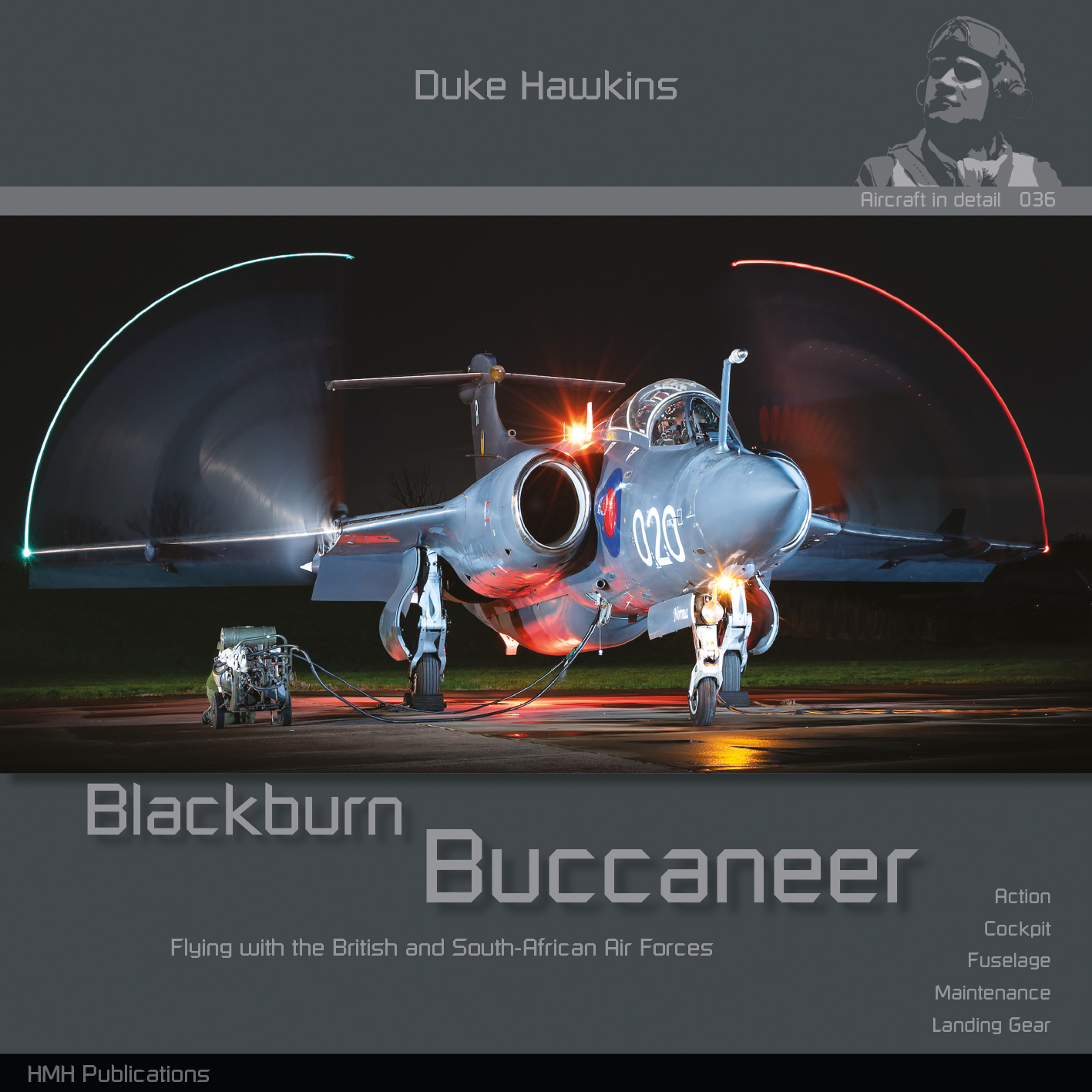 | Duke Hawkins - HMHDH-036 - No Scale | Blackburn Buccaneer The Blackburn Buccaneer is one of those typical British aircraft designs that has proven itself more versatile and effective than originally intended. While it was extremely stable when flying at high speeds and very low level for both the Fleet Air Arm and Royal Air Force, it was near the end of its career that it got into the spotlight it so deserved; during the first Gulf War, the few Blackburn Buccaneers that were deployed became important assets for other aircraft to destroy targets with precision weapons. In this book, we show you a close-up of this magnificent jet. A close-up that was made possible with the help of The Buccaneer Aviation Group. [S.2B S.2C] More | Aircraft books | Catalogue | £26.99 | |
 | HAD Models - HUN72255 - 1:72 | McDonnell F-4J Phantom US NAVAL Air Test Center " The final Countdown" More | Aircraft decals (military) | Limited Availability | £20.99 | |
 | HAD Models - HUN72256 - 1:72 | BACK IN STOCK!!! LTV A-7E Corsair US NAVAL Air Test Center " The final Countdown" More | Aircraft decals (military) | Catalogue | £20.99 | |
 | HAD Models - HUNE721005 - 1:72 | Grumman A-6E/KA-6D Intruder VA-35 The Black Panther "The final Countdown". Aircraft stencilling with sewing patches and Helmet markings More | Aircraft decals (military) | Catalogue | £21.99 | |
 | IsraDecal Studio - IAFB-17 - No Scale | General-Dynamics F-16A/B Netz Israeli Air Force The First Jet Squadron 1979-1986 More | Aircraft books | Catalogue | £25.99 | |
 | IsraDecal Studio - IAFB-30 - No Scale | The One Squadron McDonnell F-4E Phantom 1969-89 Publication #5 of 'Israeli Air Force Mini Photo Album' series. Soft Bound; 64 pages Over 270 photos. Color profiles. More | Aircraft books | Catalogue | £24.99 | |
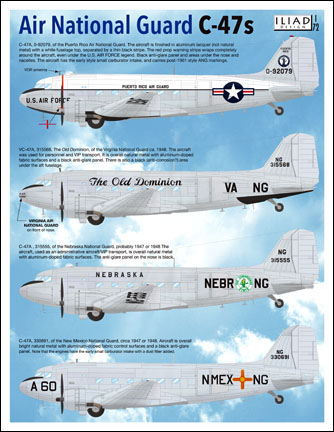 | Iliad Design - ILD72018 - 1:72 | Air National Guard Douglas C-47A Skytrain. Puerto Rico Air Guard 0-92079; 'The Old Dominion' Virginia Air National Guard 1948; Nebraska National Guard NG315555; A60 New Mexico National Guard circa 1947 NG330691; More | Aircraft decals (military) | Catalogue | £13.99 | |
 | Kits-World - KW172098 - 1:72 | Gloster Meteor F.4- EE455, known as 'The Yellow Peril' or 'Forever Amber', flown by Gloster chief test pilot, Eric Greenwood to beat the air speed record, November 1945. Scheme is overall high gloss Trainer Yellow. Note lack of aerial masts and faired over gun ports. Gloster Meteor F.4, Y9'5, operated by No.323 Squadron, Royal Netherlands Air Force, based at Leeuwarden, 1950's. Scheme is overall silver with the nose tip in red. Gloster Meteor F.4, 1406, operated by No.20 Squadron, Royal Egyptian Air Force, based at Almazah 1950. Scheme is overall silver, with black and white identification bands. More | Aircraft decals (military) | Catalogue | £10.20 | |
 | Kits-World - KW172153 - 1:72 | REPUBLIC F105D THUNDERCHIEF 60-0504 MEMPHIS BELLE II 357TH TFS, 355TH TFW RTAB (Royal Thai Air Base) Takhli, Thailand, 1967. The nickname Memphis Belle II refers to the B-17F that carried the same artwork during WWII. The two red stars under the cockpit represent the two MiG kills it claimed during the Southeast Asia War. Pilot: MAJ Buddy Jones. REPUBLIC F105D THUNDERCHIEF 61-0165 MY HONEYPOT VIRGINIA AIR NATIONAL GUARD F105D My Honeypot was the first to reach the 4000 flying hours mark (in February '70) and completed 600 south-east Asia missions in all. More | Aircraft decals (military) | Catalogue | £10.20 | |
 | Linden Hill - LHB-01 - 1:72 | Book 'Airlift to the Top of the World' (book to accompany Shorts Sunderland decals) https://www.lindenhillimports.com/lhi-blog#/ "By 1950 it had been almost forty years since a publicly funded British polar expedition had been attempted. In contrast to the days of Scott and Shackleton, it was now possible to support such a venture with both motor and air transport. The British North Greenland Expedition (BNGE), a combined scientific and military venture to a remote region within 800 miles of the North Pole and headed by a Royal Navy Lieutenant-Commander, would not have been possible without the support of military aviation, mostly in the shape of the Royal Air Force's Coastal and Transport Commands. This book examines the origins of the Expedition and for the first time tells the full story of the role played by the RAF in transporting the BNGE northwards, supplying it, supporting its scientific research work, and bringing it safely home. It is a story that includes both potential and actual calamities and details missions flown by the RAF in some of the world's most extreme climatic conditions." More | Aircraft books | Catalogue | £26.99 | |
 | Linden Hill - LHD72009 - 1:72 | Aero L-39C/L-39ZA of the New Great Game- The Aero L-39 Albatros over Russia, the Caucasus, Central Asia and Beyond (14) White 44, White 59, Both Centre for the Demo of Air Technology, Kubinka AB,2002; Red 122; Blue 04, Both Fighter Pilot Academy,early 1990s; Yellow 11, Chechen Republic 1994; Red 01, 121 Armenian Air Force, 2005; Blue 03, Azerbaijani Air Force 2004; Black 0010 Rep of Afghanistan Air Force 1977; Black 003; Black 005, Afghanistan, 1983; Blue 15, Uzbek Air Force 2005; Red 8703, VPAF, Vietnam, 2003; Black 1709 Ethiopian Air Force, 1980s; White 209, Bulgarian VVS, AB, 2004 More | Aircraft decals (military) | Catalogue | £19.99 | |
 | Linden Hill - LHD72014 - 1:72 | 'Lipetsk Top Guns' - The Aircraft of the Soviet Air Force's elite 4. TsBP PLS (21) Mikoyan MiG-31; Red 37; Sukhoi Su-27SM; Red 02; Sukhoi Su-25T; Red 85; Sukhoi Su-25; Red 73; Mikoyan MiG-29 9-13; Red 29; Red 32; Red 30; Mikoyan MiG-29UB; Red 37; Sukhoi Su-27UB; Red 61; Red 16; Red 17 `Air Force One'; Sukhoi Su-27S; Red 08 `Lipetsk Shark'; Red 01; Sukhoi Su-24MR; Red 52; Sukhoi Su-24M2; Red 44; Plus bonus options for Sukhoi Su-24MR; Mikoyan MiG-29; Mikoyan MiG-31B; Sukhoi Su-27. More | Aircraft decals (military) | Catalogue | £24.99 | |
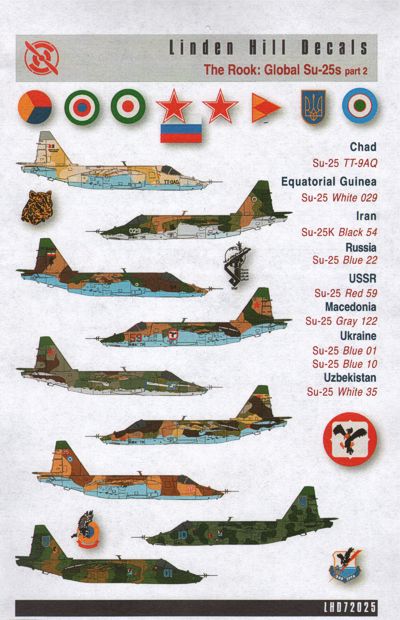 | Linden Hill - LHD72025 - 1:72 | International Sukhoi Su-25/Su-25K The Rook Part 2 (9) Black TT-9AO Chad 2010; White 029 Equatorial Guinea 2009; Red 59 Afghanistan 1986; Grey 122 Macedonia Air Force 2001; Blue 01 and Blue 10 Ukranian AF; White 35 Uzbekistan AF2009; Black 54 Iran 2008; Blue 22 Russia 2005. More | Aircraft decals (military) | Catalogue | £18.99 | |
 | Linden Hill - LHD72026 - 1:72 | International Sukhoi Su-25 The Rook Part 3 (9) Red 18 Armenia 2007; Blue 23 Azerbaijani 2009; Red 59 Gambia 2004; Black 25616 Iraq 201; White FG-501 Congo 2007; Red 02 Ivory Coast Big Shark Mouth 2004; Red 32 Russia small Shark Mouth 2004; Blue 81 Gambia; Yellow 04 Kzakha Air Force 2011; Black 203 Sudan 2009. More | Aircraft decals (military) | Catalogue | £18.99 | |
 | Start - LIF18 - No Scale | Luftwaffe im Focus Edition No 18 - 50 pages, about 65 photos - thereof 10 in colour, 4 colour profiles, 2 maps, Readerforum - Aircraft in Focus: Me-262 'black D' of 2./KG 51 in February 1945 - Photos with a story: Of "Crabs", "Snakes" and "Dodeln" (The story of 3. Staffel JGr.10 in 1945, Part 2) - Tail: Ship killer in the Arctic Sea -Lt. Hennemann 2./KG 26 - Colourphotos: The 1.500 mission of 3.(H)/Aufklarungsgruppe 31 in autumn 1942 near Stalingrad - Scenery: Flooding and mud on Soviet airfields - Alliied fate: Emergency landing in Bad Zwischenahn, kill of a B-17 on 26.11.1943 - Unusual: Bullet damage with date! - Personal Emblem: The "Siegfriedsword" on the Junkers Ju-88 of the Kommodore of KG 3, 1942 - Unknown Emblems: The "Vistula"-Emblem of 7.(H)/32 (Pz) - as well as photos of Wekusta 76, Breguet 521, Close Support aircraft - as well as articles and photos to more topics... More | Aircraft books | Catalogue | £17.80 | |
 | Start - LIF19 - No Scale | Luftwaffe im Focus Edition No 19 - 50 pages, about 67 photos - thereof 8 in colour, 3 colour profiles, 1 coloured map, 1 coloured document, 4 coloured emblems, Readerforum - Yellow or orange-the never-ending discussion: Colour slides provide new insight - Aircraft in Focus: The Junkers Ju-88 Flamethrower Aircraft of I./KG 51 - The Staffel Emblem of 3./JG52: One of the last unknown fighter emblems is identified - The history of the Savoia Staffel - Unusual: The Taxiway Bridge - Tails: Hptm. Hans-Christian Schafer, 4./JG5 - The fate of a close-support pilot on the Somme - as well as articles and photos to more topics... More | Aircraft books | Catalogue | £17.80 | |
 | Start - LIF21 - No Scale | Luftwaffe im Focus Edition No 21 - 50 pages, 64 photos - thereof 11 in colour, 3 colour profiles, 2 coloured emblems, 1 coloured document, Readerforum - Aircraft in Focus: A Great Moritz Emil, but Whose Was It? - Portait: Dr. Ernst Kupfer, StG. 2 - Personal Emblems: Pedro 2 of 9./KG 51 - Color Photos: KG 40 Impressions of the Atlantic Coast - Tails: Lt. Gunther Specht, 3./ZG 26 - Documents: The 3,000th Flight by Wekusta 26 - Unknown Emblems: 2.(H)/10 Stork in Mountain Boots - Fate: Made it! (NAG 4) - as well as articles and photos to more topics... More | Aircraft books | Catalogue | £17.80 | |
 | Start - LIF22 - No Scale | Luftwaffe im Focus Edition No.22 Training aircraft: Dewoitine D.520, JG105, 19423 Fighters: Bf-109G, Stab III./JG11 and 7./JG11, 1943 Heavy fighters: Bf-110C-2, 4./ZG 76, 1940 Personal Emblems: In Action with the 'Red Mill' Tails: An Hs 129 'Can Opener' with an impressive Scoreboard Color photos: Crash in the Forest Aircraft in Focus: The interesting Aircraft Graveyard on the Lyuban Airfield; II. (Schl)/Lehrgeschwader 2 Documents: Invitation to the One-Year Anniversary of 4.(F)/12 Background: Lt. Detlev Rohwer and gis 'Gotz von Berlichingen'Emblem, I./JG3 Equipment: The 'Dobbas I' Transport Device Scenery: An aircraft of the Eagle Geschwader makes a headstand in Gilze-Rijen Seaplanes: An Arado 196 from the 'Prinz Eugen' comes home. More | Aircraft books | Catalogue | £17.80 | |
 | Start - LIF23 - No Scale | Luftwaffe im Focus Edition No.23 - 50 pages, 52 photos - thereof 7 in colour, 2 colour profiles, 1 coloured emblem, 3 coloured maps, Readerforum - Scenery: Hit in the Cockpit! (JG26) - Colour Photos of a Seldom-Seen Kampfgeschwader (I./KG 28) - Aircraft in Focus: An Extraordinary Aircraft from the Defense of the Reich-The Fw-190 of Major Philipp, Geschwaderkommodore of JG1 - Unknown Emblems: 7.(H)/12's "Jaunty Dachshund" - Photos with a Story: Target: Kramators- kaya Tank Works (KG 55-1941) - Unusual: The Camouflaged Tarpaulin - Fate: Shot Down Over the Murmansk Railway-The Fate of a KG 30 Crew in the Summer of 1942 - Documents: II./NJG1's 100th Night Victory - Close-Support Aircraft: Ground Attack Pilot in the Closing Months of the War" Night Close-Support Missions by 2./EJG2 in April-May 1945 - Fighters: Me-262 A-1a of JG7, April 1945 - Bombers: Ar-234 of III/KG 76 - As well as photos Fotos of Ju 290, DFS DFS-230 of St.G. 2, Ju-87 with an impressive snorting rhinoceros-Emblem, colourphotos of the emblem of IV./KG 54 and photos to more topics More | Aircraft books | Catalogue | £17.80 | |
 | Start - LIF25 - No Scale | Luftwaffe im Focus Edition No.25 50 pages, 64 photos - thereof 8 in colour, 2 colour profiles, 2 coloured maps, Readerforum - Close-Support Aircraft: Fw 190 F-8 der II./SG 2, 1945 - Personal Emblems: A Supplement to the Hs 129 with Impressive Scoreboard from Edition 22 - Color Photos: Zellhausen, An Operational Airfield like a Model Diorama - Photos with a Story: 6 May 1941-Air Battle over Calais (JG 51 Encounters No. 74 Squadron RAF) - Technology + Equipment: An Ar 96 with Dive Brakes - Unusal: Manufacturer's Code and Werknummmer on the Nose - Scenery: The 500th Operational Sortie by 4.(H)/12 in Africa - Bomber: He 177 of I./FKG 50 at Brandenburg Briest - Tails: 1944-An Emblem on the Tail of a He 111 of 14.(Eis)/KG 55 - Seaplanes: Friend and Foe, To the Aid in White (Norway) and photos to more topics More | Aircraft books | Catalogue | £17.80 | |
 | Start - LIF27 - No Scale | Luftwaffe im Focus 27 Schulflugzeuge / Training Aircraft D.520, I./JG 107, 1943 é Schulflugzeuge / Training Aircraft Maschinen der Flugzeugfuhrerschule C 7 Aircraft of Flugzeugfuhrerschule C 7 é Fotos mit Geschichte / Photos with a Story Die wahre Geschichte des "Lowen"-Emblems von Hptm. Bar bei der I./JG 77 The Real Story of Hptm. Bar's Lion Emblem, I./JG 77 é Aufklarer / Reconnaissance Aircraft Me-262A-1a/U3, 2./NAGr. 6, 1945 é Personliche Embleme / Personal Emblems "Lili Marleen" geht auf Reisen (Ju 52) "Lili Marleen" Goes on the Road é Maschine im Focus / Aircraft in Focus Die II./StG. 2 im Einsatz vor Stalingrad im Spatsommer 1942 Embleme und Markierungspraktiken an den Stukas der "Bamberger-Reiter"-Gruppe é II./StG. 2 in Action at Stalingrad in Late Summer 1942 Emblems and Marking Practices of the Stukas of the Bamberger-Reiter Gruppe é Dokumente / Documents Nachturlaubskarte Overnight Pass é Schicksale / Fates Woruber meist geschwiegen wird . . . Das Jagdfliegerschicksal von Eichenlaubtrager Hptm. Fritz Geishardt é Something usually kept quiet The Fate of Fighter Pilot and Holder of the Oak Leaves Hptm. Fritz Geishardt é Ungewohnliches / Unusual Treffen fernab der Heimat Reunion far from Home é Unbekannte Embleme / Unknown Emblems Die Eulen-Staffel - 2.(H)/13 - und ihr Emblem The Owl Staffel 2.(H)/13 and Its Emblem é Wasserflugzeuge / Seaplanes Norwegen, gefahrliches Terrain fur Seeflieger Norway, Dangerous Terrain for Seaplanes More | Aircraft books | Catalogue | £17.80 | |
 | Start - LIF28 - No Scale | Luftwaffe im Focus 28 50 pages, 54 photos - thereof 4 in colour, 4 colour profiles, 2 coloured emblems, 3 coloured maps, Readerforum - Bombers: A Second Helping of the Special Weapons on the Ju 88s of KG 51 - Unknown Emblems: The Ominous "Schleppgruppe 4" - Background: The Luftwaffe's X-Ray Stuka; The Luftwaffe Aviation Medicine Service's Investigations during Diving Flight - Fates: Missing During an Ice Reconnaissance Mission over the Gulf of Finland; The fate of a crew from Wekusta 1 - Aircraft in Focus: Hptm. Hans von Hahn and his "Friedrich" with the Ring Camouflage; An unusual camouflage scheme on the aircraft of the Kommandeur of I./JG 3 - Unusual: When It Comes to Camouflage, Anything Goes! - Photos with a Story: New Photos of the Ju 388 - Color Photos: A Different General der Flieger Ritter von Greim - Tails: Fw. Karl Gratz, 8./JG 52 and 11./JG 2 - Personal Emblems: The Much- Photographed Do 17 "Madrid" - Allied Fates Victim of the Raid on Berlin on April 29, 1944 - Scenery: An Aircraft in the Middle of Town! - As well as photos of Do 217 of KG 40, Bf-109, Messerschmitt Bf-110nightfighter and seaplanes and photos to more topics ... More | Aircraft books | Catalogue | £17.80 | |
 | Start - LIF29 - No Scale | Luftwaffe im Focus 29 54 pages, 55 photos - thereof 20 in colour, 3 colour profiles, 1 coloured emblems, 1 cloured cocument, 6 coloured maps, reader's forum - Fighters: When the Fw-190 D-9 Came to the Front - Background: Operations on the Ta 152 by the Geschwaderstab and the III. Gruppe of JG 301 ��½" - Facts and Fiction Fates: Shot Down during a Mission over Silesia The fate of a pilot of 10./JG 77 in March 1945 - Close-Support Aircraft: 10.(Pz)/SG 9 ��½" Anti-Tank Operations until the Final Hour - Reconnaissane Aircraft: Necessity is the Mother of Invention! The Bf-109G-12 in Frontline Service with NAGr. 3 Color Photos: New ��½" Old - Colour Photos of Mistel Aircraft - Scenery: The End of the Lockheed F-5E of the "Circus Rosarius" - Nightfighters: Crash on the Way to the Frontline Unit - Portrait: Oberleutnant Karl-Heinz Wilke, 2./NAGr. 4 - Documents: A Previously Unknown Close-Support Flier with 600 Combat Sorties - Fighters: Rare Photos of 7./JG 3 Taken in April 1945 - Unusual: The Paper Drop Tanks Carried by American Fighters As well as photos of Me 410 of ZG 26 with BK 5 and Fi 156 in Allied Services More | Aircraft books | Catalogue | £17.80 | |
 | Start - LIF30 - No Scale | Luftwaffe im Focus Edition No 30 50 pages, 60 photos - tehreof 7 in colour, 1 colour profil, 1 coloured emblem, 3 coloured document, 5 coloured maps, reader's forum Fighters: Look What Turned Up Colour Photos of the Aircraft of Hptm. Bar, Kommandeur of I./JG 77 Photos with a story: Kurierstaffel (trop) Afrika The Unit with Many Names Scenery: Three Days Confined to Barracks for a "Flying Obscenity" Awards: The Honour Goblet for Distinguished Achievement in the Air War Reconnaissance Aircraft: Hit by Flak in the Area North of Rzhev! Fortunate return by a 4.(F)/14 crew in January 1942 Documents: The Arab Identity Card of the German Africa Corps Heavy Fighters: Me 410 Production at Messerschmitt in Augsburg Color Photos: The Red Devil That Suddenly Disappeared (1./KG 76) Photos with a story: Hit by Flak Return Flight with No Rudder! Happy Ending to a Dramatic Mission by Nahaufklarungsgruppe 4 Tails: Einsatzbilanz einer Do 217 des KG 40 Heavy Fighters: Derna Base of Operations for the 9. Staffel of ZG 26 in North Africa Unusual: A Rare Boundary Stone as a Victory Marker (I./ZG 52) Seaplanes: Seenotstaffel 8 in the Black Sea More | Aircraft books | Catalogue | £19.60 | |
 | Start - LIF31 - No Scale | Luftwaffe im Focus Edition No 31. 50 pages, 56 photos - thereof 3 in colour, 6 colour graphics, 4 coloured emblems, 4 coloured documents, 3 coloured maps, reader's forum Aircraft in Focus: An Me 410 of ZG 26 with Wave Mirror Camouflage Unknown Emblems: It Really Did Exist " Luftgaukommando Moskau Scenery: First Photos of the Ju 252 of "Kommando Gotz" (1944) Background: The Operational Flying Clasp and Staffel Markings of III./KG 1 " 1940-1942 Unusual: The Ju 52 for Night Operations! Photos with a Story: The First Fallen of "Kommando Nowotny" Last Photos of Major Walter Nowotny Color Photos: Wave Mirror Camouflage on a He 111 of KG 27 Scenery: Spa Time" Before a Mission over England (KGr. 606) Personal Emblems: Only the "Finest" For the Enemy! (KG 26) Tails: The Tail of Priller's Bf-109, For Once in Its True Colours (JG 26) Reconnaissance Aircraft: What Is That? Unidentified Equipment under the Wing of a Bf 110 As well as additional informations about the articels: "II./StG. 2 in Action at Stalingrad in Late Summer 1942" (LIF 27) and "Kurierstaffel (trop) Afrika " The Unit with many Names" (LIF 30) and photos of Messerschmitt Bf-109and Fw 58. More | Aircraft books | Catalogue | £19.60 | |
 | Start - LIFSPEZ04 - None | Luftwaffe im Focus Spezial No 4 58 pages, 88 photos - thereof 6 in colour, Colourprofil, 4 coloured maps - The English Channel " Feared by German Fighter Pilots (main article main article covering various topics) - They Failed to Return " And Became Prisoners of War - Aerial Combat over the Thames Estuary " The Staffelkapitan of 1./ZG 26 Is Forced to Come Down "In the Drink" - Photos with a Story: The He 111 and Ju 88 Balloon-Cable Fender Aircraft in Action over England Correcting a long-standing factual distortion - Aircraft in Focus: The "Old Channel Kites" " Pushed Off On the Replacement Training Staffeln - Scenery: He 111 of KG 100 " Emergency Landing and Subsequent Take-Off - Fates: 4.(F)/14 " "5F + MM", An Unlucky Aircraft Code - Fates: Rammed Preparing for Take-off " Fate of a Staffelkapitan - Photos with a story: The Speculation about Luftflotte 2's Command Post Is Over! First private photos of the command post Casar II at Sangatte More | Aircraft books | Catalogue | £27.80 | |
 | MA Publications - MAE01 - No Scale | Building the Focke-Wulf Fw-190. The Focke-Wulf Fw-190 is generally viewed as a far superior fighter than the much more famous Messerschmitt Bf-109 - and for good reason. This highly adaptable aircraft served in an enormous variety of roles, including fighter, night-fighter, fighter-bomber/ ground attack, reconnaissance and torpedo bomber throughout much of the Second World War. It initially appeared as an interim fighter designed to complement the Bf-109 and the first production model, the Fw-190A-1 was deployed on occupation duties in France in the summer of 1941, from where it could threaten the British Isles. The sheer number and variety of model kits of the Fw-190 makes this one of the most popular aircraft in various scales. This new book in the Model Aircraft Extra series from MA Publications brings you a guide to modelling some of the variants of this aircraft using some of the best model kits currently available, and some of the best model makers around. 13 build projects will be included, in a 'how-to' format, and herald the start of a fantastic modelling guide series from MA Publications, the new name in scale modelling. More | Aircraft books | Limited Availability | £14.99 | |
 | MA Publications - MAE02 - No Scale | Building the Messerchmitt Bf-109. The iconic Messerschmitt Bf-109 was the backbone of the Luftwaffe's fighter force during World War II. The aircraft first saw operational service in 1937 during the Spanish Civil War and was still in service at the dawn of the jet age at the end of the War in 1945. The Bf-109 is the most produced fighter aircraft in history, with a total of 33,984 airframes produced from 1936 up to April 1945. It was also one of the most advanced fighters of the era, including such features as all-metal monocoque construction, a closed canopy, and retractable landing gear, and was powered by a liquid-cooled, inverted-V12 engine. It was conceived as an interceptor, and later models were developed to fulfil multiple tasks, serving as bomber escort, fighter- bomber, day-night all-weather fighter, ground-attack aircraft, and as reconnaissance aircraft. It was supplied to and operated by several countries during World War II and served with a number of air arms for many years after the war. The Bf-109 was flown by the three top-scoring German fighter aces of World War II, who claimed 928 victories among them. The highest scoring fighter ace of all time, Erich Hartmann, flew the Bf-109 and was credited with 352 aerial victories. The aircraft was also flown by Hans-Joachim Marseille, the highest-scoring German ace in the North African Campaign, who achieved 158 aerial victories. It was also flown by several other aces from Germany's allies, notably the Finn Ilmari Juutilainen, the highest scoring non-German ace on the type. This second book in the MA Publications 'Model Aircraft Extra' series brings you a guide to building some of the variants of the Bf-109. In all some 14 build projects are included in a 'how-to' format using kits in popular scales from some of the best model makers around. More | Aircraft books | Limited Availability | £14.99 | |
 | MA Publications - MAE04 - No Scale | Model Aircraft Extra 4. Building the North-American P-51D Mustang. WAS £14.99. TEMPORARILY SAVE 1/3RD!!! Marrying an American dive-bomber design and a British engine, the North-American P-51 Mustang became one of the greatest fighters of World War II. The iconic P-51 was a World War II single-seat fighter and fighter-bomber that also saw service in the Korean War and other conflicts. The Mustang was designed in 1940 by North-American Aviation (NAA) in response to a requirement of the British Purchasing Commission. The Purchasing Commission approached North-American Aviation to build Curtiss P-40 fighters under license for the Royal Air Force (RAF). Rather than build an old design from another company, North-American Aviation proposed the design and production of a more modern fighter. The prototype NA-73X airframe was rolled out on 9 September 1940, 102 days after the contract was signed, and first flew on 26 October. The Mustang was designed to use the Allison V-1710 engine, which had limited high-altitude performance in its earlier variants. The aircraft was first flown operationally by the RAF as a tactical-reconnaissance aircraft and fighter-bomber (Mustang Mk I). Replacing the Allison with a Rolls-Royce Merlin resulted in the P-51B/P-51C (Mustang Mk III) model and transformed the aircraft's performance at altitudes above 15,000ft, without sacrificing range, allowing it to compete with the Luftwaffe's fighters. The definitive version, the P-51D, was powered by the Packard V-1650-7, a license-built version of the two-speed two-stage-supercharged Merlin 66 and was armed with six .50 calibre M2/AN Browning machine guns. From late 1943, P-51Bs and P-51Cs (supplemented by P-51Ds from mid-1944) were used by the USAAF's Eighth Air Force to escort bombers in raids over Germany, while the RAF's Second Tactical Air Force and the USAAF's Ninth Air Force used the Merlin-powered Mustangs as fighter-bombers, roles in which the Mustang helped ensure Allied air superiority in 1944. The P-51 was also used by Allied air forces in the North African, Mediterranean, Italian and Pacific theatres, and during World War II, Mustang pilots claimed to have destroyed some 4,950-enemy aircraft. At the start of the Korean War, the Mustang, by then redesignated F-51, was the main fighter of the United Nations until jet fighters, including North-American's F-86, took over this role, the Mustang then became a specialised fighter-bomber. Despite the advent of jet fighters, the Mustang remained in service with some air forces until the early 1980s. In Model Aircraft Extra #4, some 15 P-51 Mustang build projects will be included, in a 'how-to' format, and continue this fantastic series modelling guides from MA Publications, the new name in scale modelling. More | Aircraft books | Special Offers | £9.99 | |
 | MA Publications - MAE05 - No Scale | Building The Harrier. Model Aircraft Extra #5 Building the Harrier The iconic Hawker-Siddeley Harrier was the first of the so- called Harrier 'Jump Jet' series. It was developed in the 1960s as the first operational close-support and reconnaissance fighter aircraft with vertical/short take-off and landing (V/STOL) capabilities, and the only truly successful V/STOL design of the many that arose in that era, and at its heart was the innovative Rolls-Royce Pegasus engine with its thrust vectoring nozzles. The Harrier was developed directly from the Hawker Siddeley Kestrel prototype aircraft, following the cancellation of a more advanced supersonic Hawker Siddeley P.1154. Originally said to be 'unable to carry more than a matchbox over a football field' the Harrier matured into one of the most potent warplanes of its generation. The RAF ordered the Harrier GR.1 and GR.3 variants in the late 1960s, as well as T.4 trainers versions, and it was also exported to the United States as the AV-8A and TAV-8A, for use by the US Marine Corps as well as the Spanish Navy in the 1970s. Spain sold seven single-seat and two twin-seat Harriers to Thailand in 1998. The Sea Harrier FRS.1, which shot to fame during the Falklands War, was designed to fill the strike, reconnaissance and fighter roles for the Royal Navy, and the innovative use of a 'ski jump' allowed the aircraft to take-off from a short flight deck with a heavier loadout than otherwise possible. After the Falklands War, the Sea Harrier was upgraded to the F/A2 standard and featured the Blue Vixen radar and carried the AIM-120 AMRAAM missile. The Indian Navy was the only other user of the Sea Harrier aboard their aircraft carriers INS Vikrant and INS Viraat. The BAe/McDonnell Douglas Harrier II was a second-generation of V/STOL aircraft designed for use by the US Marne Corps, RAF and the Royal Navy and continues in service with the USMC as the McDonnell-Douglas AV-8B and TA-V8B trainer and is also in service with the Spanish and Italian Navies. For the RAF, initial deliveries of the Harrier II were designated as Harrier GR.5 and subsequent upgraded airframes were redesignated accordingly as GR.7 and GR.9. The RAF Harriers saw action over Bosnia and Afghanistan before being retired in 2011. Most of the original US Marine Corps McDonnell-Douglas AV-8B 'day attack' aircraft were upgraded to either the FLIR equipped 'Night Attack Harrier' or the more capable radar equipped 'Harrier II Plus' and have participated in support of Operation 'Southern Watch', Operation 'Allied Force'. USMC McDonnell-Douglas AV-8Bs also took part in Operation 'Enduring Freedom' in Afghanistan from 2001, and the aircraft also participated in the Iraq War in 2003, acting primarily in support of USMC ground units, and in 2011, they flew in support of Operation 'Odyssey Dawn', enforcing the UN no-fly zone over Libya. This fourth book in the MA Extra Series contains fourteen model builds, colour profiles and scale plans, and will be a must for the Harrier aficionado! More | Aircraft books | Limited Availability | £14.99 | |
 | MA Publications - MAE06 - No Scale | Building the Supermarine Spitfire The iconic Supermarine Spitfire, the most strategically important British single-seat fighter of World War II. The Spitfire, renowned for winning victory laurels in the Battle of Britain along with the Hawker Hurricane, served in every theatre of the War and was produced in more variants than any other British aircraft. The Spitfire was designed by Reginald Mitchell of Supermarine Ltd., in response to a 1934 Air Ministry specification calling for a high-performance fighter with an armament of eight wing-mounted 0.303-inch machine guns. The airplane was a direct descendant of a series of floatplanes designed by Mitchell to compete for the coveted Schneider Trophy in the 1920s. One of these racers, the S.6, set a world speed record of 357 miles per hour in 1929. Designed around a 1,000-horsepower, 12-cylinder, liquid-cooled Rolls-Royce PV-12 engine (later dubbed the Merlin), the Spitfire first flew in March 1935. It had superb performance and flight characteristics, and deliveries to operational Royal Air Force (RAF) squadrons commenced in the summer of 1938. A more radical design than the Hurricane, the Spitfire had a stressed-skin aluminum structure and a graceful elliptical wing with a thin airfoil that, in combination with the Merlin's efficient two-stage supercharger, gave it exceptional performance at high altitudes. The version of the Spitfire that fought in the Battle of Britain was powered by a Merlin engine. Faster than its formidable German opponent the Bf-109 at altitudes above 15,000 feet and just as manoeuvrable, Spitfires were sent by preference to engage German fighters while the slower Hurricanes went for the bombers. More Hurricanes than Spitfires served in the Battle of Britain, and they were credited with more 'kills,' but it can be argued that the Spitfire's superior high-altitude performance provided the margin of victory. Meanwhile, Supermarine was developing more-capable versions of the Spitfire driven by progressively more-powerful Merlin's. The eight 0.303-inch machine guns gave way to four 0.8-inch automatic cannons, and by war's end the Spitfire had been produced in more than 20 fighter versions alone, powered by Merlin's of up to 1,760 horsepower. Though outperformed by the German Fw-190 on that aircraft's introduction in 1941, the Spitfire restored parity the following year and eventually regained the advantage. It remained a first-line air-to-air fighter throughout the war. Spitfires were used in the defence of Malta, in North Africa and Italy, and, fitted with tail hooks and strengthened tail sections, as Seafires from Royal Navy aircraft carriers from June 1942. Spitfires helped to provide air superiority over the Sicily, Italy, and Normandy beachheads and served in the Far East from the spring of 1943. Fighter-bomber versions could carry a 250 or 500lb bomb beneath the fuselage and a 250-pound bomb under each win One of the Spitfire's most important contributions to Allied victory was as a photo-reconnaissance aircraft from early 1941. Superior high-altitude performance rendered it all but immune from interception, and the fuel tanks that replaced wing-mounted machine guns and ammunition bays gave it sufficient range to probe western Germany from British bases. n late 1943 Spitfires powered by Rolls-Royce Griffon engines developing as much as 2,050 horsepower began entering service. Capable of top speeds of 440 miles per hour and ceilings of 40,000 feet, these were used to shoot down V-1 'buzz bombs.' During World War II, Spitfires were exported in small numbers to Portugal, Turkey, and the Soviet Union, and they were flown by the U.S. Army Air Forces in Europe. When production ceased in 1947, 20,334 Spitfires of all versions had been produced, 2,053 of them Griffon-powered versions. Fighter versions of the Spitfire were withdrawn from RAF service during the early 1950s, while photo-reconnaissance Spitfires continued in service until 1954. In Model Aircraft 'Extra Special' #6, the biggest book of this series some 22`Spitfire build projects will be included, in a 'how-to' format, and continue this fantastic series modelling guides from MA Publications, the new name in scale modelling. More | Aircraft books | Limited Availability | £14.99 | |
 | MA Publications - MAE07 - No Scale | Building the Republic P-47D Thunderbolt. The Republic P-47 Thunderbolt Big, powerful, and truly a juggernaut of an aircraft, resulting in its appropriate nickname 'Jug', the Republic P-47 Thunderbolt was one of the really great warplanes of its generation. Alongside the superlative North-American P-51 Mustang and the twin-engined Lockheed P-38 Lightning, it was one of the three principal fighter types which the US Army Air Forces (USAAF) successfully operated in the later stages of World War Two. The initial production version was the P-47B, and examples of this type started to reach the USAAF's 56th Fighter Group in June 1942. The first really combat-ready model was the refined and slightly longer P-47C, which entered service later in 1942. Like all front-line P-47 versions it packed a formidable punch of four 0.5in M2 Browning machine guns in each wing, although early models did not carry the wing pylons that became so important later in the Thunderbolt's combat career. The first P-47C examples to reach Britain for the US Eighth Army Air Force did so in December 1942, followed by what became the main combat model of the Thunderbolt, the P-47D, in April 1943. Weighing in at some 15,000lb (6,804kg) fully loaded and powered by the R-2800-59 Double Wasp of 2,000hp, the P-47D was a big, powerful beast. Water injection introduced for some versions of the R-2800 would see even greater power on demand when needed in aerial combat. All of these early Thunderbolts had the 'razorback' high line rear fuselage pioneered with the P-35 and P-43, with a rearwards-sliding heavily framed cockpit canopy. Although the USAAF at first saw the Thunderbolt as a high altitude interceptor, its main initial role very soon became that of daylight bomber escort with the England- based Eighth Air Force, which was in great need of escort fighters for its B-17 Flying Fortresses and B-24 Liberators that were increasingly facing stiff Luftwaffe fighter opposition. he Thunderbolt helped to turn the tide for the US daylight bombing offensive during 1943 and early 1944, with a number of P-47 pilots gaining impressive scores in air-to-air combat against Luftwaffe fighters. Eventually the appearance of the Merlin-engined P-51B Mustang and later versions of the superb Mustang long-range fighter resulted in the Eighth Air Force almost completely re-equipping its fighter groups with the P-51, but the Eighth's 56th Fighter Group continued to fly the Thunderbolt right up to the end of the war in Europe in May 1945. The Eighth Air Force also pioneered the P-47 for air-to-ground operations as a part of its policy of taking the fight to the Luftwaffe, and additional to this the Thunderbolt eventually equipped several fighter groups specifically for fighter-bomber operations within the tactical England-based US Ninth Air Force. The P-47 proved to be a formidable fighter-bomber due to its impressive eight-gun armament, bomb load and ability to survive enemy fire. The underwing pylons that proved so useful for long-range fuel tanks were equally at home carrying a 500lb (227kg) bomb (one under each wing), and the Ninth Air Force in particular used this capability to devastating effect against German tactical targets before and after D-Day. 'Razorback' Thunderbolts additionally equipped USAAF units in Italy, the Pacific (including exceptional use by the Fifth Air Force), and the China-Burma-India theatre (CBI). Continuing development of the P-47 design led to the adoption later in P-47D manufacture of a cut- down rear fuselage spine and all-round vision 'bubbletop' canopy. This resulted in a further series of later Thunderbolt versions with even greater range and capabilities, but many 'razorback' P-47s nevertheless continued in service right to the war's end " some pilots in fact preferring the 'razorback' to the later models particularly for their better directional stability. Other important users of the Thunderbolt in World War Two included the Soviet Union, the RAF and the Free French. This seventh book in the highly successful MA Extra Series contains fourteen showcase and step by step model builds and will be a must for any P-47 aficionado! More | Aircraft books | Limited Availability | £14.99 | |
 | Max - MAX7226 - 1:72 | Irish Civil Classics Pt. 1 features the Aer Lingus Douglas DC-3/C-47 and Bristol Freighter from the early 1950s in 1/72 scale. This limited edition silk screen printed decal sheet contains enough markings for one Bristol Freigther and one DC-3 or C-47 with or without the cargo door. markings are also provided for inside the C-47 doors should you wish to model them open. The decals are suitable for any C-47 kit from Airfix, Italeri or others. The Bristol Freighter markings are suitable for the Fly Models Bristol Freighter Mk31 kit. More | Aircraft decals (civil) | Catalogue | £15.99 | |
 | Matterhorn Circle - MHN72017 - 1:72 | Pilatus PC-21 Birth' oft he PC-21 started in November 1997 when Pilatus modified a PC-7 with new wings and a Pratt and Whitney Canada PT6 turbine. Based on those trials, actual development started early 1999 metal was cut in 2001 and the Rollout was celebrated in May 2002. Type certification was reached by the end of 2004. Soon after, Pilatus started serial production despite the fact, that they had no orders in their books. The PC-21 was developed with characteristics of a Jet Trainer in mind. The PT6A-68B turbine is throttled electronically to simulate a jet engine the propeller torque is automatically compensated over the rudder. The roll rate of the aircraft is enhanced to 2000/s with additional spoilers on top of the wings. The airfoil is build for speed the PC-21 reaches a top of Mach 0.72 but still lacking the power of a real jet engine. Hart of the system are the flexible avionics depending on the Jet the customer has in mind. The cockpit is equipped with two Martin-Baker CH16C ejection seats. The wing is prepared with 5 hard points 2 wet for long-range fuel tanks. Thus the PC-21 carries no weapons they are simply simulated electronically for the training of the pilot. The big breakthrough happened in November 2006 when Singapore placed an order for 19 aircraft. The Swiss Air Force followed with an order for 6 JEPAS (Jetpiloten Ausbildungssystem) PC-21. A-101 to A-106 were delivered in 2008 to the Swiss Air Force. Already in the middle of this year, the first pilot training course on the PC-21 with direct transition onto the F-18D Hornet started, avoiding the step via the F-5F Tiger. Training cost for new F-18 pilots could be reduced by 50%. However it was soon realized, that the demand of 6 to 8 new pilots per year could not be satisfied with 6 training aircraft only. A second order of two additional aircraft was placed in 2010 and the handover to the air force in 2012 increased the PC-21 fleet to 8 aircraft. While the first 6 PC-21 carried a striking red and white scheme, visibility of the aircraft was deemed unsatisfactory - the follow up aircraft were painted all red with white trim. In time, all six PC-21 were painted in the same manner. A further exterior modification are the black leading edges of the wings and stabilizers. The landing gear, wheel wells and inside of the gear doors are painted white, as well as all Antennae. The cockpit canopy has a black trim. As a general note SAF PC-21 are glossy painted and kept in impeccable clean condition. By the end of 2017, Pilatus has received orders for 209 PC-21. Next to Singapore and Switzerland, the following countries have ordered the type: Australia, France, Jordan, Qatar, Saudi Arabia, United Arab Emirates and the United Kingdom. As always I like to stress, that the decals should be applied to glossy surfaces. They react well to Micro Sol and Micro Set if you are using a stronger decal softener, please make your own tests. This decal sheet has been designed with a 1/48 scale version as an option. This said in 1/72 scale some markings are ways too small to be readable when screen-printed. On the real aircraft, the maintenance markings are subdued and barely recognizable from a short distance. However I feel to give you the most data as possible on this decal sheet and it is up to your decision, to make use of them, or not. The Whites have been double printed with the intention of a high opacity on the red surface. Before applying the decal for the canopy detonation cord, please dip the canopy into 'Future' as the decal will not stick on the bare plastic for a long time. More | Aircraft decals (military) | Catalogue | £14.99 | |
 | Matterhorn Circle - MHN72018 - 1:72 | Northrop F-5E/F Tiger Peace Alps Part Two) 40 years ago the F-5E/F Tiger was introduced into the inventory of the Swiss Air Force. The Tiger was the last 'inexpensive' mass fighter aircraft for the Swiss Airforce, 98 single-seaters and 12 two-seaters were purchased. It was also the last Jet Fighter that was to be crewed by the militia pilot system; men who followed normal professions but also were professional Fighter Pilots. The end of the 'Flying Baker' has been proclaimed for many years. The fleet reduction started already in 2002 when the U.S. Navy became interested in the F-5 to beef up their 'Aggressor Squadrons'. In the media, the Tiger got called old, night-blind and lame winged. A replacement was required, found and tested, the Saab 39 Gripen came out superior to the Dassault Rafale and Eurofighter. Not everybody liked this and in 2014, three million aviation experts voted not to purchase any new aircraft at all. Peace Alps Part Two is the story of an aircraft that has reached 40 years of service in Switzerland against all odds and continues flying. This set offers decals for the very first aircraft up to some retirement schemes of today, but is not covering the end, as the final pages still need to be written. Tigers delivered in the original first batch (J-3001 J-3066 and J-3201 J-3206) did not have the extended Leading Edge Wing Extensions (LERX) or the aerodynamically more streamlined shark shaped radar nose cones. However the second batch (J-3067 J-3098 & J-3207 3212) delivered from 1982 onwards, were built from new with the LERX and the improved nose cone. The prominent VHF antenna was installed behind the cockpit. These modifications were also retrospectively introduced to the earlier Tiger fleet. As has become an established tradition, the last aircraft off the production line received special nose art and J-3066 became Peace Alps I and featured a flying dove while J-3098 had Peace Alps II titles above a flying witch (both aircraft are featured on the 'Peace Alps Part Two' decal sheet). There is hardly any F-5 in Swiss service that did not receive a squadron badge at some time during its service life. Since the aircraft are not assigned to any specific squadron, some aircraft have more than one squadron badge applied or may have had a mix of various badges at different times. Tiger airplanes also participated in training missions and competitions abroad. Sardinia (SAKA) or Waddington (NORKA) in the United Kingdom created new badges. It is imperative to check photo references to get a picture of the exact look of a particular aircraft at any given time. The paint scheme applied was similar to the USAF McDonnell Eagles's of the time. The original colors are F9453 Medium Grey and F9452 Light Grey, produced by the company Walter Mader AG in Switzerland. The closest equivalent is a mix of FS 35237 Grey Blue and FS 36622 Grey in parts 33/67 and 50/50 respectively. With the introduction of the F/A-18 Hornet in 1998, things became easier and the colors were harmonized with FS 36320 Dark Ghost Grey and FS 36375 Light Ghost Grey. This is a matter of evolution, some aircraft were completely repainted, some merely received only a partial replacement while others simply received a touch up, thus leaving a 4 color mottled effect. While similar, the new Ghost Grays are a shade darker than the original colors; a very pleasing challenge to the modeler. In 2002, the U.S. Navy purchased 32 surplus F-5Es from the Swiss Air Force to strengthen their 'Aggressor Squadrons'. Later, a similar deal for an additional 12 F-5E was finalized. Renamed as 'F-5N' , these Tigers now serve with VFC-13, VMFT-401 and also VFC-111 'Sundowners' in Florida, a suitable retirement home for ageing airplanes! Research for this project was extremely interesting and creating the artwork for the decals placed a challenge. I'm aware, that I got carried away. This presents my biggest decal project and while preparing these instructions, I have not seen the finished product myself. I do know, that some registration numbers are missing but they are easy made up with spare numbers. This said with this sheet you will be able to create almost any Swiss F-5 Tiger at some point in time. Extra squadron badges are provided. There is simply not enough space on the instruction sheet for the whole fleet. More | Aircraft decals (military) | Catalogue | £19.99 | |
 | Mark I Guide - MKD48010 - 1:48 | Messerschmitt Me-210/Messerschmitt Me-410B-2/U4 colours and markings. Designed in accordance with the 'Zerstorer' (heavy fighter-bomber) concept just prior WWII, the Me 210 was, however, a failure in terms of flying characteristics. Following extensive modifications, its successor, the Me 410 Hornisse (Hornet), was produced in substantial numbers and many variants and saw operational service in Italy and North Africa, and over Germany and Central Europe. The improved Me 210 was also licence-built in Hungary. The publication has 28 pages, including a total of 49 overall and detailed photographs, 12 pages with colour camouflage schemes and their description. Text in English. A comprehensive decal sheet is added for modellers' convenience. Following aircraft are depicted on each decal sheet: Luftwaffe (7x), Royal Hungarian Air Force (1x), Royal Air Force (2x), Soviet Air Force (1x) and Imperial Japanese Army Air Force (1x). More | Aircraft books with decals | Catalogue | £19.50 | |
 | Mark I Guide - MKD72010 - 1:72 | Messerschmitt Me-210/Me-410B-2/U4/Me-410A-1/U-2 & U4 colours and markings. Designed in accordance with the 'Zerstorer' (heavy fighter-bomber) concept just prior WWII, the Me 210 was, however, a failure in terms of flying characteristics. Following extensive modifications, its successor, the Me 410 Hornisse (Hornet), was produced in substantial numbers and many variants and saw operational service in Italy and North Africa, and over Germany and Central Europe. The improved Me 210 was also licence-built in Hungary. The publication has 28 pages, including a total of 49 overall and detailed photographs, 12 pages with colour camouflage schemes and their description. Text in English. A comprehensive decal sheet is added for modellers' convenience. Following aircraft are depicted on each decal sheet: Luftwaffe (7x), Royal Hungarian Air Force (1x), Royal Air Force (2x), Soviet Air Force (1x) and Imperial Japanese Army Air Force (1x). Messerschmitt Me-410 Hornisse More | Aircraft books with decals | Catalogue | £19.99 | |
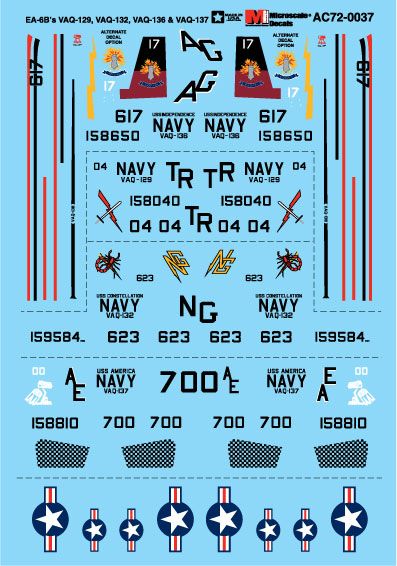 | Microscale - MS72037 - 1:72 | Grumman EA-6B Prowlers. The EA-6B Prowler is a twin-engine, mid-wing electronic warfare aircraft derived from the A-6 Intruder airframe We have created a decal sheet that contains four different configurations for you to model; VAQ-136 "Gauntlets", VAQ-129 "Viking", VAQ-132 "Scorpions" and the VAQ-137 "World Famous Rooks". The Prowler has been in service with the U.S. Armed Forces since 1971. It has carried out numerous missions for jamming enemy radar systems, and in gathering radio intelligence on those and other enemy air defense systems. From the 1998 retirement of the United States Air Force EF-111 Raven electronic warfare aircraft, the EA-6B was the only dedicated electronic warfare plane available for missions by the United States Navy, the United States Marine Corps, and the United States Air Force until the fielding of the Navy's EA-18G Growler in 2009 - 1/72nd Scale Aircraft More | Aircraft decals (military) | Catalogue | £8.50 | |
 | Microscale - MS72908 - 1:72 | WWI German Naval Lozenge Pattern. (FULL SHEET) 6' X 8.65' .. 6 Degree Skewed Pattern Used From March 1917 To March 1918 On All WWI German Naval Aircraft Such As The Albatros W4, Hansa-Brandenburg W29, W12, W20, All Dorniers More | Aircraft decals (military) | Catalogue | £7.99 | |
 | Microscale - MS72909 - 1:72 | WWI German Naval Lozenge Pattern. (FULL SHEET) 6' X 8.65' .. 6 Degree Skewed Pattern Used From March 1917 To March 1918 On All WWI German Naval Aircraft Such As The Albatros W4, Hansa-Brandenburg W29, W12, W20, All Dorniers More | Aircraft decals (military) | Catalogue | £7.99 | |
 | Naval Fighters - NF100 - No Scale | "BLUE GOOSE" COMMAND AIRCRAFT of the USN, USMC and USCG 1911 to 1961 BY: William A. Riley and Thomas E. Doll 128-pages, 15-color illustrations, 13-color photos, 435-B&W photos, and 9-B&W illustrations. This book covers US Naval Aviation from its beginnings in 1911 until 1961 through the interesting and some times colorful "Blue Goose" or Command Aircraft. "Blue Goose" refers to a color scheme that developed for these aircraft in the 1930s. Command Planes were aircraft that were used by the Secretary of the Navy, Assistant Secretary of the Navy, Secretary of the Treasury, Assistant Secretary of the Treasury, Admirals and Generals of the Navy and Marines, and Captains and Commanders in command of naval installations, ships, squadrons, and air groups/air wings. Many were prototypes and one off civilian and military types converted for such use. The book also provides an overview of US operations in WWII and Korea. More | Aircraft books | Limited Availability | £29.99 | |
 | Naval Fighters - NF102 - No Scale | Grumman S-2F/S-2 Tracker and WF-2/E-1B Tracer Part Two. 248-pages, 608 B&W photos, 16 color photos, 201 squadron and station patches. The book covers the operational history of the aircraft in squadron service including the reserves and training squadrons and as a squadron utility and command aircraft at Naval Air Stations and facilities. It is authored by Douglas Siegfried, Tailhook Association Archivist and former S-2 pilot, and Steve Ginter. More | Aircraft books | Catalogue | £43.99 | |
 | Naval Fighters - NF103 - No Scale | Sikorsky S-43/JRS-1 Amphibian By Steve Ginter 100-pages perfect bound 3 color and 232 b&w photos, 8 drawings. 53 S-43/JRS-1 "Baby Clippers" were produced (31 civil, 15 Navy, 2 Marine, and 5 USAAC). The book covers all users including civilian and post war users. 10 of the Navy's JRS-1s were at Pearl Harbor on December 7th, all survived the attack and one, BuNo 1063, is undergoing restoration at the Smithsonian today. Two civil S-43s have also survived, one originally owned by Howard Hughes and one at the Pima Air and Space Museum (painted as a Marine JRS-1). More | Aircraft books | Catalogue | £24.99 | |
 | Naval Fighters - NF104 - No Scale | Brewster F2A Buffalo, Richard S. Dann; Ginter Publishing, Simi Valley, CA, 2017; softcover, 176 pages, 391 photos, 22 illustrations. This comprehensive monograph covers the entire history of Brewster's much maligned Buffalo fighter aircraft. The book starts out with the background of the Brewster Aeronautical Corporation and the events that led to the selection of the F2A as the Navy's first monoplane fighter. Following this, each variant of the aircraft is covered in detail including all three major variants purchased by the U.S. Navy as well as the versions purchased by Belgium, Finland, Great Britain, and the Netherlands. Indivdual squadron histories are also included as they relate to the F2A. Many interviews are included with pilots who flew the Buffalo, some with glowing comments on its performance, while others cast a less than stellar light on the Brewster. It is up to the reader to draw his own conclusions as to where the F2A sits in the history of modern aerial warfare. It is interesting to note that the Brewster 239, as used by the Finnish Air Force during the 1939-1945 period achieved the highest kill ratio of any fighter plane of the war with an impressive 26-1 score. Finland produced many Aces with the Buffalo, including the all-time high scoring Buffalo Ace, Hans Wind with 39 aerial kills, and followed closely by Ilmari Juutilainen with 34. The book is lavishly illustrated with over 300 photos, many of which have never been published. 22 illustrations are also included. This is the ultimate history of the Brewster Buffalo. More | Aircraft books | Catalogue | £33.30 | |
 | Naval Fighters - NF106 - No Scale | Vought SB2U Vindicator by Steve Ginter with Joe Weathers, Jr. 248-pages, 89-color photos, 22-duotone photos, 506 b&w photos and 25-drawings. The Vought SB2U Vindicator Scout Bomber was the Navy's second production carrier monoplane to fly after the Douglas TBD and for a time was the fastest aircraft in the Navy's inventory. The extremely clean aircraft was a unique blend of the old stick-and-rudder fabric covered construction and that of the new all-metal monoplanes that followed. About half the aircraft was metal skined and half fabric covered and each fuselage structure was individually hand made from steel tubing. The SB2U was built in three models. The very simular SB2U-1 and SB2U-2 for the US Navy, and the long range SB2U-3 for the Marines. Aircraft were also supplied to France and the United Kingdom and are covered in the book. Equipped with folding wings and capable of carrying a 1,000 lb bomb, they were in service from 1938 to 1943. By the time of the Pearl Harbor attack, the Navy Vindicators had all been assigned to the Atlantic fleet, but the Marine SB2U-3 were on the East Coast and at Pearl Harbor and aboard the Lexington for delivery to Midway. The VMSB-241 Vindicators at Midway saw the planes only combat on 4-to-6 June 1942 during the Battle of Midway and Henderson Field was named after the squadron CO who lost his life during the squadron's attack on the Japanese fleet on 4 June. Maj Hendersons replacement Maj Norris was also lost on 4 June during the squadron's 2nd attack. On 5 june, Capt Fleming was also lost during his attack on the cruiser Mikumo, for which he received the Medal of Honor for his actions. This book has extensive first person narative from Vought test pilots and USN/USMC pilots as well as the French V-156-F commander gathered by Joe Weathers in 1966 through 1974 when their minds were still sharp and their memories strong. All of which are gone today. A truly interesting read. More | Aircraft books | Catalogue | £43.99 | |
 | Naval Fighters - NF108 - No Scale | BIRTH OF A LEGEND McDONNELL F4H-1 PHANTOM II 185-pages, 69-color photos, 251-b&w photos, 127-illustrations. In late 1953, McDonnell Aircraft made an unsolicited proposal to the U.S. Navy for a big, carrier-based, supersonic, "All-Weather Attack Fighter". After not much more than a cursory review, it was rejected. That inauspicious beginning subsequently resulted in one of the world's best known jet fighters, the F-4H/F-4 Phantom. This book covers the 1st 47 F4H-1/F-4A aircraft. This monograph by highly regarded U.S. Naval aircraft historian Tommy H. Thomason documents in well-illustrated detail how the Phantom came to be, including previously unpublished information about the Bureau of Aeronautics evaluation in 1954 of unsolicited proposals from other manufacturers competing for the Navy's fighter business that resulted in the award of a development contract to McDonnell for the AH-1; the conflict within the Navy over the decision to convert it to a all missile-armed, fleet-air-defense fighter, the F4H; and the fly-off between the F4H and the Vought F8U-3. Also illustrated in three-view drawings and photographs are the evolution of the configuration from the proposal to the final one that took flight in 1958. The most significant steps in the process of designing , developing, and evaluating the Phantom in the late 1950s are highlighted, with a discussion and depictions of the most significant new technology incorporated and the changes that rested. A description of each of the flights that resulted in records and two that tragically didn't is included. At least one photograph is provided of each of the first 47 F4Hs, along with a summary history of each one from its first flight to the circumstances of its withdrawal from service and the location of the 10 known survivors. Other sections provide a matrix by Bureau Number of configurations, cockpit and technical illustrations of interest to modelers, a summary of model kits/conversions available, and color photographs of notable F4Hs and test pilots. cover NF108 ads.jpg Naval Fighters Number 108 More | Aircraft books | Catalogue | £41.60 | |
 | Naval Fighters - NF109 - No Scale | Douglas A-4C/L Skyhawk In Navy Service by Steve Ginter 192-pages, 16 in color. Book contains 70-illustrations, 389 b&w photos, and 50-color photos. Book six in the Naval Fighter Series on the Douglas A-4 Skyhawk covers the A-4C/L in Navy service. It covers the technical aspects of these aircraft and squadron histories including squadron patches. Previous books in the series are: NF-49, USN A-4A/Bs; NF50, USMC/USMCR/USNR A-4A/Bs; NF-51, USN A-4E/Fs; NF52, USMC A-4E/Fs, and NF82, USN/USMC Two-Seat Skyhawks. The A-4C was the most numerous version of the Skyhawk built (636). It also saw more combat service during the Vietnam war than any other A-4 version, completing 44 of the 111 deployments to Vietnam made with the Skyhawk. In 1970, the A-4C was given a second lease on life when 100 were upgraded to A-4Ls. These were to equip the attack squadrons of the newly reorganized reserves and their two Air Wings. The A-4Cs were given the A-4Fs electronics and hump and thus emulated the A-4Fs. After usage in seven reserve squadrons, these A-4Ls were used by the VC/utility squadrons into the late 1970s. More | Aircraft books | Catalogue | £33.30 | |
 | Naval Fighters - NF112 - No Scale | Grumman F2F and F3F (pre-war Navy/Marine biplane fighters. 192-pages [ F3F-1 F3F-2 F3F-3] And Civilian Variants By Richard S. Dann Published by Ginter Books The 192-page F2F and F3F book is generously illustrated with over 440 photos, including 34 color photos, many not previously published. In addition, 39 illustrations and line drawings are included. The early 1930s was a time of great change in the field of military fighter aviation. At the beginning of the decade, the state-of-the-art in fighter manufacture was the use of traditional construction techniques of welded tube fuselages and fabric covered surfaces. Fixed landing gear and open cockpits were standard equipment. By mid-decade, the state-of-the-art was changing. Lightweight aluminum alloys were being developed that offered high strength and light weight. External bracing gave way to cantilevered aero surfaces. Enclosed cockpits, retractable landing gear and aerodynamic streamlining were becoming standard design features on civilian and military aircraft of the day. In the late 1920s, the U.S. Navy fighter market was dominated by Curtiss and Boeing with aircraft manufactured using conservative design and construction techniques that had been employed at the beginning of the decade. By the early 1930s, however, Boeing had updated their F4B/P-12 design, incorporating a stressed skin, semi-monocoque fuselage into later models of both. In the Autumn of 1929, three engineers from the Loening Aircraft Company on Long Island made the decision not to relocate to Pennsylvania during a merger. Instead, they resolved to form their own aircraft manufacturing company. Thus, Leroy Grumman , Leon "Jake" Swirbul and William Schwendler founded the Grumman Aeronautical Engineering Corporation, in December 1929. Following early successes with the FF-1/SF-1 naval aircraft, Grumman turned its attention to designing a single-seat naval fighter for use aboard the U.S. Navy's growing carrier fleet. With excellent performance attributes, the Navy purchased 55 F2F-1s. While performance of the F2F-1 were impressive, Grumman continued development, offering the Navy an improved design known as the F3F-1. With even better performance than the F2F, the Navy eventually ordered a total of 162 F3Fs in three major subvariants. Grumman 's stubby F2F and F3F airplanes dominated U.S. Navy fighter squadrons from 1935 to 1941, with the final operational F3Fs relinquished to the training command a mere two months before the Japanese attack on Pearl Harbor and surrounding facilities. The first half of this 192-page monograph covers the developmental history of the F2F and F3F. Individual aircraft histories are provided for each aircraft, listing assigned commands, mishaps and final disposition. Detailed period engineering photos show every aspect of the aircraft. This is followed by an operational history of each Navy and Marine Corps squadron that operated the F2F and F3F. More | Aircraft books | Catalogue | £37.50 | |
 | Naval Fighters - NF115 - No Scale | McDONNELL FH-1 PHANTOM 64-pages, perfect bound, color covers, 159-b&w photos, 4-color photos, 25-drawings, 6-insignias. By Steve Ginter The US Navy's first purpose-built carrier jet fighter was the McDonnell FD-1/FH-1 Phantom, first ordered in January 1943. The small elegant aircraft had a long gestation period due to the delay in development of its Westinghouse jet engines. Originally six and even eight small 300 lb thrust engines buried in the wing were considered as powerplants, before two 1,600 lb thrust engines were settled on. These were mounted just outside of the wing roots and allowed conventional flaps and ailerons of any size to be utilized on the wing. It was fitted with tri-cycle landing gear, tailhook, and catapult equipment. The 500 mph aircraft first flew in 1946, and two XFD-1 protoypes were built along with 60 FD-1/FH-1 production Aircraft with half the FH-1s going to Navy carrier squadron VF-17A/VF-171 and half to Marine squadron VMF-122. The Navy operated its full squadron operationally aboard the USSa�é-Ë�Saipan (CVL-48) and the USS Franklin D. Roosevelt (CVB-42) proving the feasibility of jets and carriers. The Marines fielded a FH-1 Flight Demonstration Team, "The Flying Leathernecks" too. The FH-1 had no vices in the air and with new engines the Phantom was re-engineered into the larger and very successful Korean War carrier fighter, the F2H Banshee. The Phantoms were relegated to the reserves from 1950 More | Aircraft books | Catalogue | £29.95 | |
 | Naval Fighters - NF119 - No Scale | Curtiss XF15C-1 "Stingaree" 36 b&w pages with color covers, 87 b&w and 4 color photos. During WWII, the Navy ordered two carrier capable composite powered fighters (each equiped with one prop and one jet engine) to counter the land based all jet aircraft being developed by the Germans. The first was the small Ryan FR-1 "Fireball" followed by the much larger Curtiss XF15C-1 "Stingaree" heavy fighter. Three XF15C-1s, BuNos 01213-01215 and a static airframe were ordered on 7 April 1944. They were powered by a Pratt & Whitney R-2800-34W prop engine of 2,100 hp in the nose and an Allis-Chalmers H-1B (J36) (British "Goblin') jet engine of 2,700 lbs thrust in the tail. Ship one's first flight was made on 27 February 1945. All three ships were completed with a conventional tail group. During flight testing of ship one it was decided to retrofit ships two and three with "T"-tails to improve overall performance and to increase the number of aircraft that could be spotted on the carrier's deck and hangar deck. The first aircraft was lost to fuel starvation caused by a faulty gage. The other two XF15C-1s were delivered to the Naval Air Test Center where they were flown until the program was cancelled in October 1946 by which time the Navy decided to go with the all-jet FD/FH-1 Phantom. More | Aircraft books | Catalogue | £16.60 | |
 | Naval Fighters - NF121 - No Scale | Grumman FF/SF Plus G-23 Delfin/Goblin and Prototypes By Richard S. Dann 132 pages (128 B&W, plus 4 color Pages), 363 photos and drawings The Grumman FF-1 and its derivatives, namely the SF-1 and G-23, represent a paradox in naval aircraft design. On one hand, it represented the end of the line for two-seat US Navy fighters in the biplane era. On the other hand, it incorporated relatively new technologies that when brought together, gave the FF-1 a significant performance margin over existing U.S. Navy fighters. Indeed, design choices such as retractable landing gear, enclosed cockpits and all-aluminum construction existed previously, but the FF-1 incorporated all these technologies into a single airframe. In the Navy's own words, "The design of the XFF-1 marked a considerable advance in the reduction of weight and drag for this class of airplane and resulted in correspondingly high performance." The origins of the FF-1 can be traced back to early 1930, just months after the Grumman Aircraft Engineering Corporation filed articles of incorporation. During discussions with the Navy's Bureau of Aeronautics regarding their "A" Float, the Navy became intrigued by Grumman's approach to retractable landing gear, the Navy asked Grumman about the feasibility of adapting their patented landing gear system to existing Navy fighters, such as the Boeing F4B and the Curtiss F8C. Grumman advised against this approach stating that adding retractable landing gear to these existing aircraft would force a complete redesign. Furthermore, being an aircraft manufacturing company, Grumman desired to design and build its own aircraft. Grumman's Design G-5, was submitted to the Navy, and in March 1931, a contract was awarded to Grumman for the XFF-1. Naval Fighter Series NF121 is an in-depth study of the design and development of the FF-1 and its derivatives. The first half of the book describes the XFF-1, FF-1, XSF-1, SF-1, XSF-2, GG-1 and XSBF-1 in detail with photographs and drawings, while the second half of this book covers operational use. While U.S. Navy service was limited to two fleet squadrons, the FF-1 and SF-1 enjoyed long careers in Navy and Marine Corps Reserve squadrons until mid-1942. Perhaps the most interesting aspect of this series was the G-23, a license-built derivative manufactured by Canadian Car & Foundry in Fort William, Ontario, Canada. A total of 52 G-23s were built, with 34 finding their way into combat use by Republican forces during the Spanish Civil War. The Spanish "Delfin", as it was known saw extended service after the war, with the last one being retired in early 1954, nearly 22 years after the first flight of the XFF-1. 15 G-23s were accepted by the Royal Canadian Air Force in 1940 as the "Goblin", and their service is also included in this book. This book is a fascinating in-depth study of a little-known Navy fighter that set the stage for Grumman's dominance of carrier-based naval aircraft that lasted over 50 years. Lots of MPM/Special Hobbies kits of this have been released. More | Aircraft books | Catalogue | £39.99 | |
 | Naval Fighters - NF125 - No Scale | CHANCE VOUGHT REGULUS II 48-pages, 48 b&w photos, 18-drawings, 5-color photos By Steve Ginter ABOUT THIS BOOK: In a time when most fighters were subsonic and a handful were supersonic Chance Vought was contracted to build a Moch 2, submarine-launched, nu-clear-armed cruise missile. The result was an airframe so fast that the Navy's fastest fighter (also built by Vought), the F8U Crusader, could not keep up with it. The attack profile was either by high altitude or on the deck with a pitch up and then a vertical terminal 1,000 mph plus dive. The W27 nuclear warhead could be delivered with pinpoint accuracy because of the Vought developed Internal Navigation System (INS). The Regulus II program was extremely expensive because it included three specially built submarines, two diesel and one atomic boat. At the same time the Navy was developing a submarine launched Intercontinental Ballistic Missile (ICBM), Polaris, a program even more expensive and technically ambitious than the Regulus II. In spite of the fact that the Regulus II was within a year of being deployed, the Navy cancelled the program in December 1958 and concentrated on the Polaris. 27 Regulus IIs had been completed. The 21 remaining partial airframes were completed as K2DU-1s target drones in 1960-1962. The drones were used by the Air Force from 1959 through 1962 as a target for the Bomarc surface-to-air missile. The Navy used them from 1959 through 1965 as targets for air-to-air and surface-to-air missiles.. More | Aircraft books | Catalogue | £24.99 | |
 | Naval Fighters - NF302 - No Scale | FROM BATS TO RANGERS A Pictorial History of Electronic Countermeasures Squadron Two (ECMRON-2) Fleet Air Reconnaissance Squadron Two (VQ-2) by Angelo Romano and AMHC (AW) John D. Herndon, USN, Ret. This Pictorial History of US Navy's Electronic Countermeasures Squadron Two (ECMRON-2 or VQ-2), later designated Fleet Air Reconnaissance Squadron Two (FAIRECONRON TWO or VQ-2) by Angelo Romano and AMHC (AW) John D. Herndon, USN, Ret. is the second title of the new U.S. Navy SQUADRON HISTORIES by GINTER BOOKS. The photo coverage of the history of the Electric Bats, also known as the Rangers, is comprehensive, both in terms of photography and in terms of historical content. Much of the squadron's mission was top secret, as were many of its cold war missions, but the authors were able to utilize official (declassified) documents and first-hand accounts to write this book. For completeness, it is also a history of the U.S. Navy Electronic Intelligence gathering activities going back to WWII, beginning with the creation of the Cast Mike (Counter Measures) Project in 1942 and the deployment of early XARD receivers aboard aircraft like the Consolidated PBY Catalina and PB4Y Liberator. After WWII, the Navy started to use the Privateers as dedicated ELINT platforms and assigned them to two special units operating jointly with the National Security Group. One of these units, designated Port Lyautey Patrol Unit (NPU), was based at Naval Air Activities Port Lyautey, in French Morocco. It was first assigned modified PB4Y-1s and later, the Martin P4M-1Q Mercator. The NPU teamed with the Naval Security Group's Naval Communications Unit 32 George (NCU32G), which provided the ELINT equipment installed on board and the crew to operate them, mostly for covert operations around Europe and the Mediterranean. When the NPU reached its full complement of four P4M-1Qs, the unit and NCU32G, needed to have an administrative identity for budgetary and logistics purposes. Airborne Early Warning Squadron TWO (VW-2), based at NAS Patuxent River, was therefore selected to be its "mother" squadron. On 1 May 1953, NPU Port Lyautey became VW-2 Detachment A (or DET ABLE). In 1955, the Navy decided to establish a dedicated squadron for the unique mission rather than continue with a detachment: Electronic Countermeasures Squadron TWO (ECMRON TWO) was established on 1 Sep 1955. ECMRON TWO was assigned the alphanumeric designation "VQ-2". Its mission was to conduct electronic-search in support of fleet operations to obtain adequate and timely information on enemy radar, communications, and other emissions in support of fleet operations. The Squadron inherited the P4M-1Qs from VW-2 DET A and acquired a Lockheed P2V Neptune for utility purposes. On 1 Jan 1960, EMCRON TWO was redesignated Fleet Air Reconnaissance Squadron TWO (FAIRECONRON TWO) but still retained the alphanumeric designation "VQ-2". In 1956, VQ-2 received its first Douglas A3D-1Q Skywarrior, followed in 1957 by one A3D-1. In 1958, the Squadron received the Lockheed P2V-5F Neptune to augment the P4M-1Qs. The more capable A3D-2Q/EA-3B arrived in 1959 followed by the big Lockheed WV-2Q/EC-121M Constellation in 1960. The first Lockheed EP-3E ARIES arrived in 1971 and the squadron continued to fly this aircraft until disestablishment in 2012. The VQ-2 history and all worldwide events surrounding it are very well described and documented. This 242-page book contains 180 B&W and 444 color photos, most never published before. Thirty-seven superbly detailed aircraft color profiles show the evolution of the color schemes and markings and the different aircraft types and sub-types, providing very useful information for the benefit of both modelers and aviation historians. The inclusion of many squadron patches completes this masterpiece. THE AUTHORS Angelo Romano Angelo has authored six books: Wings from Coral Sea (Golden Wing Publications, 1986), Naval Fighters (Osprey, 1990), Naval Air Weapons Meet 1956-1959 (Model Publishing, 2006), First and Foremost - An illustrated History of Carrier Air Wing One - CVW-1 Part One 1934-1957 (Model Publishing, 2006), CVW-1 Part Two 1957-1973 (Model Publishing, 2008), and Black Knights Rule! (BKR) - A Pictorial History of VBF-718 / VF-68A / VF-837 / VF-154 / VFA-154 - 1946-2013 (Ginter Books, 2014). John D. Herndon AMHC (AW) Retired U.S. Navy John joined the U.S. Navy in 1978, Assigned to VQ-2 a total of 13 years E-1 to E-7, deployed to six Aircraft carriers in support of the EA-3B aircraft. Additionally deployed to locations all around the world in support of the EP-3E aircraft, Maintenance Control, Aircraft Division and Detachment Leading Chief Petty Officer. Retired out of VQ-2 his last tour which ended in 2000, went on to civilian life, employers ATA and American Airlines and finally the FAA as an Aviation Safety Inspector, currently the Boeing 787 Fleet Program Manager overseeing United Airlines safety compliance. Very involved over the years in collecting VQ-2 information/ history, assisted in raising funds and restoring a VQ-2 EA-3B Aircraft in Fort Worth Texas Ranger 15 BuNo 146453. More | Aircraft books | Limited Availability | £58.30 | |
 | Naval Fighters - NF303 - No Scale | US NAVY SQUADRON HISTORIES No. 303 Title: Electronic Aggressors Subtitle: US Navy Electronic Threat Environment Squadrons - Part One 1949-1977 218 pages, 544 photos (mostly color), 48 color profiles, 22 patches, 34 tables and graphs. Author: Angelo Romano Short Desc: A Pictorial History of Composite Squadron ASW THIRTY-THREE (VC-33), Composite Squadron Night THIRTY-THREE (VC-33), Composite Squadron All Weather THIRTY-THREE (VC-33), Carrier Special Squadron Night THIRTY-THREE (VC-33), All Weather Attack Squadron THIRTY-THREE (VA(AW)-33), Air Early Warning Squadron THIRTY-THREE (VAW-33), Tactical Electronic Warfare Squadron THIRTY-THREE (VAQ-33), and Fleet Electronic Warfare Support Group (FEWSG). Long Desc. The first in a two-book series, this volume covers Fleet Electronic Warfare Support Group's (FEWSG's) activities, vital to fleet training, but still unknown to many. Angelo Romano has done a superb job of writing the complete history of FEWSG, its units and their histories. In particular, Part One covers the history of VAQ-33 through its previous designations, VC-33, VA(AW)-33 and VAW-33, from 1949 to 1969, when the squadron mission ranged from Day & Night Attack with conventional weapons, Anti-Submarine Warfare (ASW), Electronic (or Electro-magnetic) Counter Measures (ECM), Target Towing, All-Weather Fighter and, when assigned to CVBs, Nuclear Weapons Delivery. With the establishment of FEWSG in 1969, VAQ-33 changed its mission to Electronic Warfare (EW) training. Plenty of historical photos illustrate in detail the Squadron activities both at sea and ashore. These two books are dedicated to the women and men of the Electronic Aggressors. More | Aircraft books | Catalogue | £45.80 | |
 | Naval Fighters - NF304 - No Scale | US NAVY SQUADRON HISTORIES No. 304 Title: Electronic Aggressors Subtitle: US Navy Electronic Threat Environment Squadrons - Part Two 1978-2000 218 pages, 499 photos (mostly color), 31 color profiles, 33 patches, 41 tables and graphs. Author: Angelo Romano Short Desc: A Pictorial History of Fleet Electronic Warfare Support Group (FEWSG), Fleet Tactical Readiness Group (FTRG), Tactical Electronic Warfare Squadron THIRTY-THREE (VAQ-33), Tactical Electronic Warfare Squadron THIRTY-FOUR (VAQ-34), Tactical Electronic Warfare Squadron THIRTY-FIVE (VAQ-35), and Fleet Air Reconnaissance Squadron ELEVEN (VQ-11). Long Desc: This book is the second in a two-part series and describes the FEWSG structure and mission in detail. FEWSG provided threat training which stressed the US Navy's ability to respond, from applying anti-jamming fixes, to understanding the weaknesses and what assets and tactics were usable for defense. FEWSG (later redesignated Fleet Replacement Training Group - FTRG), and its complement of Tactical Electronic Warfare Squadrons (VAQ-33, VAQ-34 and VAQ-35), were so much more than Cold War training assets. They represented another Navy EW intellectual center, a cadre of personnel who monitored opposition capabilities in order to accurately mimic the threat. In order to accomplish that goal, ingenuity and improvisation was required. As a result, the community prized unconventional thinkers, people who tried to use common equipment to achieve uncommon ends. Starting with the operators who saw the advantage of modulating jamming with the propellers of the Skyraiders, FEWSG operators pioneered EW tactics. Those personnel then percolated back into the fleet, bringing with them an ability to innovate tactics and get more from installed electronics. Plenty of historical photos illustrate in detail the Squadron activities both at sea and ashore. These two books are dedicated to the women and men of the Electronic Aggressors. More | Aircraft books | Catalogue | £45.80 | |
 | Naval Fighters - NF305 - No Scale | US NAVY SQUADRON HISTORIES - NO. 305 WORLD WATCHERS A Pictorial History of Electronic Countermeasures Squadron ONE (ECMRON-1) and Fleet Air Reconnaissance Squadron ONE (VQ-1). by Angelo Romano Pages: 304 Size: 8.5 X 11 (inches) Format: Paperback with semi-rigid cover Illustrations: 633 mostly color photos, 39 color profiles, 82 patches Publisher: Ginter Books The lineage of VQ-1's "World Watchers" can be traced back to two PBY-5A Catalina "Black Cats" modified for electronic reconnaissance during World War II. In Oct 1951, the unit was formally established as the Special Electronic Search Project (SESP) at NAS Sangley Point, Republic of the Philippines, in Oct 1951. On 13 May 1953, the unit was redesignated Detachment Able of Airborne Early Warning Squadron One (VW-1), and operated four P4M-1Q Mercator aircraft. On 1 Jun 1955, Detachment Able was reorganized into Electronic Countermeasures Squadron One (VQ-1) at MCAF Iwakuni, Japan. This was the first Navy squadron dedicated to electronic warfare. In Sep 1956, VQ-1 received the first A3D/A-3 Skywarrior, or "Whale" as it came to be known, which served the squadron for the next three decades. In 1960, VQ-1 moved to NAS Atsugi, Japan and redesignated Fleet Air Reconnaissance Squadron ONE. The last Mercator was retired and replaced by the WV-2Q Super Constellations. The "Willie Victor" would remain the backbone of VQ-1's long range, land-based reconnaissance efforts through the Vietnam Era and into the 1970s. The squadron's involvement in the Vietnam War started characteristically, at the very beginning, when a Skywarrior crew was awarded the Navy Unit Commendation for their role in the Gulf of Tonkin incident of 2-5 Aug 1964. For the next nine years, VQ-1 would operate from DaNang, Cubi Point, Bangkok, aircraft carriers on patrol in Yankee Station and other bases in Southeast Asia. VQ-1's aircrews supported countless air strikes and were credited with assisting in the destruction of numerous MiG aircraft and Komar patrol boats. In 1969, The first EP-3B joined the squadron, which began the replacement program for the Super Constellations, which was completed in 1974. In 1971, VQ-1 moved its homeport to NAS Agana, Guam. At that time it absorbed Heavy Photographic Squadron SIXTY ONE (VAP-61) and its former parent unit, VW-1. For a time, VQ-1 consisted of thirty aircraft: sixteen Skywarriors, twelve Super Constellations and two Orions. In Jul 1974, VQ-1 welcomed the first of three EP-3E ARIES I, which served well until retirement, in 1992. On 29 Nov 1988, the last four Skywarriors left the squadron which now flew EP-3E exclusively. In 1991, the squadron closed its permanent detachment at Atsugi, after 30 years and relocated it to Misawa, Japan. In the same year, VQ-1 received the first EP-3E Aries II, an upgraded version of the ARIES I, using modified P-3C airframes. The squadron played a key role in Operations DESERT SHIELD and DESERT STORM. Tasking included strike support, combat search and rescue, communications and over-the-horizon-targeting support to Coalition forces. In 1994, as a result of the base closure of NAS Agana, VQ-1 was notified of the homeport change to NAS Whidbey Island. Coincidentally, in Jul 1994, VQ-1 retired the Navy's oldest operational P-3, EP-3E ARIES I BuNo 148887. Its retirement also marked VQ-1's transition to all EP-3E ARIES II mission aircraft. The next aircraft upgrade, the Sensor Systems Improvement (SSIP) Program, became operational in Aug 2000. On 1 Apr 2001, a VQ-1 EP-3E collided with a People's Republic of China F-8 II fighter, 70 nm off the coast of Hainan Island in the South China Sea. After struggling to regain control of the crippled aircraft, the crew performed a successful three-engine, no-flap emergency landing at Lingshui Air Base on Hainan Island. The crew of 24 was detained for ten days. After the terrorist attacks of 11 Sep 2001, VQ-1 surged aircraft and crews to the Central Command, where missions were flown in support of Operations ENDURING FREEDOM, IRAQI FREEDOM and NEW DAWN. On 17 May 2012, VQ-1 became the largest operational aviation squadron in the Navy when Fleet Air Reconnaissance Squadron Two (VQ-2) was officially disestablished and its personnel consolidated into VQ-1. Today, VQ-1 continues to provide Intelligence, Surveillance, and Reconnaissance (ISR) flights over an area of responsibility spanning 17 time zones from the East Coast of Africa to the West Coast of the United States. The World Watchers maintain a constant, forward-deployed status to ensure global support to Combatant, Joint and Fleet Commanders. This book is a tribute to all World Watchers who have served the squadron since its establishment to date. A special mention goes to those crews who were lost in tragic accidents, while serving their country. More | Aircraft books | Catalogue | £74.99 | |
 | Naval Fighters - NF306 - No Scale | World Class DIAMONDBACKS. A Pictorial History of Strike Fighter Squadron 102 (VFA-102) by Angelo Romano US NAVY SQUADRON HISTORIES No. 306 ISBN-13: 978-1-7349727-3-3 Soft bound (NF306) Originally designated Fighter Squadron 102 (VF-102), the DIAMONDBACKS of Strike Fighter Squadron 102 (VFA-102) were established on 1 Jul 1955 in Jacksonville, Florida. The first aircraft to carry the distinctive DIAMONDBACK markings was the McDonnell F2H Banshee, a twin-engine fighter-bomber with four 20mm internal cannons. The DIAMONDBACKS' inaugural deployment took place on-board the USS RANDOLPH (CV-15), in July 1956. After this deployment, the squadron transitioned to the Douglas F4D-1 Skyray. In 1960, the DIAMONDBACKS moved to NAS Oceana, Virginia, and transitioned to the McDonnell Douglas F-4B Phantom II. This marked the beginning of a 20-year association with the Phantom. In Jun 1981, the DIAMONDBACKS bade farewell to the Phantom and transitioned to the Grumman F-14A Tomcat. The Tomcat's design provided the pilot and RIO with a formidable air-to-air radar and weapons system. The long-range AWG-9 radar and its multiple track, multiple launch capable AIM-54 Phoenix missile system, AIM-7 Sparrow and AIM-9 Sidewindermissiles, and the six-barrelled 20mm cannon, comprised the Tomcat's weapons suite. With the addition to the Tomcat of the Tactical Air Reconnaissance Pod System (TARPS) in 1982, the DIAMONDBACKS added the tactical aerial photo reconnaissance mission to their traditional fighter role. In 1992, VF-102 and the Tomcat entered the critical air-to-ground mission area, thus solidifying the DIAMONDBACKS' role as a strike fighter squadron, and leading the way into the 21st century. In 1994, the DIAMONDBACKS transitioned to the re-engined F-14B and, with the installation of the Low Altitude Navigation Targeting Infrared for Night (LANTIRN) pod in 1998, they added the precision strike mission to their capabilities. In 2002, VF-102 was assigned to Commander, Strike Fighter Wing Pacific and transferred to NAS Lemoore, California to transition to the Navy's newest strike fighter, the Boeing F/A-18F Super Hornet. In March 2002, the DIAMONDBACKS were redesignated Strike Fighter Squadron 102 (VFA-102). After completion of the transition to the Super Hornet, VFA-102 moved across the Pacific to Naval Air Facility Atsugi, Japan, to join Carrier Air Wing FIVE (CVW-5), the Navy's only forward deployed air wing and part of the Forward Deployed Naval Forces (FDNF). Since then, the DIAMONDBACKS were assigned respectively to the following FDNF carriers: USS Kitty Hawk Models (CV 63), USS GEORGE WASHINGTON (CVN 73), and USS RONALD REAGAN (CVN 76). Pages: 284 Size: 8.5 X 11 (inches) Format: Soft bound Illustrations: 741 color and 124 B&W photos, 52 color profiles, 82 patches Publisher: Ginter Books More | Aircraft books | Catalogue | £66.60 | |
 | Naval Fighters - NF307 - No Scale | SMOKIN' TIGERS A Pictorial History of Reconnaissance Attack Squadron ONE (RVAH-1)by Michael Grove and Angelo Romano On 1 Nov 1955, Heavy Attack Squadron ONE (HATRON ONE or VAH-1) was established and temporarily based at Naval Air Station (NAS) Jacksonville, Florida. On the same day, CDR P.F. Stevens assumed the command of the squadron. He was a highly decorated patrol-bomber pilot during World War II. In 1956, VAH-1 underwent an intensive training schedule in anticipation of the receipt of the new jet, Douglas A3D-1 Skywarrior. Designed with an eye toward the Heavy Attack mission, the A3D was an atomic bomber, fully capable of carrier operations. On 31 Mar 1956, the squadron received five A3D-1s, thereby becoming the first fleet unit to take delivery of the jet-powered nuclear bomber. The squadron's initial deployments were to the Mediterranean and North Atlantic area onboard USS FORRESTAL (CVA-59) and USS INDEPENDENCE (CVA-62). Following their return from their Apr-Aug 1962 cruise, the SMOKIN' TIGERS began transitioning to the North-American A-5A Vigilante. On 22 Jan 1963, the first A-5A was accepted for service by the squadron at NAS Sanford, Florida, and in March of that year, VAH-1 became the first squadron to win a monthly bombing contest while flying the A-5A. The squadron also completed one deployment with the heavy attack version of the Vigilante on the INDEPENDENCE during Aug 1963-Mar 1964, participating on several NATO and Sixth Fleet exercises. Upon returning to Sanford, VAH-1 began transitioning to the RA-5C, with squadron skipper CDR J. W. Taft delivering the first example from the North-American plant at Columbus on 10 July 1964. On 1 Sep 1964, the squadron was redesignated RVAH-1. The SMOKIN' TIGERS logged their first combat deployment to Southeast Asia during May-Dec 1965, completing 308 combat missions. Over the course of the next 13 years, RVAH-1 alternated between the Atlantic and Pacific Fleets, completing three additional combat cruises. Like all RA-5C squadrons, it shifted homeports from Sanford to NAS Albany, Georgia, in 1968, and in 1974 moved to NAS Key West, Florida. The second fleet squadron to operate the Vigilante, RVAH-1 disestablished on 29 Jan 1979. Pages: 120 Size: 8.5 X 11 (inches) Format: Soft bound Illustrations: 140 color and 93 B&W photos, 73 color profiles, 10 drawings and 24 patches. More | Aircraft books | Catalogue | £41.60 | |
 | Naval Fighters - NF96 - No Scale | Consolidated P2Y Ranger (patrol flying boat) by Steve Ginter. The book begins with a 24-page in depth review of the origins of the patrol flying boat covering most Curtiss boats (except the NC boats), the Naval Aircraft Factory PN boats and their derivatives (Douglas PD-1, Keystone PK-1, Martin PM-1/2), the Boeing PB-1, and the Hall PH-1/2/3 and XP2H-1. 13 3-view drawings by Lloyd Jones help illustrate this section. The book then goes on to cover the Consolidated XPY-1 Admiral, Consolidated Model 16 Commodore, Martin P3M-1/2 and XP2M-1 before detailing the Consolidated's P2Y Ranger development and squadron usage. The P2Y was the aircraft that put Consolidated on map of great aircraft manufacturers and led to the PBY and PB2Y flying boats that served with such distinction during WWII. More | Aircraft books | Catalogue | £27.40 | |
 | Naval Fighters - NF98 - No Scale | Douglas AD/A-1 Skyraider Part One Covers: Development, Testing, Variants, Test/R&D, CAG, FASRONs, Training Squadrons, Base/Carrier/Air Group/Squadron Hacks and Marine Skyraiders. By Steve Ginter 256-pages, Color Covers, 169 illustrations, 472-photos. The Douglas Skyraider entered fleet service with VA-19A in February 1947 and was retired in 1969. A single engine attack aircraft able to carry more tonnage of bombs than a WWII B-17 all while operating from a aircraft carrier. Marine Squadron VMA-121 routinely struck enemy targets with bomb loads in excess of 9,000 lbs. The 3,180 Skyraiders were produced in 20 different versions and modified further into at least 7 other variants. Furthermore, Douglas created conversion kits for the AD-5 allowing it to be modified at squadron level into a four-seat or ten seat COD aircraft, a target tug, an air ambulance, a cargo aircraft, or a aerial tanker. As an attack aircraft, it became the weapon of choice for close air support and ground attack in Korea because of its ability to loiter for hours with a variety of bombs, rockets and napalm and its ability to take hits and bring its pilot's home. It repeated these tasks in Vietnam where it also became the RESCAP aircraft of choice due to its ability to stay airborne for up to 12-hours. More | Aircraft books | Catalogue | £43.99 | |
 | Naval Fighters - NFAF217 - No Scale | Curtiss XP-55 Ascender By Gerry Balzer, 72-pages, 148-b&w photos, 4-color photos. The Curtiss XP-55 Ascender was a tailless swept-wing WWII pusher fighter design born out by the USAAC 1940 fighter competition. The USAAC was looking for a fighter to counter the threat of the German Bf-109 and the Japanese Zero and replace the obsolete P-35s, P-36s and the front line P-40s just entering service. From this competition three unusual pusher prototypes were ordered, the Consolidated XP-54, Curtiss XP-55, and the Northrop XP-56. A low powered full scale flying model (model CW 24B)was built out of wood and cloth to substantiate the flying qualities, and was first flown on 2 December 1941. The XP-55 mock-up was completed in August 1942, and the first of three XP-55s was completed on 26 June 1943 with its first flight being conducted on 13 July 1943. The first aircraft was destroyed on 15 November 1943. Changes deemed necessary were incorporated in the second airframe in which performance testing began on 16 September 1944. Although the much more capable P-38, P-47, and P-51 had entered service, research into the XP-55s unusual design continued. The third XP-55 had entered flight testing in April 1944 and was used at Eglin Field for armament tests before being lost during a war bond rally display on 27 May 1945. By then the program had been terminated. Today, the second XP-55 presides in restored condition at the Kalamazoo Air Museum. More | Aircraft books | Catalogue | £20.80 | |
 | Naval Fighters - NFAF219 - No Scale | Republic XF-84H Thunderscreech. The XF-84H was derived from the RF-84F as a supersonic propeller test vehicle driven by an afterburning Allison XT-40 turboprop engine. Two aircraft were built and briefly tested as noise produced by the propeller even at idle was too severe for safe ground crew activities. The sickening noise gave the aircraft its nickname "Thunderscreech". It was the 1st U.S. aircraft built with a Ram Air Turbine (RAT) which provided emergency electrical and hydraulic power in subsequent U.S. aircraft, but provided needed power for the XF-84H when landing. Another novel feature was a "take-off fin" or "vortex gate" aft of the cockpit to overcome the effects of the propeller torque. The flight program lasted from June 1955 until October 1956 with the program being taken over by the McDonnell XF-88B which flew until January 1958. The XF-88B had both turbojet and turboprop engines and could taxi and take off without the turboprop operating, thus without subjecting the ground crew to the painful noise. 40-pages, 77 b&w and 4 color photos, 21 drawings More | Aircraft books | Catalogue | £12.40 | |
 | Naval Fighters - NFAF222 - No Scale | Lockheed XF-90 Penetration Fighter By William Simone. 68-pages, including 21-pages of color. 212 B&W photos, 68 color photos, and 90 illustrations. Created by the famous Lockheed "Skunks Works" and highly publicized at the start of the 1950s, the futuristic XF-90 seemed to epitomize what a supersonic fighter ought to look like. I was one of the first Air Force jets to be equipped with afterburners and the first Lockheed aircraft to exceed the speed of sound. Its handsome good looks captured the public's imagination. Even the creators of the popular Blackhawk comic book series adopted the XF-90 as its hero's jet fighter of choice. The text covers the design criteria of the 1945 penetration fighter request-for-proposal and the 8 companies that submitted proposals. Lockheed made over 60 design studies for the XF-90 which included delta wings, V-tails, forward swept wings, variable sweep wings, and Navy proposals, many of which are discussed in the book. The text goes on to describe its development and testing and flight testing at Muroc/Edwards AFB by Tony LeVeir, Lockeed's chief test pilot. Also included is an extensive history (14-pages) of the second XF-90's involvement in the nuclear testing at the Nevada Test Site and its subsequent retrieval. Additionally, 2-pages are devoted to Blackhawks and 9-pages to XF-90 models. More | Aircraft books | Catalogue | £33.30 | |
 | Naval Fighters - NFAF223 - No Scale | Douglas C-74 Globemaster By Nicholas M. Williams, 104 pages (88 in b&w, 16 in color), 141 b&w photos, 35 color photos, 22 illustrations. The Japanese attack on Pearl Harbor in December 1941 brought U.S. Army Air Corps strategists to the realization that a new global transport was needed to carry large loads over great distances. The Douglas Aircraft Company in Santa Monica, California, also quickly saw this need and design studies were begun immediately on an expanded version of the company's DC-4. The "C-74 Project Group" adopted a design philosophy to produce a "no frills" transport able to accommodate at least two of the Army's T-9 tanks, two 105mm Howitzers, or two angle dozers. Douglas contacted the Air Corps early in 1942 to determine their interest and a letter of intent was issued in March 1942 for procurement of the Model 415A, now designated the C-74. A contract of over $50 million was signed in June 1942 for fifty airplanes. To speed its delivery to operational units, the C-74 was designed to be released without the benefits of an experimental or prototype model, all aircraft being designated as C-74s with design features following conventional "state-of-the-art" practice. Originally, powered by Wright R-3350 engines, a decision was made in March 1943 to switch to the new, mammoth Pratt & Whitney R-4360 Wasp Major. The first C-74 was rolled out in July 1945 from the Douglas Long Beach factory. At rollout, the C-74 was the largest land-based transport in the world with a wingspan of 173 feet, length of 124 feet, and gross weight of 145,000 pounds. Able to carry 125 passengers, the C-74 was called the Globemaster as its 11,100-gallons of internal fuel gave it a maximum range of over 7,000 miles, enabling it to circumnavigate the world with only two refueling stops. In its final form, the C-74 was a remarkably efficient airplane, using a semi-laminar flow airfoil for its wings with a full-span flap arrangement. The pilots were enclosed by two teardrop-shaped, double-bubble canopies that provided them with a 360-degree view. Douglas had every intention of adapting the C-74 into a civil airliner once hostilities had ended. In 1944 Pan American World Airways ordered 26 examples of the civil version, the DC-7, for a route expansion program into Latin America. However, further development of this DC-7 design increased its gross weight to 162,000 pounds and the unit cost to $1.4 million and Pan American cancelled its order in October 1945, opting for smaller transports. The first C-74, 42-65402, made its maiden flight from Long Beach in September 1945, but with the end of World War II, most of the C-74 production order was cancelled and only 14 Globemasters were built. Unfortunately, during contractor demonstration flights the second Globemaster crashed. The fourth C-74 was subsequently diverted for static tests and its components tested to destruction at Wright Field, Ohio. Beginning in September 1946, the remaining twelve C-74s were flown for the next nine years by the Army Air Forces' Air Transport Command and the U.S. Air Force's Military Air Transport Service. Once in service, the C-74 Globemaster, based first in Memphis, Tennessee, then Morrison Field, West Palm Beach, Florida, finally at Brookley AFB, Mobile, Alabama, set many records for tonnage carried. In November 1949, a C-74 flew the Atlantic to England with a record 103 passengers aboard. One Globemaster set several records during the Berlin Airlift, averaging over 38,000 pounds of cargo and setting a new Airlift Task Force utilization record by flying 20 hours in a 24-hour period. Until one C-74 was converted to the prototype C-124A and the Globemaster II became available, the C-74 was the only Air Force transport capable of carrying outsized cargo. After the C-74's retirement from service in 1955, several were purchased surplus and began flying for a contract air carrier, Aeronaves de Panama, hauling prize cattle from Denmark to the Middle East, horses to Singapore, and ships' parts and vegetables throughout Europe. Unfortunately, after the tragic crash in 1963 of one C-74 in Marseilles, France, the airline suspended operations and its C-74s eventually were scrapped. Today, no examples of this record-setting transport exist. This monograph of the C-74 Globemaster is written by Nick Williams, an award-winning author of over two dozen articles published in the Journal of the American Aviation Historical Society and publications in the U.K. Nick has written two previous books in Steve Ginter's Naval Fighters series as well as his 1999 book published in the U.K., "Aircraft of The Military Air Transport Service 1948-1966". His new book on the C-74 is the result of nearly fifty years of research, containing comments from several of the C-74's engineers as well as former Douglas and Air Force pilots. More | Aircraft books | Catalogue | £27.40 | |
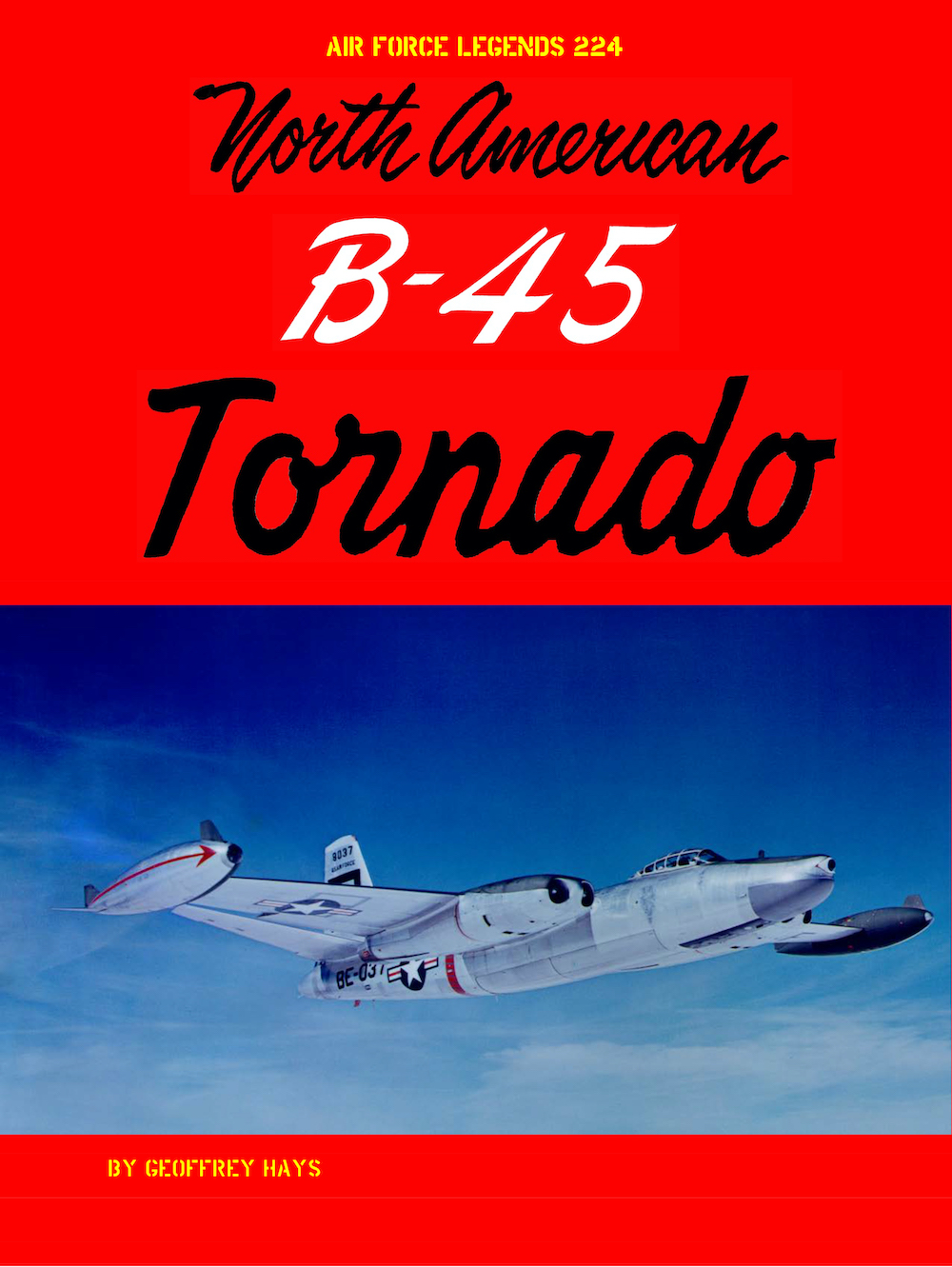 | Naval Fighters - NFAF224 - No Scale | North-American B-45 Tornado. 264-pages (13-pages of color). 90,000 words, over 450 images. Author Geof Hays. This 264-page book about the North-American B-45 is generously illustrated with 267 drawings, 355 photos, of which 15 are color aircraft images, and color drawings of 33 insignia of units which flew the Tornado. The book is presented in 12 chapters detailing B-45A, B-45C and RB-45C design, production, performance, payload, endurance and operations as it served as a bomber, reconnaissance and flight test aircraft. The author delves into the technological difficulties, lack of operational assignments, and politics which plagued the first third of the Tornado's career, from 1947 through 1950. He then presents the Tornado's more demanding and highly successful career from 1952 through 1958, which saw this turbojet develop into a fully combat capable aircraft using an entirely new field of weapons and carrying out a new and essential element of reconnaissance. The author includes the tail numbers of RB-45Cs assigned to Yokota AB, Japan who flew combat missions during the Korean war, and highly classified covert missions following the Korean War. Configurations, colors and marking of aircraft assigned to units at Yokota AB, Japan are provided as well. Mission details, tail numbers, and markings for aircraft supporting NATO from the UK, such as RB-45Cs which flew Peripheral Aerial Reconnaissance Program missions or PARPRO in Europe. For the first time, serial numbers of all armed RB-45s in the Far East Air Forces and US Air Forces in Europe are covered. And critically important sorties flown by allied personnel over denied territory deep into eastern Europe and the Soviet Union in 1952 and 1954 are also covered in detail. A separate detailed table presents a list and facts of all known accidents. Scale models of the B-45 Tornado from 1956 to the present day are presented with pictures of the boxes and a review of each kit. Geoffrey Hays is a retired USAF officer, Museum professional and the respected author of Ginter Books' sell out title, Air Force Legends No. 215, the Boeing B-50. As with the B-50 book, he once again presents here a detailed, accurate and highly readable history of the USAF's first multiengine turbojet bomber and reconnaissance aircraft, the North-American B-45 Tornado. More | Aircraft books | Catalogue | £47.50 | |
 | Naval Fighters - NFAF225 - No Scale | The Bell XFM-1/YFM-1 Airacuda Bomber Destroyer Air Force Legends 225 48-pages 131 b&w photos, 7 drawings Author Steve Ginter The Bell XFM-1/YFM-1 Airacuda was the first airplane designed and built by Larry Bell's new Bell Aircraft Corp. (founded in July 1935). This was to be a futuristic and innovative Allison V-1710 powered twin pusher bomber destroyer armed with 37mm canons mounted in the forward engine nacelles. The aircraft carried a crew of five and had both .30cal and .50cal defensive armament. It was also the first fighter to have an Auxillary Power Unit (APU). Fourteen aircraft were built: one XFM-1, nine YFM-1s, three YFM-1A (with tricycle landing gear) and two YFM-1Bs. The Airacuda's first flight was on 28 September 1939 with all aircraft being withdrawn from service in 1941. More | Aircraft books | Catalogue | £16.60 | |
 | Naval Fighters - NFAF226 - No Scale | Martin XB-48 48-pages, 96 b&w photos, 3 color photos, 26 b&w illustrations. In 1944, the Army issued requirements for a jet-propelled medium bomber which eventually spawned four aircraft. These were the North-American B-45 (see Air Force Legends 224), Convair XB-46 (see Air Force Legends 221), Boeing B-47, and the Martin XB-48 the sudject of this book. Specifications were somewhat general and called for an 80,000 to 200,000 lb aircraft with a 45,000 ft ceiling, range of 3,000 miles and a maximum speed of 550 mph. The Martin designwas a three-place, straight wing, six-jet, high wing, all metal medium bomber. The unique landing gear developed by Martin consisted of dual wheel main gear located in tandem with outrigger single type wing gear. This gear arrangement allowed for a huge continuance bomb bay with quick acting doors capable of carrying a 22,000 lb "Grand Slam" bomb. The other unique feature of the airplane was instalation of the six J35 engines. Each engine (three on a wing) had its own squarish nacelle seperated with by-pass ducts framed by a thin airfoil plate across the bottom of the three engines mounted under each wing. Two aircraft were produced and were tested at the Naval air Test Center, NASa�é-Ë�Patuxent River, MD, about 70 miles from Martin's New River plant before being accepted by the Air Force. The XB-48 was not accepted for production, those contracts going to the B-45 and B-47. The second XB-48 finished its life as a landing pilot training plane for future B-47 pilot's. More | Aircraft books | Catalogue | £18.30 | |
 | Naval Fighters - NFAF227 - No Scale | North-American YF-93A Penetration Fighter Air Force Legends 227 By William Simone 52-pages, 4-color and 87-b&w photos, with 39 draqwings. North-American's oft-forgotten YF-93A (NA-157) was an advanced version of the F-86A Sabre day fighter designed for the penetration fighter reqirement. It was originally designated the F-86C and was designed around NACA flush inlets and a 8,000 lb thrust J48 afterburning engine with three times the fuel of the F-86A, which gave it extremely long range. The two other penetration fighter candidates (the XF-88 and XF-90) had flown much earlier than the YF-93. All three types were not developed beyond the prototypes as the penetration fighter requirement was dropped by the Air Force. The aircraft sported F-86-style wings and tail mated to a new beffy fuselage with added electronics and 6-20mm cannon. The increased weight of the design led to a redesigned and strengthened dual-wheel main undercarrige. Only two-aircraft were built and the NACA flush intakes were replaced on ship one with conventional ram intakes resulting in increased overall performance. After retirement the two YF-93As were utilized at Moffett Field, CA, for further NACA testing before being scrapped. More | Aircraft books | Catalogue | £20.80 | |
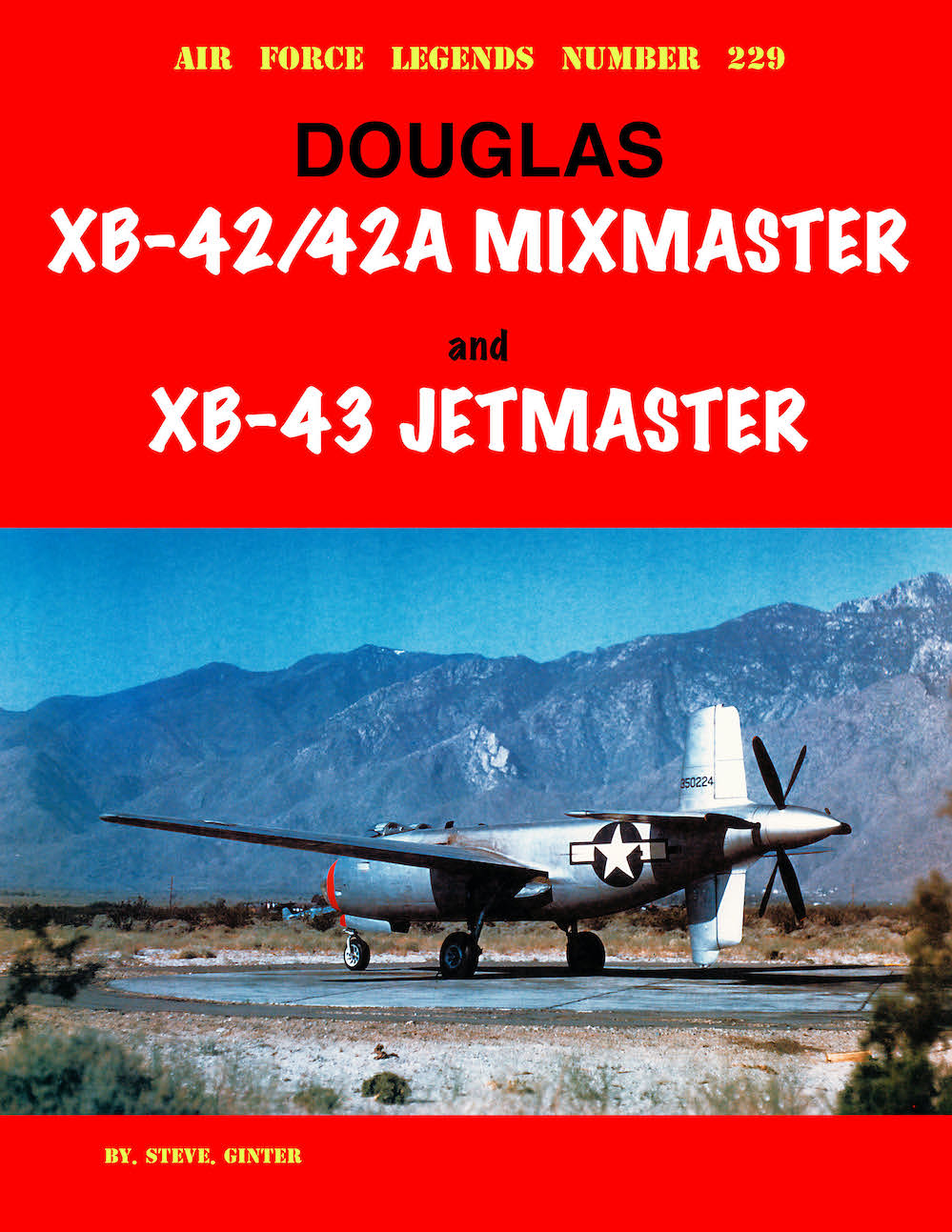 | Naval Fighters - NFAF229 - No Scale | Douglas XB-42/42A Mixmaster and XB-43 Jetmaster Air Force Legends number 229 ISBN: 979-8-9899509-3-5 88-pages, 182 b&w photos, 3-color, 40 drawings During WWII, the unsolicited Douglas Aircraft proposal for a contra-rotating pusher propeller powered light bomber would become the most unusual and iconic U.S. military aircraft built during the war. Shades of "Buck Rogers" to be sure. Amazingly, no major problems were encountered by this challenging design. The XB-42 "Mixmaster" performed well, even setting a transcontinental speed record. It's fuselage housed two Allison V-1710 engines and their long propeller driveshafts. This gave the fuselage enough width to house two jet engines and the all-jet XB-43 proposal was born. Where the XB-42 was designed, built, and flown within a year of Douglas first proposing it, the XB-43 "Jetmaster" took many years to complete, mostly waiting for its promised J-35 engines to be delivered. More | Aircraft books | Catalogue | £29.99 | |
 | Procal Decals - PD72-2201 - 1:72 | 64TH AGGRESSORS Lockheed-Martin F-16 WRAITH PAINT. The aircraft painted in the new "Wraith" aggressor paint scheme was aircraft number 48, an Lockheed-Martin F-16C Block 42. This Lockheed-Martin F-16 was already in Air Force inventory, but is new to the 57th Wing's 57th Adversary Tactics Group (57th ATG). The 57th ATG contains the 64th Aggressor Squadron, to which the new "Wraith" Lockheed-Martin F-16C Block 42 is attached. More | Aircraft decals (military) | Catalogue | £8.10 | |
 | Procal Decals - PD72-2303 - 1:72 | Greek restored Supermarine Spitfire Mk.IX IN 4 SCALES also set include decals for propeller blades Some history for plane... Spitfire MJ755 was built at Castle Bromwich, and delivered to No. 33 MU at RAF Lyneham in December 1943, remaining in store until early 1944 when it was allocated to the Middle East Air Force and dispatched by sea to Casablanca, arriving 13th March 1944.- By August 1944, MJ755 had been allocated to 43 (China-British) Squadron-known as the 'Fighting Cocks'-coded FT-V and covering the Operation Anvil landings in the South of France. The MJ755 was one of 77 Spitfires presented to the then Hellenic Royal Airforce to help rebuild Greece's fleet, delivered to Athens by RAF pilot George Dunn DFC on February 27, 1947. In April of that year, it joined the 335th Royal Hellenic Pursuit Squadron in Sedes while from 1949 it was used as a training aircraft for military pilots in Tatoi. (Mk.IXc Mk.IXe] More | Aircraft decals (military) | Catalogue | £12.99 | |
 | Print Scale - PSL72027 - 1:72 | Curtiss P-40 Kittyhawk Part 1 1. Р-40К, 7th FS, Air ForcesBlack Sea fleet, Airdrome Sokologornoe,April-May 1944 2. P-40N, 2nd GvIAP, Northern Fleet. Second half of 1943. 3. P-40E, 196th IAP, Leningrad Front, Kapitolovo, winter 1942-1943 4. H-40M, 191st IAP Air Forces RKKA. On December, 27th, 1943. The lieutenant Revin V. A has made the compelledLanding to the Finnish party The Karelian front. H-40M,191-й 5. Р-40E 154th IAP. The pilot - commander of a squadron, сaptain Zelenov N.A.Autumn 1942г 6. Р-40E 154th IAP, Leningrad, summer 1942г. The pilot - major Pokryshev Peter Afanasevich 7. Р-40E. 154th IAP, 39th IAD. The pilot - the commander of a part, lieutenant colonel, Matveev A.A. Summer 1942гг. Р-40E. 154 8. Р-40С, 126th IAP, air defense of Moscow. The pilot - Hero of Soviet Union,The item lieutenant Ridnyj S.G Winter 1942-1943 9. Р-40Е, 2nd GvIAP, Northern Fleet.The pilot - twice the Hero of Soviet Union B.F.Safonov. Was lost by the given plane On May, 30th, 1942, covering escort PQ-16. 10. P-40K, 191st IAP, Air Forces RKKA, The Leningrad Front, winter 1942-1943 11. P-40C, 147th IAP, Northern Fleet, Murmashi. April, 8th, 1942 Hero of Soviet Union Lieutenant A.S.Hlobystov rammed German Me 110. 12. P-40E, 7th IAP, Air Forces of the Black Sea Fleet. Summer of 1943. P-40E, 7-й ИАП ВВС Черноморского Флота. Лето 1943 года. 13. P-40E, Air Force Northern Fleet, Varlamoro, 1942. P-40E, ВВС Северного Флота, Варламоро, 1942. 14. P-40C, it is found in northern taiga. Possibly served in air defense of Murmansk. P-40C, найден в северной тайге, вероятно служил в ПВО Мурманска. 15. P-40N, 191st IAP, Leninigradsky Front. Winter of 1942-1943 P-40N, 191-й ИАП, Лениниградский Фронт, зима 1942-1943гг. 16. P-40K, 7th IAP, Air Forces of the Black Sea fleet.The plane of the commander of a regiment, major Denisov K.D. P-40K, 7-й ИАП ВВС Черноморского флота. Самолет командира полка, майора Денисова К.Д. More | Aircraft decals (military) | Limited Availability | £15.99 | |
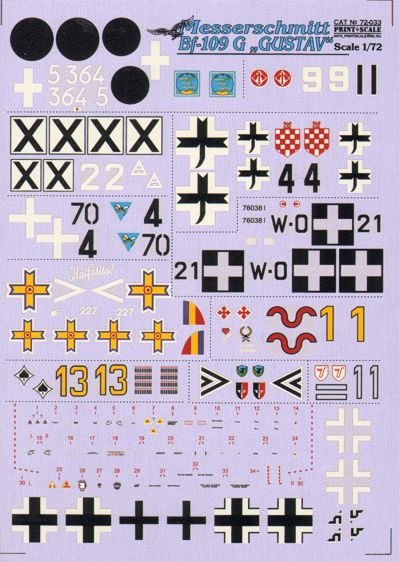 | Print Scale - PSL72033 - 1:72 | Messerschmitt Bf-109G-2 (11) Various different camouflage schemes in service with Luftwaffe; Italian AF; Yugoslavia AF; Hungarian AF; 1.Sicily, June-July 1943. So-called "Kanonen Booten" Bf.109 151/20 armed with three guns MG in under wings contain (Rustsatz R6). A camouflage: top-RLM74/75, a bottom-RLM76 2. BF.109G-10, III./JG 1, Anklem, �½�¾'���'�é-'l' 1944 ��. 3. Bf-109G-2. Pilot- D. Spisarevsky. By this plane it rammed bomber B-24. 4. Bf-109G-10/U3, 2. Lovacko Jato, 1. Zrakoplovna Skupina. Airdrome Zagreb-Lutsko, April 1945 5. Bf. 109G-6/R6/Trop, 70 Squadrilia, 23 Gruppo, 3 Stormo Caccia Terrestre. Cerveteri (Rome) July-August 1943 6. Bf. 109G-6 lieutenant Laslo Daniela, destructive group of 101/1 Hungarian Air Forces, summer 1944 7. Bf. 109G-2/R6, second lieutenant lon Dicezare, summer 1944 8. Bf-109-2. The commander 9 groups of 52 squadrons (9./JG 52) Herman Graf 212 victories, September 1942, airdrome Pitomnik, Stalingrad area 9. Bf. 109G-2, 3./JG 53, the pilot- Krinius. Augus 19th, 1942 10. Bf. 109G-4, Gruppen Kommandeur, I./JG 52, Summer 1943 11. Bf-109G-6 Staffelkapitan Hptm. Kirschner, 5/JG 3, Schipol, October 1943 More | Aircraft decals (military) | Catalogue | £17.40 | |
 | Print Scale - PSL72043 - 1:72 | Fairey Swordfish 1. L2720:680 of 821 Squadron, Fleet Air Arm, on board H.M.S. Ark Royal, February 1939. 2. Fairey Swordfish Mk.I K 6009:912 of 822 Sguadron, H.M.S. Furious, 1937-39. 3. Fairey Swordfish Mk.I floatplane K5959;809 823 Sguadron, H.M.S. Glorious 1937-38. 4. Fairey Swordfish Mk.I K8449;649 820 Sguadron, H.M.S. Courageous, 17 October 1938. 5. Fairey Swordfish floatpane P4199;E8F, 702 Sguadron, H.M.S. Resolution December 1939. Scheme 2. 6. Fairey Swordfish Mk.I L7647:4H 820 Sguadron, H.M.S. Ark Royal, 1941. Scheme 3. 7. Fairey Swordfish Mk.ll LS274;1F of 818 Squadron, 1945. Modified Type C1 roundel and fin flash for operations in Far Eastern waters, Scheme 4. 8. Fairey Swordfish Mk.lll NF374;NH-M, No-119 Sguadron, RAF, based at Bircham Newton, 1945. 9. Swordfish Mk.II 816 NAS, FAANumber: S (NF243)July 1944 Camouflage fuselage and lower surfaces - white, upper surface - the old standard color. The aircraft is marked with a thin band of white invasion okaemkoy on the fuselage and wings. Markings on the fuselage - the type C1, on the upper wing - type B, on the ground - no. 10. Swordfish Mk.III Part: 119 Sqn, RAF Number: NH-F (NF410) Knocke, Le Zoute, Belgium, 1945 The aircraft is equipped with ASV radar and armed with 113 kg bombs. Painted entirely in black. Squadron machines used against E-and R-boats (?), Were about the Dutch coast. 11. Fairey Swordfish Mk.l L2817;T4F 767 Sguadron, Kalafrana, Malta September 1940. Scheme 2. http://www.internetmodeler.com/scalemodels/nraviation/Print-Scale-1-72-Fairey-Swordfish-Decals.php More | Aircraft decals (military) | Catalogue | £21.99 | |
 | Print Scale - PSL72068 - 1:72 | Mitsubishi A6M Zero 1. A6M2 Zero of boatswain H. Toyoshima from IJN Hiryu aircraft carrier. The aircraft was lost on February 19, 1942 2. A6M2 Type 0 Model 21, third Kokutai No. X-108Pilot - Tamotsu Yokoyama. Takao, Formosa, 19 3. A6M2-type 0, Model 21- Zero IJN Carrier Akagi Pilot: PO Sueyoshi Osanai 4. A6M5-Hay Type 0 Model 52 Hay. Tsukuba Kokutai No.Tsu-46 The air base in Oita, Japan Islands Defense, February 1945 5. A6M2 Type 0 Model 21. Tainan Kokutai No. V-103 Pilot - Petty Officer Saburo Sakai, Bali, Indonesia, in February 1942 6. A6M2 Type 0 Model 21. Third Kokutai No.X-183 Pilot - Petty Officer 2nd Class Yoshiro Hashiguchi, Kendari Air Base, March 1942 7. A6M2 of P/O 1-st Cl. Simakawa Masaaki front Tainan Kokutai. End of 1941 8. A6M5-Hay Type 0 Model 52 Hay. 303rd hikotai, 203rd Kokutai No. 03-09 Pilot - Petty Officer Takeo Tanimitsu. Navy airbase Kagoshima, Japan, June 1945 9. A6M2 Type 0 Model 21. Tainan Kokutai No. V-141, 439 Pilot - Petty Officer 1st Class Yoshisuke Arita, February 1942 10. A6M2 model 11Aircraft captured army of Chiang Kai-shek. 11. A6M5 Technical Air Intelligence Center No. TAIC-8 Technical Center of Military Intelligence - Technical Air Intelligence Center (TAIC) 12. A6M2 Tainan Kokutai. V-172 No. 26, 1941 made ??an emergency landing in China, and was captured by Chinese nationalists. More | Aircraft decals (military) | Catalogue | £14.99 | |
 | Print Scale - PSL72070 - 1:72 | Bell OH-58 'Kiowa' 1. OH-58A 68-16779 (16779) 120th AHC Bien Hoa, Vietnam 1970. 2. OH-58A 68-16761 (16761) 173rd ABN Bong Song, Vietnam 1970. 3. OH-58A 68-16935 (16935) 17th Cavalry Regiment Quan Loi, Vietnam 1970. 4. OH-58A 68-16697 (16697) 1st Cavalry Regiment Vinh Long, Vietnam 1971. 5. OH-58A 69-16962 (16962) 17th Cavalry Regiment Quang Tri, Vietnam 1971 6. OH-58C 70-15170 (15170) New Mexico, USA 2000. 7. ОН-58А 71-15266 (15266) Вell Helicopter Textron, USA 1989. 8. OH-58A 68-16934 (16934) 17th Cavalry Regiment Di An, Vietnam 1970. 9. OH-58D 727 H-Company, 4th Brigade, 3rd Aviation Regiment, 3rd Infantry Division, Operation 'Desert Storm' Iraq 1991 10. This OH-58D was assigned to 2nd Squadron 17 th Cavalry Regiment, 101 st Airbome Division Its nickname, "Arsenal", was painted on both sides of the upper cowling 11. OH-58D 'Monsta' 95-00004 (50004) C-Troop, 3/17th Cavalry Regiment, Iraq 2004. 12. This OH-58D (R) was assigned to E Troop, 1st Squadron, 7th Cavalry Regiment 1st Cavalry Division, in Bosnia in1998 as part of SFOR. A 1st Cavalry emblem is on the nose of the Warrior. The "Bounty Hunter" emblem of E Troop is on the right side of the ALQ-144 pedestal, and the "Garryowen" crest is on the left 13. OH-58A 70-15236 (15236) Australian Army, 161 Recce Flight Assoc, Nui Dat, Vietnam 1971. 14. Bell 206B A17-003 Australian Army, Brisbane, Australia 1971 15. Bell 206B A17-043 Australian Army, Australia 2002 16. CH-136 136213 early training scheme, Canada 1971. 17. CH-136 136207 3CFFTS (training squadron), Canada 1980. 18. CH-136 136238 10 TAG, Canada 1980. 19. OH-58A 3C-OH Austria 2010. 20. Hkp-6B 06047 Sweden Navy, Berga, Sweden 1980. 21. Bell 206 131 Light Helicopter Squadron, Israel 1998 More | Aircraft decals (military) | Catalogue | £17.30 | |
 | Print Scale - PSL72072 - 1:72 | Yakovlev Yak-9 1. Yak-9U - flown by Georgiy Baevski, Hero of the Soviet Union (19 personal victories). The 5th Guards Fighter Regiment (GIAP), Germany, March 1945. 2. Yak-9T - flown by Capitan Rene Challe. Normandie-Niemen Regiment of the 303rd Fighter Division (IAD). Eastern Front, February 1945 (according some sources this a/c was also spotted at Dubrovka airfield in June 1944). The portrait of Fury was mark of G C I II/7 aircraft since 1940. . 3. Yak-9P (Yak-9B) "Moscow" - tactical number "2' - flown by Captain I.I. Petrov, the commanding officer of the 1st Sq. 168th IAP. Khimki, Moscow, June 13, 1944. 4. Yak-9M - flown by soviet ace pilot G.L. Nakaznyuk. (5 personal and 5 group victories. Participated in 60 aerial combat in 78 sorties). This a/c was flown Nakaznyuk from August 1944 and shot down a Fw-190. The aircraft was gray on all surfaces. The emblem of the Orden of the Battle Red Banner was only on the port side. 5. Yak-9D, tactical number 31 - flown by Vladimir I. Voronov, the wingman of M. Grib. The 6th GIAP of the 11th ShAD, Black Sea Fleet Arm, May 1944. 6. Yak-9D - tactical number 22 - flown by Captain M. Grib (17 victories). The 6th GIAP of the 11th ShAD, Black Sea Fleet Arm, Saki Airfield, April-May 1944. 7. Yak-9U - flown by Major Victor Kalashnikov, Commander of the 291st Niemen (Suvorov Orden IIIrd Degree) IAP (of the 265th IAD, the 3rd IAK). (15 personal victories). Noidorf Airfield, Germany, 1946. 8. Yak-9UT - flown by Major Grigori Kudlenko, Deputy Commander (Navigator) of the 6th Orshansk Red Banner, Suvorov Orden IIIrd degree GIAP of the 4th GIAD, the 1st GIAK. 5 personal victories. Perleberg, East Prussia, 1947. 9. Yak-9UT - tact.#37 - belonged to the 12th Red Banner IAP of the Baltic Sea Fleet, Kohlberg, East Prussia, 1945. 10. Yak-9UT - tact.# 31 - belonged to the 3rd sq. of the 43rd, IAP, 3 IAK, 16VA. East Prussia, May 1945. 11. Yak-9U with VK-107 engine - tact.# 14 "Vakhtangovets" belonged to the 29th Volkhov GIAP, 7VA. Karelia Front, winter 1944-1945. 12. Yak-9UT - tact.# 31 - flown by Major Alexei Reshetow, Hero of the Soviet Union, Commander of the 1st sq., 21 GIAP, 268 IAD, 8VA (36 personal and 8 group victories), Hungary, 1945. 13. Yak-9UT - tact.number 1 "Pobeda" - flown by Captain Garry Merkveladze, Hero of the Soviet Union, deputy squadron commander in the 152nd Sandomir, Bogdan Khmelnitski and Alexander Nevski Orders GIAP, 12 GIAD. (13 personal and 2 group victories) Prague, Czechoslovakia, May 1945 14. Yak-9U - tact.# 9/5 - unknown unit. April, 1945 15. Yak-9T - tact.# 52 - flown by Lieutenant Petr Peskarev. The 812th IAP. This a/c was shot down on April 12, 1944 - pilot KIA. 16. Yak-9T - tact.# 38 - flown by Lieutenant Alexandr I. Vybornov, Commander of the 3rd sq. 728 IAP, 3 IAK, 256 IAD. (20 victories) Poland, autumn 1944. 17. Yak-9P (Yak-9B) - s.n. 12153100 - flown by Lieutenant Colonel G.A. Kokrushev, Commander of the 168th IAP 18. Yak-9T - tact.# 04 - flown by Major I.N. Stepanenko, sq. commander in the 4th IAP, 1945 19. Yak-9T - tact.# 10 - flown by Captain Soloviev. The 845th IAP. Spring 1945. 20. Yak-9M - tact.# 1 - this aircraft was presented to Stojan Stojanov (a Bulgarian ace pilot), by A.Pokryshkin (the Soviet ace, triple HSU). Bulgaria 1945 21. Yak-9U - tact.# 2, ser. N. 42166097 - flown by Lieutenant N.F. Kizim, the 2nd sq. Yambol Airfield, Bulgaria, 1945-1946. 22. Yak-9P - tact.# T2-3002 - this aircraft was tested at Wright-Patterson Air Force Base, USA in 1955 and was marked with the US insignia. 23. Yak-9P of North Korean Air Force. This a/c was captured by the US troops at "Kimp-Ho" airfield. More | Aircraft decals (military) | Catalogue | £15.99 | |
 | Print Scale - PSL72075 - 1:72 | Junkers Ju-52/3M 1. Ju-52/3m, 2nd snd squadron of 1/KGzbV.I, Southern Greece, May 1941 2. Ju-52/3m g7e, 4V+HL, 3./kgRZBV 9, Eastern Front, 1941 3. Ju.52/3m, 6th squadron of II/TG.2, Mediterranean, 1943 4. Ju-52/3m g4e, 4U+NH, allocated to 2. (F)/123,Derna, Northern Africa, June 1941 5. Among the Ju-52/3m g7es assigned to the VII. Fliegerkorps (7th Air Corps) was this aircraft (V1+LP). The Corps operated on the Eastern Front during the winter of 1943-44 [Junkers Ju-52/3mg4e] More | Aircraft decals (military) | Catalogue | £15.99 | |
 | Print Scale - PSL72077 - 1:72 | Bell P-39 Airacobra 1. P-400 of 39 FS, 35 FG, 5 AF, 12 Mile Aerodrome New Guinea, 1942, personal aircraft of Lt. Eugene Wahl 2. P-39D-I(41-28297) "51' of 363rd Training Squadron California 1942 3. P-39D-I (41-38350) "P' of 35 FS, 8 FG, 5 AF, Milne Bay, New Guinea, October 1942. Personal aircraft of pilot Lt. I. A. Erickson 4. P-400 "80' "Pepper" of 67 FS, 347 FG, 13 AF, Guadalcanal, end of 1942. Aircraft in rather unusual camouflage. 5. P-39N (42-9033) of 9 GIAD, 100 GIAP, Germany, May 1945. Personal aircraft of Gieorgij Dolnikov (15+l victories). Earlier it was yhe personal aircraft of Capt. Iwan Babak (33+4victories),who become POW on 22 April 1945 6. P-39N of 191 IAP, Leningrad Front, summer 1944 7. P-39N-5 (218738) "A" of GC I/4 "Navarre", 1944 8. P-39L-I (42-4558) "QT" "The Pantie Bandit" of 93rd FG, Tunisia 1943 9. P-39Q Airacobra (84/J. Baracca) 4° Stormo C.T. Italian Co-Belligerent Air Force Italy 1945 10. 'TARAWA BOOM DEAY' was a P-39Q-1-BE flown by Major Josef H. Powell. He served with the 72nd Fighter Squadron of the 21st Fighter Group in the Mariana Island during 1944. More | Aircraft decals (military) | Catalogue | £15.99 | |
 | Print Scale - PSL72086 - 1:72 | Fairey Firefly. 1. Firefly FR.Mk.5 Unit: 812 NAS, FAA No. 206/R H.M.S. Glory, Korean coast, circa 1951. 2. Firefly FR.Mk.1 Unit: 827 NAS, FAA No. 273/P (PP 596) H.M.S. Triumph, Task Force 77 (US Navy), Yellow Sea, July 1950. This aircraft took part in the first air strike (on Haejo airfield) of the Korean War on 3rd July 1950. 3. Fairey Firefly FR.5,Fleet Air Arm, 810 Sqn., WB 266, H.M.S. Theseus ca. 1952. 4. Firefly TT.5 Wb271 (889) of 725 Squadron, Royal Australian Navy, New South Wales 1959. 5. Fairey Firefly Mk.l, Royal Thai Navy 1952. 6. Firefly F.Mk.I 'Evelyn Tentions' Unit: 1771 NAS, FAA No. 275/N (DK431) Usual pilot: Sub-Lieutenant P.H.Dawton. H.M.S. Implacable, British Pacific Fleet, March-April 1945. One notes red L on the landing gear door, reminiscence of the former code of the plane '4L'. The plane had been baptized 'Evelyn Tentions', a word game for the expression "evil intentions". More | Aircraft decals (military) | Catalogue | £14.99 | |
 | Print Scale - PSL72095 - 1:72 | Vought F-8 Crusader 1. Vought F-8 Crusader,F-8E (F8U-2NE), VF-162, US Navy, 202/AH (BuNo.150908), CVA-34 USS Oriskany. Pilot - Commander Richard M.Bellindzher. July 14, 1966 was shot down in combat with J-5 Ndo Duck. 2. Vought F-8C Crusader (F8U-2),VF-111, Det.11, US Navy, 103/AK (BuNo.146961), CVS-11 USS Intrepid, 1968. 19th September 1968. Lieutenant Anthony Gran on this machine knocked North Vietnamese MiG-21 of 921 IAP. 3. Vought F-8 Crusader. This F-8H (316/ BuNo 148628) was assigned to the 7th Tactical Fighter Squadron, 5th Fighter Wing. Philippine Air Force at Basa Air Base, Luzon, the Philippines.It was painted in two-tone 'wrap around' camouflage scheme of Glossy Dark Gray (FS 15327) and Glossy Neutral Grey (FS 16320) adopted in 1982. All markings were Flat Black, except for the full color national insignia on the wings and fuselage. 4. Vought F-8 Crusader assigned this F-8E (FN) (21/ Bu No 151752) to Flottille 14F. This Squadron was embarked on the Porteavions (Pa: Aircraft Carrier) FOCH (R-99) in June of 1967.The Crusader was painted in the stancard US scheme of Light Gull Gray over Insignia White. This aircraft has English data stencils and a Radome Tan (FS 33613) radome. More | Aircraft decals (military) | Catalogue | £15.99 | |
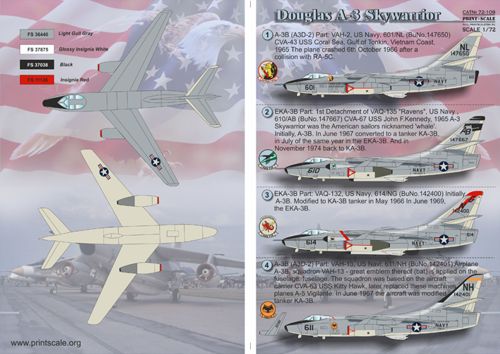 | Print Scale - PSL72109 - 1:72 | Douglas A-3 Skywarrior 1. A-3B (A3D-2) Part: VAH-2, US Navy, 601/NL (BuNo.147650) CVA-43 USS Coral Sea, Gulf of Tonkin, Vietnam Coast, 1965 The plane crashed 6th October 1966 after a collision with North-American RA-5C. 2. EKA-3B Part: 1st Detachment of VAQ-135 'Ravens', U.S. Navy , 610/AB (BuNo.147667) CVA-67 USS John F.Kennedy, 1965 A-3 Skywarrior was the American sailors nicknamed 'whale'. Initially, A-3B. In June 1967 converted to a tanker KA-3B, in July of the same year in the EKA-3B. And in November 1974 back to KA-3B. 3. EKA-3B Part: VAQ-132, US Navy, 614/NG (BuNo.142400) Initially, A-3B. Modified to KA-3B tanker in May 1966 In June 1969, the EKA-3B. 4. A-3B (A3D-2) Part: VAH-13, US Navi, 611/NH (BuNo.142401) Airplane A-3B, squadron VAH-13 - great emblem thereof (bat) is applied on the fuselage. fuselage. The squadron was based on the aircraft carrier CVA-63 USS Kitty Hawk, later replaced these machines planes A-5 Vigilante. In June 1967 the aircraft was modified tanker KA-3B. More | Aircraft decals (military) | Catalogue | £15.99 | |
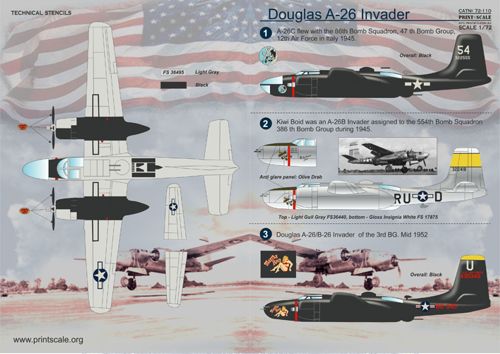 | Print Scale - PSL72110 - 1:72 | Douglas A-26 Invader 1. A-26C flew with the 86th Bomb Squadron, 47 th Bomb Group, 12th Air Force in Italy 1945. 2. Kiwi Boid was an A-26B Invader assigned to the 554th Bomb Squadron 386 th Bomb Group during 1945. 3. Douglas A-26/B-26 Invader of the 3rd BG. Mid 1952. 4. Jersey Bounce was a B-26B modified with a B-26C glass nose. The aircraft was assigned to the 90th Bomb Squadron, 3rd Bomb Group in Korea during 1952. 5. A B-26B Invader of GB 11/23 Guyenne, French Air Force stationed in Algeria during 1959. 6. B-26C-50-DT Part: GB 1/19 'Gascogne', Armee de l'Air , BC-911 / E (44-35911) Turan, French Indochina, 1951. 7. Douglas B-26C Invader, coded 931, Fuerza Aerea Ejercito de Cuba,1957. 8. Douglas A-26/B-26 Invader, Congo, 221 Escadrille, 21 Wing, 2 Groupement, Force Aerienne Congolaise, B-26K, FM-662, Albertville 1966-67. More | Aircraft decals (military) | Catalogue | £15.99 | |
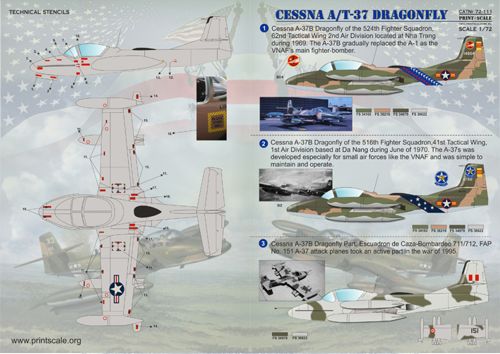 | Print Scale - PSL72111 - 1:72 | Cessna A-37 Dragonfly 1. Cessna A-37B Dragonfly of the 524th Fighter Squadron, 62nd Tactical Wing 2nd Air Division located at Nha Trang during 1969. The A-37B gradually replaced the A-1 as the VNAF's main fighter-bomber. 2. Cessna A-37B Dragonfly of the 516th Fighter Squadron,41st Tactical Wing, 1st Air Division based at Da Nang during June of 1970. The A-37s was developed especially for small air forces like the VNAF and was simple to maintain and operate. 3. Cessna A-37B Dragonfly Part: Escuadron de Caza-Bombardeo 711/712, FAP No. 151 A-37 attack planes took an active part in the war of 1995. 4. Cessna A-37B Dragonfly (69-6359) of the 8th SOS, 14th SOW based at Bien Hoa Air Base , Vietnam, during 1970. 5. The Vietnamese Air Force (VNAF) flew large numbers of A-37Bs, including this Dragonfly of the 520th Fighter Squadron based at Binh Thuy Air Base. 6. T-37A-CA 56-3464 was evaluated by the U.S. Army during the HPAOA trials held during the late 1950. 7. This T-37B-CE (58-7982) of the 38th FTW carries the standard trainer scheme used during the 1970s and 1980s and has an Air Force Outstanding Unit Award ribbon painted on the fin. 8. T-37Bs assigned to the 507th TACW carry the wrap-around "Lizard" camouflage scheme of Dark Grey and Dark Green. 9. This A-37A-CE(67-14525) Dragonfly of the 604th Air Commando Squadron, 3rd Tactical Fighter Wing was based at Bien Hoa, Vietnam, during 1967-1968. 10. A-37Bs of the Escuadrille de Caza of the Fuerza Aerea Salvadorena (FAS) have seen combat against insurgent forces in El Salvador. The aircraft are based at llopango Air Base. 11. This A-37B-CE (J-603) is operated by the Chilean Air Force. The aircraft was delivered to Chile during May of 1975. 12. A-37B Dragonfly Escuadron Aereo 8470;2 Fuerza Aerea Uruguaya 1976. 13. A-37B of 520th Fighter Squadron, 74th Tactical Wing, 4th Air Division at Binh Thuy during 1970. A-37 were well liked by VNAF aircrews for their agility and load carrying capability. 14. This T-37B-CE (2415,ex-62-5940) is flown by the Portugese Aerial Demonstration Team. The team performs at numerous air shows throughout Europe during the Summer months. More | Aircraft decals (military) | Catalogue | £15.99 | |
 | Print Scale - PSL72112 - 1:72 | Douglas SBD Dauntless 1. SBD-2 flown by CDR Howard Young, Commander of the Enterprise Air Group. Upper surfaces are Blue Gray over Light Gray lower surfaces. Red centered stars are carried in four locations. Pearl Harbor. 2. Douglas SBD-3 'Dauntless' Squadron VS-2 aircraft carrier 'Lexington', May 1942. 3. SBD-5 of Flottille 4FB, Aeronavale, Cognac January 1945. 4. Light bomber CAC CA-5/CA-9 Wirraway of the No.12 Sqn. RAAF (above) and A-24 Banshee of the No. 27 BAG USAAF (below) became victims of the Japanese strike to Darwin on February,19,1942. 5. Douglas SBD Dauntless representing GCB I/18 'Vendee' (Groupe de Chasse Bombardment), Armee de l'Air Serial: F/254543 operating from Vannes, November 1944. Note unit emblem right. 6. Douglas SBD-5 Dauntless,NZ 5057(BuNo 36925). of No25 Sqn. RNZAF, crewed by the squadron commander S/L T.J.Maclean de Lange and his radio operator F/O Sewell. Piva airfield, Bougainville, spring 1944. 7. Douglas SBD-5 Dauntless NZ 5056 (ex BuNo36924) of No 25 Sqn RNZAF, crewed by f/ Sgt C.N O'Neil and F/Sgt D.W. Gray. Piva airfield, Bougainville, spring 1944. 8. SBD-3 from the Air Group off the Wasp participated in attacks on Guadalcanal on7 August 1942.The roundels have been crudely enlarged by hand, while the stars have been left the original size. 9. Douglas SBD-5 Dauntless NZ 5048 of 25 Dive Bomber Squadron, Piva, Bougainville, April 1944. More | Aircraft decals (military) | Catalogue | £15.99 | |
 | Print Scale - PSL72114 - 1:72 | Fiat CR.32 1.Fiat CR.32 (154-4) was a flight demonstration aircraft assigned to 154 Squadriglia,4 Stormo 'Diavoli Rossi' in 1936.The fuselage fasces and the House of Savoia emblem on the rudder were standard markings on Italian military aircraft. 2. Fiat C.R. 32, 410 Sq., Diredaua and Addis Addis Ababa, Abyssinia, 1940-1941. 3. Fiat CR.32, Part 19 Escuadrilla, Grupo XXIII AS 'de Bastos'No. 3-12 (435) 4. Fiat CR.32 Part: X Grupo Autonomo de Caza Baleari No. 8. 5. Fiat CR.32 bis details: Air Force Institute of the USSR. 3-6 ex (s/n 431) This aircraft was tested at the Air Force Institute in 1937 . Summer of 1937 the aircraft was captured. 6. Fiat CR.32 bis Part: I / JG 138, No. 179 (?) Aspern, Vienna, Austria. September, 1938. 7. Fiat CR.32 Part: X Grupo de Caza Basado No. 9 Majorca. Plane without camouflage. 8.Fiat CR.32, No. 801 One of the 16 fighters , ordered by China in 1933. 9. Fiat CR.32, Part: Escuadrilla 'Gamba di Ferro' No. 3-7. More | Aircraft decals (military) | Limited Availability | £17.30 | |
 | Print Scale - PSL72115 - 1:72 | Mikoyan MIG-19 Farmer 1. MiG-19 PM, a board 335. Museum of the Air Forces of GDR, Berlin-Gatov.1980. 2. Mikoyan/Gurevich MiG-19 '24 red' of the 33rd IAP based at Wittstock AB was flown by Capt. Fyodor Zinov'yev against the RB-66 which intruded into East German airspace on 10th march 1964. The plan had standard painted for this type - all silvery. MiG-19 sans suffixes '27 red', 35th IAP. This fighter was flown by Capt. Vitaliy Ivannikov when he intercepted the intruding RB-66 on 10-th March 1964 and turned the destroyer into a destroyed. Later MiG-19 sans suffixes '27 red' had a single 'kill' star applied on the port side under the cockpit to commemorate the shoot down. 3. A two tone Gray camouflaged F-6, 19 Squadron, Pakistani Air Force. The aircraft is a late production F-6 with Pakistani modifications including the deletion of the antenna mast under the cockpit and the addition of AIM-9 Sidewinder rails on the outboard wing panels. 4. Bangladeshi F-6, Black 7104. Is armed with seven shot rocket pod and two 200 gallon (760 liter) underwing fuel tanks. It is a late production F-6 with the bullet shaped braking parachute container at the base of the rudder and N-30 cannons without gun gas defectors on the muzzles. 5. Shenyang F-6s of the Commanders School area Swat hills near Sargodha, Pakistan. The plane is armed by AIM-9P Sidewinder infra red homing air-to-air missiles on the outboard wing pylons. 6. Shenyang F6, Pakistan Air Force. 7. Lim 7 (MiG-19 PM Farmer E) of the 28 Pulk Lotnictwa Mysliwskiego (28th Fighter Regiment) Slupsk-Redzikowo, Poland, 1980. Plan is overall Natural Metall. Polish aircrafts did not carry the national insignia on the wing upper surfaces. 8. MiG MiG-19/J-6 Farmer , Czechoslovakia , Aero S-105 No. 0218. 9. MiG-19/J-6 Farmer, Indonesia, No. 1904/F. 10. �l"���"-19/J-6 , China , Shenyang J More | Aircraft decals (military) | Catalogue | £14.99 | |
 | Print Scale - PSL72116 - 1:72 | MIG Air force of the Vietnam war 1. Shenyang J-5 (Mikoyan MiG-17F 'Fresco-C') 2011 of Ngo Duc Mai, 923rd 'Yen The', 12 May 1967. 2. MiG-17F 'Fresco-C' 2047 of Nguyen Van Bay, 923rd 'Yen The', 19 April 1972. 3. Shenyang J-5 (MiG-17F 'Fresco-C') 2050 of Pham Ngoc Lan, 921st'Sao Do', 6 November 1965. 4. MiG-17F 'Fresco-C' 2072 of the 921st'Sao Do', 1968. 5. MiG-17F 'Fresco-C' 2077 of the 923rd'Yen The', 1968. 6. MiG-17PF 'Fresco D' 4721 of Lam Van Lich, 921st 'Sao Do', 3 February 1966. 7. Shenyang J-6 (MiG-19S) 'Farmer C' 6032 of Nguyen Hong Son, 925th Fighter Regiment, 8 May 1972. 8. Shenyang J-6 (MiG-19S) 'Farmer-C' 6066, 925th Fighter Regiment, 1972. 9. MiG-21PF 'Fishbed-D' 4324 of Nguyen Dang Kinh, 921st 'Sao Do', 19 November 1967. 10. MiG-21PFM 'Fishbed-F' 5015 of the 921st 'Sao Do', 1972. 11. MiG-21PFM 'Fishbed-F' 5066 of the 927th 'Lam Son', 1972. 12. MiG-21PFM 'Fishbed-F' 6122 of the 927th 'Lam Son', 1972. 13. MiG-21UM 'Mongol-B' 5903 of the 927th 'Lam Son', 1972. 14. MiG-21MF 'Fishbed-J' 5121 of Pham Tuan, 921st 'Sao Do', 27 December 1972. 15. MiG-21PF 'Fishbed-D' 4326 of Nguyen Van Coc, 921st'Sao Do', 7 May 1968. 16. MiG-21PFM 'Fishbed-F' 5020 of Nguyen Tien Sam, 927th 'Lam Son', 5 July 1972. 17. MiG-21PF 'Fishbed-D' 4128 of 921st 'Sao Do', April 1966. 18. MiG-21F-13 'Fishbed-C' 4420 of Nguyen Ngoc Do , of the 921st 'Sao Do', 16 September 1967. More | Aircraft decals (military) | Catalogue | £14.99 | |
 | Print Scale - PSL72131 - 1:72 | Cessna O-1 Bird Dog 1. L-19A of the 8th Army was used to transport President elect Dwight D. Eisenhower on an inspection trip of Korea in December of 1952. 2. TO-1D carries the high visibility Gloss White end Red scheme used for aircraft that operated over the Arctic or jungle areas. 3. Cessna O-1D " Little Annie Fanny", 199th Reconnaissance Airplane Company, the " Swamp Foxes" Vinh Long, RVN, understand was flown bu Rich Burns. Mid-60s. 4. This shark mouthed O-1D of the 19th TASS was one of the first Air Force Bird Dogs to deploy to Vietnam during July of 1963. 5. Marine Corps OE-2 (O-1C) of VMO-6 based at Chu Lai, South Vietnam during the early 1960s. 6. A number of Air Force O-1s carried three color camouflage schemes that varied from aircraft to aircraft. The Orang identification panels on the wing uppersurface helped attack aircraft spot the O-1. 7. Cessna O-1C, US Marines Corps, BuAer 140100, System Test Division, NAS Patuxent River MD, ca.1965. 8. Cessna O-1D Bird Dog, Cambodian Air Force, s/n 23529 (55-4689),Pochentong Air Base, ca 1972. 9. Cessna O-1E Bird Dog of tHe-112th Liaison Squadron, 23rd Tactical Wing, Bien Hoa during 1966. 10. MAJ Boung used this VNAF O-1A to South Vietnam with his wife and five children. MAJ Boung made the first landing bu an O-1 on an aircraft carrier, landing on USS MIDWAY on 30 April 1975. More | Aircraft decals (military) | Catalogue | £15.99 | |
 | Print Scale - PSL72140 - 1:72 | Grumman TBF Avenger 1. TBF-1C, White 97 (BuNo 48102),was assigned to Torpedo Squadron 2 (VT-2) aboard the carrier USS HORNET (CV-12) during the summer of 1944. The VT-2 insignia was displayed on the forward fuselage, while the white disc on the vertical stabilizer identified the HORNET's Carrier Air Group 11 (CVG-11). This Squadron participated in the Battle of the Philippine Sea on 19-20 June. 2. TBF-1 (C-5) was assigned to Composite Squadron 30 (VC-30) aboard the light carrier USS MONTEREY (CVL-26) in the fall of 1943.The red-bordered national insignia was only authorized for use between 28 June 1943 and 31 July 1943; however, the change to the blue-bordered insignia was not complete until late in that year. 3. The first production Grumman TBF-1 Avenger was BuNo 00373, was delivered to the U.S. Navy (USN) in January of 1942. 4. White 110 was a Grumman TBM -3 assigned to VT-82 adoard the USS BENNINGTON (CV-20) in February of 1945.The aircraft was overall Glossy Sea Blue FS 15042 , with Glossy Insignia Blue FS 15044 and Glossy Insignia White FS 17855 national markings. The white arrowhead on the rudder and the upper starboard and lower port ailerons was the BENNINGTON's air group insignia. In early 1945, VT-82's Avengers attacked enemy targets in Japanese home islands. 5. Lt (JG) George Bush- the future 41st President of the United States - flew this TBF-1C, while assigned to VT-51aboard the USS SAN JACINTO (CVL-30) in the western Pacific in the fall of 1944. He named the Avenger BARBARA for his fiancee, Barbara Pierce. Bush's aircraft was shot down while attacking the Japanese-held island of Chichi Jima on 2 September 1944. His turret gunner and radio operator/bdombardier were killed; however, Bush safely parachuted from the stricken TBF and was rescue by the submarine USS FINBACK (SS-2300) 6. This Grumman TBM -3S (Y-AR, 53682) was assigned to Number 880 Squadron (later VS-880), Royal Canadian Navy (RCN) at RCN Air Station Shearwater, Nova Scotia in 1952. The aircraft- locally designated the Avenger AS Mark 3-was used for anti-submarine patrols off Canada's Atlantic coast between 1950 and 1957. This Avenger retained the USN finish of overall Glossy Sea Blue. 7. Grumman TBM -3E2 Avenger, Royal Netherlands Marine Luchtvaart Dienst, s/n 071, VSQ-1 Valkenburd AB, ca 1959. 8. Grumman TBM -3, 89, of VC-94 onboard the USS Shamrock Bay, early 1945.The aircraft is painted Glossy Sea Blue overall and carries the Irish symbols of White Shamrock and Crossed Pipes on the rudder and thirty-five white mission markings under the cockpit on starboard side. 9. (Above) A Grumman TBF-1 of U.S. Navy squadron VT-8- one of the aircraft lost in the Avenger's first operation, at Midway on 4 June 1942. 10. BETS (18) was an Eastern Aircraft Grumman TBM -1C from VT-21. This Avenger flew off the escort carrier COPAHEE (CVE-12) IN September of 1943. More | Aircraft decals (military) | Catalogue | £15.99 | |
 | Print Scale - PSL72144 - 1:72 | Fiat G.50 Freccia 1. Fiat g. 50 part: 3./jagdgeschwader 108 number: 352 Wiener-Neustadt, 1944. 2. Fiat G.50 bis Part: 352 Squadriglia Phone: 352-2 (MM8978) Libya, 1941. 3. Fiat G.50 bis Part: 352 Squadriglia, 20 Gruppo, 51 Stormo Phone: 352-7 AFB Maldegem, Belgium, Fall 1940. 4. Fiat G.50 Part: 155 Gruppo Autonomo Phone: 351-12 April 1941. 5. Fiat G.50 Part: 20 Gruppo, CAI Phone: 20 (MM5372) Belgium, November 1940 The aircraft carries a typical Italian G.50 camouflage. By car flew commander of the 20th Group Mario Bonsai. The group was part of the Italian Corps, which operated in the neighborhood of La Mashnov winter 1940/1941. 6. Fiat G.50bis Part: 356 Squadriglia, 151 Gruppo Number: 366 Greece, 1942. 7. Fiat G.50 Serie 1 Part: unknown Phone: MM3590 So the plane looked before sending the unit. The aircraft carries the standard camouflage applied at the factory: the upper and side surfaces of the Giallo Mimetico 3 (FS 33434) spotted Verde Mimetico 3 (FS 34102), the lower surface Grigio Mimetico (FS 36293). 8. Fiat G.50 Part of: Grupo 27, Regimiemto Mixto de Africa Espagnol Phone: 1-7 (MM3582) Melilla, Morocco, 1940. 9. Fiat G.50B Serie VII Part: 21.LJ, 11.LS (Lovacka Skupina) No. 3510 Borongay, Zagreb, Croatia, the beginning of 1944. 10. Fiat G.50bis Part 12 Lovacko Jato No. 3502 Of 1942-1943. 11. Fiat G.50bis Number: 8 (c / n.249, MM6197, ex-Croat Air Force No.3505) Former Croatian plane captured guerrillas. 12. Fiat G.50 (2nd series) Part 1 / LeLv 26 Number 2 (FA-15, c / n.4706) Aerodrome Lunkula, June 1941 On the first aircraft of the second series was kept vertical tail early sample. 13. Fiat G.50 Part 1 Gruppo Sperimentale Caccia Aviacion Legionaria No. 1-2 (3586) 14. Fiat G.50 Part 1 Gruppo Sperimentale Caccia Aviacion Legionaria Number: 1-1 Pilot - the commander of the Italian experimental group, Major M.Bonzano. Spain, March 1939. 15. Fiat G.50 bis of 376 Squadriglia, 154 Gruppo Autonomo C.T., Regia Aeronautica. Berat Greece, November 1940. More | Aircraft decals (military) | Catalogue | £15.99 | |
 | Print Scale - PSL72151 - 1:72 | North-American Texan 1. North-American NAA-57 3./JG 105 NF+WY (61, c/n.159) Villacoublay, Paris, circa 1943. 2. Commonwealth CAC CA-3/5 Wirraway Mk.II 4 Sqn, RAAF Serial: 03/D (A20-103) Pilot - P/O.John Archer, observer - Sergeant James Coulston. Buna, New Guinea. On 26 December 1942 when he shot down Japanese A6M. Nowadays it preserved in the Australian War Memorial. 3. T-6F part: South Vietnamese Air Force No.CD 139744 1960 ��. 4. LT-6G 'Scream N Rebel' 6147 Tactical Control Group, USAF Serial: LTA-579 (49-3579) A rocket armed aircraft. Chunchon, Korea, during 1953. The plane was remanufactured from earlier AT-6 aircraft. 5. SNJ-2 Carrier Division One, U.S. Navy Serial: BoNo.2549 Pilot - CO Aubrey Fitch. CV-3 USS Saratoga, during 1940. 6. T-6G 43 Sqn, 4th Wing, Royal Thai Air Force Serial: 4331 RTAFB Thakli, circa 1956. 7. T-6G 22nd Sqn, 2nd Wing, Royal Thai Air Force Serial: 2225 (180) RTAFB Udon Thani, circa 1959. More | Aircraft decals (military) | Catalogue | £15.99 | |
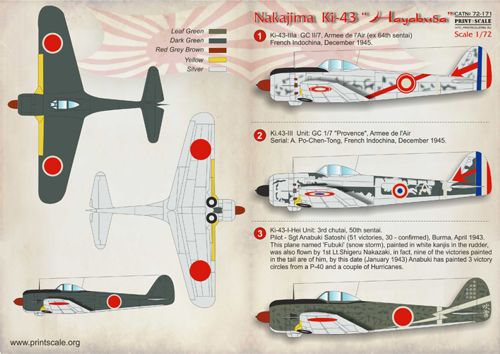 | Print Scale - PSL72171 - 1:72 | Nakajima Ki-43 Hayabusa 1. Ki-43-IIIa GC II/7, Armee de l'Air (ex 64th sentai) French Indochina, December 1945. 2. Ki.43-III Unit: GC 1/7 "Provence", Armee de l'Air. Serial: A. Po-Chen-Tong, French Indochina, December 1945. 3. Ki-43-I-Hei Unit: 3rd chutai, 50th sentai. Pilot - Sgt Anabuki Satoshi (51 victories, 30 - confirmed), Burma, April 1943. This plane named 'Fubuki' (snow storm), painted in white kanjis in the rudder, was also flown by 1st Lt.Shigeru Nakazaki, in fact, nine of the victories painted in the tail are of him, by this date (January 1943) Anabuki has painted 3 victory circles from a P-40 and a couple of Hurricanes. 4. Ki-43-II.Manchukuo National Military Force Air Corps, Summer 1944.The hieroglyphs on the fuselage are name of company which bought this aircraft. 5. Ki-43 Serial: 8 (B-24034) Communist flying shool in Tunhua, in 1946. 6. Ki-43-II-Otsu Unit: 2nd chutai, 55th sentai Serial: 3 Pilot - Lt.Tomito Toda. Kemaki airfield, Nagoi area, Summer 1944. 7. Ki-43-IIIb Royal Thai Air Force. South China. Thailand Spring 1944. 8. Ki-43-II-Kai. Unit: Indonesian People Security Force Serial: S/42. Djakarta, Java, 1946. More | Aircraft decals (military) | Catalogue | £15.99 | |
 | Print Scale - PSL72172 - 1:72 | Nakajima B5N 'Kate' 1. B5N1 Unit: 1st koku kantai, 4th koku sentai Serial: DI-362. Ryujo carrier, 1941. 2. B5N2 'Kate' Skokaku carrier, participated in the raid on Peal Harbor, 7th December 1941. 3. B5N1 Unit: 1st koku kantai, 3rd koku sentai Serial: CI-301 The Zuiho carrier. Early 1941. 4. B5N2 type 97 model 3 Unit: 1st koku kantai, 1st koku sentai. Serial: AI-316. Pilot - PO2c Yuichi Takizawa. Akagi carrier. Pearl Harbor raid, On 7th December 1941. 5. B5N2 type 97 model 3 Unit: 1st koku kantai, 1st koku sentai Serial: AI-311 Pilot - Lt.Commander Shigeharu Murata. Akagi carrier. Leader torpedo-bomber group at Midway. 6. B5N2 type 97 model 3 Unit: 1st koku kantai, 1st koku sentai. Serial: AI-307. Pilot - PO1c Shigeo Suzuki. Akagi carrier. Pearl Harbor Attack, On 7th December 1941. First wave. Its torpedo hits USS Oklahoma. 7. B5N2 Unit: 261st kokutai. Serial: Tora-310 The a/c in colours of the Flight Leader. 'Tora' = Tiger. 8. B5N1 Unit: Kanoya kokutai. Serial: ?-314. Circa 1941. 9. B5N2 type 97 model 3 Serial: 301 The a/c in which Cdr. Mitsuo Fuchida led the first wave of Japanese aircraft to attack Pearl Harbour on 7th December, 1941. Cdr. Fuchida was the General Commander Air of the Imperial Japanese Navy 1st Carrier Division; flying as observer in the second cockpit, he sent out the order to attack at 07.49 hrs. More | Aircraft decals (military) | Catalogue | £15.99 | |
 | Print Scale - PSL72175 - 1:72 | Curtiss P-40N Warhawk 1. P-40N, 7th Fighter Squadron (49th Fighter Group), Gusap, New Guinea, 1943. The leading edges were white as was the tail. Flown by Major Arland Stanton, seven kills of which three with this P-40N. 2. P-40N, serial number 42-23736 from a non-identified training unit in the USA, 1943. 3. P-40N, 18th Fighter Squadron (51 st Fighter Group) China, summer 1944, flown by 1st Lt Carl E. Harby. 4. P-40N, 8th Fighter Squadron (49th Fighter Group), Mailian, New Guinea, end of 1943, flown by Capt. Robert H. Wright. The white for the theatre of operations has been transferred to the leading edges of the wings. 5. P-40N, 8th Fighter Squadron (49th Fighter Group), Gusap, June 1944. Flown by Lt. Marion Felts. This plane had its original olive drab removed after an accident and subsequent repairs; it only kept the yellow 45 on the green background. the tail is white which continues under the American roundel for better visibility. 6. P-40N, 7th Fighter Squadron (3rd Fighter Group), Laohow, China, January 1945, flown by Wang Kuang Fu, a veteran of C.L. Chennault's American Voluneer Group, and an ace of the Chinese Air Force, with 6.5 victories. 7. P-40N, P-11249, 8th Fighter Squadron (3rd Fighter Group), Liangshan, China, Raymond L. Callaway, six confirmed kills, one probablle and one aircraft damage. 8. P-40N, 89th Fighter Squadron (80th Fighter Group) Assam, India 1944. 9. P-40N, 8th Fighter Squadron (49th Fighter Group) Kalamazoo, Guadalcanal, in 1943, flown by Ernie Harris, unit commander, 10 kills on P-40 and the first ace in the Pacific to reach this score on this type of machine. 10. P-40N, 7th Fighter Squadron (49th Fighter Group) New Guinea 1943. 11. Curtiss P-40N Warhawk Kittyhawk Mk.lV, No 122 Squadron RAF, flown by Flight Sergeant G.F. Davis Cutella, Italy, April 1944. More | Aircraft decals (military) | Catalogue | £15.99 | |
 | Print Scale - PSL72182 - 1:72 | Dassault/Dornier Alpha Jet Part 1 1. Alpha Jet MS.1 Serial: 350 The Alpha Jet is in the Egypt Air Force : the 'standard' trainer (MS.1) 2. Alpha Jet Unit: unknown. Serial: 231 Alpha Jet No 231 in the colours of the Moroccan Air Force, which has ordered 24 of these basic trainers. 3. Alpha Jet Unit: NAF Serial: NAF-452. The NAT deployed only two Alpha Jets in support of the Nigerian ECOMOG contingent in Sierra Leone. It remains unknown if the same two examples remained in country between their first deployment, in 1995, and 1999. Western specialized media claimed that an NAF Alpha Jet was shot down by anti-aircraft fire of the fighters belonging to Sierra Leonean junta, on 8 February 1998, but Grp.Cpt. Sat Easterbook from ECOMOG categorically denied such a claim, in early 1999. 4. Alpha Jet B Unit: BAF. Serial: AT-29. 5. Alpha Jet. An export Alpha Jet as supplied to Qatar. 6. Alpha Jet Serial: 5U-MBA. An export model Alpha Jet in the colours and markings of the Togo Air Force, which has ordered six. 7. Alpha Jet Unit: Esquadra 301 'Jaguares', Forca Aerea Portuguesa. Serial: 15202. Base Aerea No.11, Beja, 2002. 8. Alpha Jet A Unit: 231 Sqn, 23rd Wing, RTAF. Serial: 23142. RTAFB Udon Thani, circa 2004. 9. Alpha Jet Unit: Escadrille de Chasse, FACI. Serial: TU-VCA (CA-1) FACI received six Alpha Jets in October 1980. 10. Alpha Jet A Unit: Waffenschule 50/Furstenfeldbruck (in crisis time JaboG49) Serial: 40+17 Based at Furstenfeldbruck. The aircraft carry ventral gun pack. More | Aircraft decals (military) | Catalogue | £15.99 | |
 | Print Scale - PSL72184 - 1:72 | Sukhoi Su-24 1. Su-24 "Fencer-C" Unit: 735th BAP, Soviet AF. Serial: 10. Karshi airfield. The aircraft equipped with OFAB-250-270. 2. Su-24 "Fencer-C" Unit: 149th GvBAP, Soviet AF. Serial: 40. Crew: Sub.Col.V.A.Markin, Cpt.A.Saveliev. Typical load of FAB-500M-62 bombs. Aircraft of 149th GvBAP flew missions to Afghanistan in 1984 from Kokaidy and Khanabad in 1988-1989. 3. Su-24 "Fencer-C" Unit: 149th GvBAP, Soviet AF. Serial: 42 Karshi airfield, October-December 1988. The aircraft equipped with FAB-1500M-46 bombs. Aircraft flew missions over Afghanistan. 4. Su-24M Unit: 143rd BAP, Soviet AF. Serial: 20. Kopet-Nari. 5. Su-24 M the air force of Russia, the Krasnodar military of the United flight and technical College, summer 1993. The paint scheme has provided V. P. Pupkov. 6. Su-24M Unit: 455th BAP. Serial: 29. Voronezh, 2002. 7. Su-24M Serial: 44 . 4th trainer center, Lipetsk, 2002. 8. Su-24MK Serial: 24246. Circa 1991. 9. Su-24MK Unit: 72 Sqn, IRIAF. Serial: 3-6810 Shiraz AB. 10. Su-24MK Serial: KX-88. 11. Su-24M Unit: 455th BAP, 16th VA. Serial: 26 Bunchuk airfield, Voronezh. On 28th April 1998. 45th anniversary on 455th BAP. Note: advertisement stick Pepsi-Cola on the radar cover. On 29th May 1998 16th VA was disband. More | Aircraft decals (military) | Catalogue | £15.99 | |
 | Print Scale - PSL72189 - 1:72 | Vought SB2U Vindicator 1. SB2U-2 Unit: U.S. Navy. Serial: BuNo.1354. Flown by the Air Group Commander aboard CV-5 USS Yorktown. 2. SB2U-2 Unit: VB-3, U.S. Navy Serial: 3-B-1 (BuNo.1333). CV-3 USS Saratoga. Early 1941. 3. SB2U-2. Unit: VB-2, U.S. Navy.Serial: 2-2 (BuNo.1352) CV-2 USS Lexington. Painted in this special camouflage as part of the Barclay experiments. 4. SB2U-2. Unit: VS-9, U.S. Navy. Serial: 9-S-18. AVG-30 USS Charger while waiting for USS Essex (CV-9) to be commissioned. 5. SB2U-2. Unit: TU-1. Serial: 5/TU-1 (BuNo.1381) The commander of TU-1, Battle Force, Pacific Fleet. 1941. 6. SB2U-1. Unit: VB-2 VB-3. Serial: BuNo.0738 North Island, California, 1940. Camouflage scheme No.6. 7. SB2U-2. Unit: VS-72, U.S. Navy. Serial: 72-S-6 (BuNo.1362) CV-7 USS Wasp, circa 1940. 8. SB2U-2. Unit: VS-41, U.S. Navy. Serial: 41-S-8 VS-41 flew this Vought SB2U-3 Vindicator (41-S-8) from CV-4 RANGER in early 1942. 9. SB2U-1. Unit: VB-3 'Top Hatter', U.S. Navy. Serial: 3-B-13 (BuNo.0738) CV-3 USS Saratoga, 1939. 10. SB2U-2. Unit: VS-42, U.S. Navy. Serial: 42-S-13 CV-4 USS Ranger, circa 1941. 11. Chesapeake Mk.I. Unit: 771 NAS, FAA. Serial: M8E (AL951) RNAS Twatt, Orkney Islands, circa 1943. 12. Chesapeake Mk.I. Unit: 811 Sqn, FAA. Serial: K (AL924). Circa 1941. More | Aircraft decals (military) | Catalogue | £15.99 | |
 | Print Scale - PSL72294 - 1:72 | Hannover CL.lll/llla 1. Hannover CL.III. Unit/Location: Sonderkommando Vogel, France, March/April 1918. Code:16050/17, White S Pilot & Observer: unknown Background: "Sonderkommando Vogel" was a special purpose unit, operating with different planes in France in the spring of 1918. The time must have been end of March, at least beginning of 1918, because while the Hannover had their new. Balkenkreuz-insignias painted on, other planes still carried the Eisernes Kreuz. All planes carried a big white "S" on both sides of the fuselage, followed by a small "onderkomando" (written with only one "m"!). 2. Hannover CL.III. Unit/Location: FA(A) 286b, France, 28.05.1918. Code:16020/17, Yellow 1. Pilot: Heinrich Fichtbauer Observer: Joseph Herz. Fate: Fichtbauer survived, Herz was killed on 28.05.1918 in this plane. Background: FA (A) 286 was an artillery spotting unit and this plane carried an elaborate "ghost out of the bottle" emblem and still early and broader German Balkenkreuze. 3. Hannover CL.III. Unit/Location: Schlachtstaffel 9, Masny-Sud/France, September 1918. Code:16087/17, White 5 Pilot & Observer: unknown. Background:This plane had a rather long service life, especially when reconsidered to serve in a "Schlasta".Having their early Eiserne Kreuze firstly repainted in broader early Balkenkreuz style and then later even in the final and smaller variant. 4. Hannover CL.IIIa. Unit/Location: FA 46b, France, late summer/autumn 1918. Code:3870/18 Pilot & Observer: unknown. Background: Serving in a Bavarian (hence the suffix "b") Fliegerabteilung (FA), his unit was performed as a pure recon unit. The fuselage band might be centered in black or red. We tend to red, but provide both options as modelers choice. 5. Hannover CL.IIIa. Unit/Location: FA(A) 253, Autremencourt /France, Summer 1918. Code: 2714/18 Pilot: Peter Johannes Observer: Hanns-Gerd Raabe. Background: Artillery ranging FA 253 (hence the additional suffix "A" for artillery) carried individual emblems in black on white discs. Raabe as the observer and "chief of the plane" carried the "Wandervogel"- Emblem, because "Rabe" in German means raven and sounded very similar to Raabe and so a bird was chosen for the individual emblem. 6. Hannover CL.IIIa. Unit/Location: FA(A) 253, Autremencourt /France, Summer 1918. Code: 2???/18 Pilot: Unteroffizier Braunger Observer: Willy Hentschel. Background: Hentschel did chose a black hand as personal emblem as a "stay off me"! This might be a foreseeing measure, because together they scored an air victory on 01.08.1918 to save their lives. The code of the plane is sadly not known, but presumably it is from the 2000/18-batch and we leave it to the modelers to choose "their" number. 7. Hannover CL.IIIa. Unit/Location: FA(A) 295b, Montigny-le-Franc/France, August 1918. Code: 2622/18. Pilot: Johann "Hans" Baur Observer: Georg Hengl. Air victories: Baur: 6 victories (+3 unconfirmed, all together with Hengl), Hengl: 7 + 3 unconfirmed victories (all except one with Baur). Background: Presumably the best known and most successful CL.IIIa. Both crew members survived. Hengl was knighted after the war and had to be called Ritter Georg von Hengl. "Hans" Baur was getting famous in becoming the personal pilot of Adolf Hitler and attaining the rank of Generaloberst of the SS until the end of WW II. He flew many mighty politicians at that time and after WW II spent 10 years in Sibiria as PoW of the Soviets to lose a leg to gangrene. 8. Hannover CL.IIIa. Unit/Location: Schlachststaffel 20, Briey/France, September 1918. Code: 13369/17, White 6 Pilot: Paul Weisser Observer: Wilhelm Scharg. Background: Both were shot down in this plane on 06.09.1918, but survived to end up as POW. Planes of Schlasta 9 wore elaborate white arrows as unit insignias on both sides of the fuselage and numbers before them to show the individual rank in the Staffel. 9. Hannover CL.IIIa. Unit/Location: Schlachtstaffel 20, Thonne-le-Pres/France, 04.10.1918. Code:3892/18, White 4 Pilot: Rudolf Hager Observer: Otto Weber. Background: Another plane of Schlasta 20 that didn't make its way home. The crew was shot down on this very day. While Weber survived to become a POW, Hager died shortly thereafter of the wounds he received. The plane was shot down by American ground fire, but was credited wrongly to Eddie Rickenbacker. 10. Hannover CL.IIIa. Unit/Location: Schlachtstaffel 24b, Oudenaarde/Belgium, October 1918. Code:7005/18, Blue 6. Pilot & Observer: unknown. Background: Presumably as a Bavarian unit (hence the suffix "b"), Schlasta 24b carried its numbers in dark blue inside white diamonds. More | Aircraft decals (military) | Catalogue | £15.99 | |
 | Print Scale - PSL72295 - 1:72 | Tupolev SB/B.71 Part-3/ 72-295 / 1. The ex-Czech B.71A, TB+PK in German markings, serving as a target tug plane in training unit, Germany,1940 2. The ex-Czech B.71A, SE+FX, used by the Luftdienstkommando, summer of 1941 3. Avia B.71 of the 66th Letka (Flight) of the II perut (Squadron), 1st Mixed Regiment, taken over by the Germans in summer 1939. 4. Ex-Czech B.71 of 1st Orliak (Squadron), 5th Regiment of Bulgarian air force, and the unit emblem, painted on the fuselage, behind the nose gunner position 5. SB-2M-100A fuselage number VP-8 (later chaged to SB-8) of the 2/LeLv 6, Nummela, summer of 1941. The Finns captured this airplane during the Winter War. Note three Soviet ship silhouettes painted on the rudder to represent ships sunk on July 10, 25 and August 24, 1941. 6. Late series SB-2M-103, fuselage number SB-11 of the 2/LeLv 6, Malmi, summer of 1942. This aircraft was given over to Finland on November 5, 1941, and served in 2/LeLv 6 as of June 22, 1942. On September 24, 1942, just after take off, the elevator jammed and aircraft crashed in the woods. In the subsequent fire depth-charges detonated and all crew members died. The submarine silhouette on the rubber represents one Soviet boat claimed by the crew. 7. Late series SB-2M-103 fuselage number SB-13 of the 2/LeLv 6, Immola, winter of 1942/43. This airplane was given over to Finland on November 5, 1941, and served in 2/LeLv 6 as of August 15, 1942. It is shown in winter camouflage 8. Late series SB-2M-103 fuselage number SB-19 of the 1/LeLv 6, Turku, spring-summer 1943. This airplane was given over to Finland in April of 1942. 9. Avia B.71 (K3) of the 72nd letka (Flight) of the l perut (Squadron), 6th Bomber Regiment, Prague, autumn of 1938 10. Avia B.71. Unit: Vzdusne zbrane. Serial: V-3 (ex V-3/B.71-19). This airplane was assigned to the Vzdusne zbrane (Slovak Air Arm) in 1939. Additional Antennae mounted ob the upper and lower fuselage were for German radio equipment installed on the aircraft. Sergeant Anton Vanko and four colleagues defected to Turkey in this B.71 on 18th April 1943 11. SB-2M-103. This SB-2 was used by Chinese Central Government, former Kuomintang plane. More | Aircraft decals (military) | Limited Availability | £19.99 | |
 | Print Scale - PSL72318 - 1:72 | Aero L-29 Delfin 1. L-29. Serial: 104. Air Force Traning College at Barnaul, 1972. 2. L-29. Seria: 08. Zaporozhye, 1996. 3. L-29A "Akrobat". Serial: 0517 (c/n 390517). 4. L-29. Serial: 0105 (c/n.290105). The a/c served with Aviation College at Presov, it bearing emblem of black owl sitting on the yellow crescent. 5. L-29. Serial: 0902 (c/n.490902). Production L-29 of Air Force Training College at Kosice entered service with standard 'Soviet' colour scheme of natural metal finish with red trim and bands. 6. L-29. Unit: VSZ-103. Serial: 0108 (c/n.290108). Military Research an Test Establishment (VSZ-103) at Prague-Kbely. On this a/c was tested special antireflex (low visibility) paint. 7. L-29. Unit: 2.SBoLK. Serial: 2845 (+3404). Malacky AB. 8. L-29RS. Serial: 715 (c/n.792407). Training College at Nan-Chang. 9. L-29. Unit: Pilots and Technical School 'Killian Gyorgy'. Serial: 374 (c/n 591374). Pilots and Technical School 'Killian Gyorgy' at Szolnok, in painting scheme used during early 1970s. 10. L-29. Unit: unknown. Serial: 08. 11. L-29. Unit: GI Training Regiment. Serial: 82. Pleven AB. 12. L-29. Unit: c/n 591233. L-29 c/n 591233 originally operated by 1st Training Regiment received new paint during the overhaul after the service in Nigerian AF, when overhanded to Ghana Air Force in 1989. 13. L-29 Serial: U-510 (c/n 993328). The a/c operated from Entebe Air Force Base. The later Udandian camouflage scheme. More | Aircraft decals (military) | Catalogue | £15.99 | |
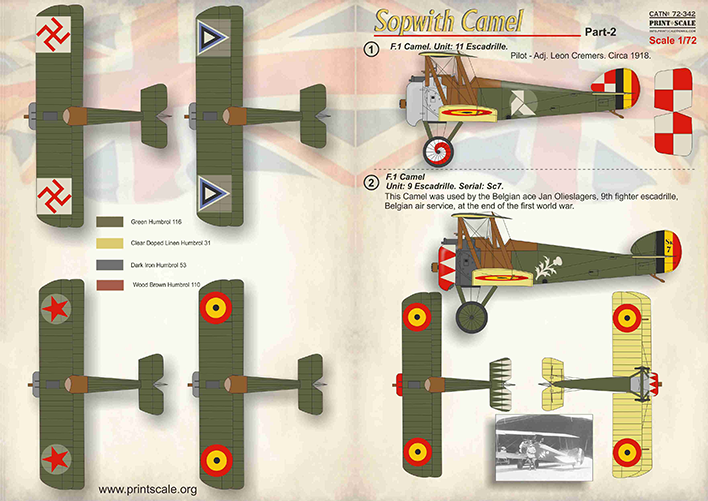 | Print Scale - PSL72342 - 1:72 | Sopwith Camel Part-2 1. F.1 Camel. Unit: 11 Escadrille. Pilot - Adj. Leon Cremers. Circa 1918. 2. F.1 Camel. Unit: 9 Escadrille. Serial: Sc7. This Camel was used by the Belgian ace Jan Olieslagers, 9th fighter escadrille, Belgian air service, at the end of the first world war. 3. 2F.1 Camel Serial: N6616. Delivered in 1919, the aircraft was obtained from H.M.S. Vindictive and served alongside other British aircraft like the Avro 504K and DH.9. 4. Sopwith 2F.1 Camel Serial: 9 (ex N8187). Latvian Air Regiment, circa 1919-20. Serial No.9 in White. The old British serial N8187 is in Black on White. 5. Sopwith F.1 Camel. Unit: 7.Eskadra Mysliwska "Tadeusz Kosciuszko". Serial: F5234. This a/c operated in Lwow from October 1920. The aircraft was destroyed during a forced landing on 1st August 1921 piloted by Maj.Ludomil Rajski. This Sopwith F.1 Camel was one of 20 ex-RAF Camels supplied to Poland and served with Eskadra 'Tadeusz Kosciuszko' from Lwow against the Red Russians in 1920. 6. F.1 Camel. Unit: 34th RAO. Serial: unknown. Pilot - P.Karpukhin. Summer 1920. More | Aircraft decals (military) | Catalogue | £15.99 | |
 | Print Scale - PSL72350 - 1:72 | Bucker Bu-131 Jungmann Bucker Bu.131 Jungmann / 72-350 / 1. Bu.131. Unit: FFS(A)43. Serial: CW+BG (50, W.Nr.483). Backer Bu.131. CW+BC. Werk Nummer 483. was flown by a pupil from FFS(A)43 at Crailsheim (Germany), who landed at Basle, Switzerland, on 14 June 1944, having mistaken the city for Strassburg. Finished in overall RLM 71 Dunkelgrun with RLM 65 undersides, the machine is a classic example of a late-war trainer. It is exceptionally fully marked by virtue of its unit emblem, school number (50) and white outlined Stammkenzeichen fuselage codes and fuselage crosses. The German pilot expressed a preference for internment and the aircraft was consequently flown back to Freiburg by a Swiss pilot. 2. Bu.131B. Unit: LKS7 (Luftkriegsschule-Airwarschool). Serial: CC+NZ (W.Nr.4262). Tulln (near Vienna), Austria 1944. 3. Hauptmann Hans Philippe. Krasnogvardeiskoe, March 1942. 4. Bu.131. Unit: 1/3 Koz Asz (Ace of Hearts). Serial: G-154 Overall Light Grey painting. 5. Bu.131. Unit: III.Kozelfelderito szdzad. Serial: I-333. This overall RLM 02 Grungrau machine served as a trainer, courier and Liaison machine with the Hungarian III.Kozelfelderito szdzad - III Tactical Reconnaissance squadron - whose falcon emblem can he seen on the fuselage. Sole the chevron-style national markings used only until 1st March 1942. The original picture on which this illustration is based does not show the code absolutely clearly, but notes that the serial number is I-333, as shown. This is of interest as it is outside the range of numbers officially allocated to the type. This could mean therefore that the serial is actually I-233. Photographic evidence exists, however, for other out-of- sequence numbers for the type in Hungarian service, possibly indicating that those machines were impressed civilian aircraft. 6. Bu.131. Serial: I-421. The national colours were also painted on the upper and lower surfaces of the elevator. 7. Bu.131. Unit: Comando Aeronautico dell'Albania. Serial: No.947. Tirana, Albania, Autumn 1941. 8. Bu.131. Unit: 1st Pilot School. Serial: 7 4th Air Base Borovo. Late 1943. It has blue outlined Swallow emblem of Pilot School, and School`s internal number '7'. 9. Bu.131. Unit: 1st air base Zagreb, 1943. Light Grey overall painting scheme. Note insignia of the Castle is badge of the 1st air base. 10. Bu.131. Unit: Schweizer Fliegertruppe (Swiss Air Force). Serial: A-4 The aircraft in wartime WWII colours with the flashy colors for German productions airplanes flew in borderland controls. 11. Bu.131. Serial: GD+EU (W.Nr.4497) Aircraft belonged to Luftdienst. On 29th April 1941 it was stolen in Caen by two former French Arme de l'Air pilots and flown to Somerford, England. In use with RAF as DR626. More | Aircraft decals (military) | Limited Availability | £17.30 | |
 | Print Scale - PSL72354 - 1:72 | Bell P-63 Kingcobra 1. P-63C-5-BE "Delma X" Serial: 43-11344 'Delma X' inscription painted by American mechanic. 2. P-63C-5-BE 'Bell Booby Trap' Serial: A (43-11076) Circa 1945. 'BELL Booby TRAP' inscription painted by American mechanic. 3. P-63C-5-BE Unit: 16th GvIAP (probably). Serial: 41 (43-11387). The airplane wore Olive Drab camouflage at the top and lateral surfaces and probably British Ocean Grey from the bottom. 4. P-63C-5-BE Unit: GC 2/5 "Ile de France", Armee de l'Air. Serial: 5T-B (43-11691). French Indochina, year 1949-1950. 5. P-63C-5-BE. Unit: 5 Escadre de Chasse, Armee de l'Air. Serial: S (43-11666). La Reghaia, Algeria, circa 1946. 6. RP-63A-11-BE "Pinball Do Not Tilt". Serial: 42-69654. 2126th Base Unit Laredo Texas. 7. P-63C-5-BE Code: E; (43-11697). Unit: 2 Escadrille, GC I/5 'Vendee'; Tan Son Nhut, Indochina, circa 1949. 8. P-63C-5-BE. Unit: GC 2/9 "Auvergne", Armee de l'Air. Serial: 44-4037 Le Vallon, France, 1946. 9. P-63C-5-BE. Unit: 1 Escadrille, GC 1/9 "Limousin", Armee de l'Air. Serial: 43-11683. Cat-Bi, French Indochina, 1951. 10. P-63C-5-BE. Unit: GC I/5 "Travail", Armee de l'Air. Serial: 5T (43-11599) Sidi-Ahmed, Tunisia, 1947. More | Aircraft decals (military) | Limited Availability | £17.30 | |
 | Print Scale - PSL72361 - 1:72 | Petlyakov Pe-2 1. Pe-2 "Leningrad-Kenigsberg". Unit: 34th GvBAP. Serial: 26. Crew commander is 1st.Lt.N.D.Panasov. Poland, August 1945. 2. Pe-2 (265th series). Unit: 125th GvBAP, 4th GvBAD. Serial: 95 (c/n.7/256). Crew commander: Gv.2nd Lt.Shelikova (woman). Balbasovo airfield, early Summer 1944. 3. Pe-2. The crew of Lt.Ovsyannikov, photographed in August 1945 (probably at Far East Front), flew 107 missions with this Pe-2 on the Leningrad Front. The aircraft decorated with three orders of the Red Banner. Most probably the airplane wore some serial code. 4. Pe-2 (31st series). Unit: BAP, Northern Fleet. Serial: 8. Temporary winter camouflage. Winter 1941-1942. 5. Pe-2 (220th series). Unit: 161st GvBAP, 2nd GvBAK. Serial: c/n.3/220. Crew commander: Gv.Lt.Matveev. On 20th February 1944. 6. Pe-2 Unit: 3rd IAK. Serial: 1. A Petlyakov Pe-2 operated by the 3rd Fighter Air Corps . (IAK - htryebitelniy Aviatsionniy Korpus) in 1943. The emblem of the 3rd IAK (a winged star) is painted on the nose. The camouflage is heavily weathered, especially on engine nacelles and the rear fuselage. Note two small windows on the fuselage side aft the canopy. 7. Pe-2. Unit: 140th BAP. Serial: K. Estonia, 1944. 8. Pe-2. Serial: NS+BA. On 29th January 1944. 9. B-32 (Pe-2FT). Unit: 1.Letka, Bombardovaciho Pluk. Serial: LV-11. Czechoslovak post-war Petljakov Pe-2FT's were painted with Grey-Blue on upper surfaces and with Light-Blue on bellow surfaces. 10. Pe-2 series 1. Unit: 2/PLeLv 48. Serial: A (PE-211). This photo-reconnaissance aircraft was issued to Capt. Jaakko Ranta when he led 2/PLeLv 48 at Onttola in August of 1944. More | Aircraft decals (military) | Catalogue | £15.99 | |
 | Print Scale - PSL72362 - 1:72 | Polikarpov R-5 1. R-5T. Torpedo-bomber, Moscow, Spring, 1934. The first produced aircraft of this type. 2. R-5. Serial: 3.Moscow military district. 3. R-5. Serial: 22. The aircraft of training brigade of Air Fleet academy. Moscow, 1933. 4. R-5SSS. Unit: RKKA Air Force. Serial: 66. Winter War. Winter 1939-1940. 5. R-5. Unit: 7th Separate Corps detachment. Serial: 3. Pilot commander of detachment D.Nikishin. Pavlograd, 1936. 6. R-5Sh. Unit: 15th ShAP, 60th air brigade, ZabVO Exercises at Chita area, 1938. Most probably this is the regiment commander aircraft. 7. R-5. Unit: 37th BLAE, 454th air brigade. Serial: 4. Pilot - L.G.Petrushevskiy. Middle Eastern military district, August 1934. 8. R-5Sh. Unit: 12th ShAP, VVS of OKDVA. Serial: 5. Pilot - Ivanov N.N. Lazarevo airfield, August 1939. 9. R-5. Serial: 4. Sinkiang Aviation School, 1935. 10. R-5. Serial: 22. This aircraft was used as trainer. Circa 1930. 11. R-5SSS Unit: 15th Group. Serial: RR-21. 1 Escuadrilla de Ataque Nocturno; December 1937. 12. R-5Sh. Unit: Mongolian Air Corps. Nomonhan Conflict, Mongolia, 1939. Originally this unit was part of the Soviet 150th mixed air regiment (VVS RKKA). However some sources said that some aircraft were under command of Mongolian pilot Bor served with Mongolian Air Corps and wore Mongolian insignias. 13. R-5. Unit: Tatbikat Bolugu-Eskishehir. Serial: 1. October 1933. Immediately after the ceremonies of the 10th anniversary of the Turkish Republic. Most probably the emblem underwing and the inverted flag were painted in Russia, before the aircraft arrived. Squadron of Polikarpov R-5's and a Tupolev ANT-9 arrived Ankara to participate the 10th anniversary ceremonies on 29 October 1933. After the ceremonies 3 R-5 and the sole ANT-9 were presented to Turkey as a symbol of Turko-Russian friendship, cooperation and good relations (The Soviet Government under the leadership of Lenin helped Turkey a lot during our War of Independence). More | Aircraft decals (military) | Limited Availability | £15.99 | |
 | Print Scale - PSL72365 - 1:72 | Polikarpov U-2/Po-2 Part 1 1. Po-2VS. Unit: 9th GbNBAD. Serial: 28. Mission of Polish rebels supply. September 1944. 2. U-2VS. Unit: 1st AE, 45th GvNBAD. Serial: 7. Pilot - CO of 1st AE, 45th GvNBAD K,Michailenko. Single white stripe means 1st AE (two stripes 2nd AE, three - 3rd AE). 3.Po-2VS. Unit: 23rd GvNBAD. Serial: 1. 4. U-2. Serial: 80. Engelsk flying school. July 1932. 5. U-2VS (LNB). Unit: 242nd NBAD. Serial: 5. Pilot - Hero of the Soviet Union Popova Nadezhda Vasilievna (852 combat missions). 6. U-2. Unit: 2nd Numberless Regiment, 46th ZAP. Serial: 9. July 1943. Aircraft were produced at Kazansky factory. 7. U-2. Unit: 399th Separate Liaison Regiment, 3rd VA. Serial: 13. 3rt Byelorussian Front, Konigsberg direction, February 1945. 8. U-2SP (PS-3). Unit: 62nd Guards air regiment of GVF. Serial: 9. Winter 1943-1944s. 9. Po-2VS. Serial: 6 Academy of Air force, Monino, 1945. 10. S-2. Unit: Separate transport-medical regiment, 4th VA. Summer 1944. 11. U-2. Serial: 5. Two-colour camouflage. This aircraft was found by Germans in Summer of 1941. 12. U-2VS (LNB). Unit: 46th GvNBAD. Serial: 2 13. U-2. Unit: Normandie-Niemen. Serial: 10. The liaison aircraft, Monastirchina, September 1943. 14. U-2. Unit: 235th ShAP, 264th ShAD. Moldova airfield, 1944. On 17.45 of June 21st, 1944 this a/c piloted by Hero of the Soviet Union Vinogradov I.N. 15. Po-2 Unit: 889th NBAP. Serial: 4. Wysoche-Bartosh, Poland, October 9th, 1944. 16. U-2. Serial: 1. This a/c was captured by Finns at Karelia on December 20th, 1939. 17. U-2 "Menzhinskiy". Unit: aeroclub of the No.39 factory. Serial: 1. Middle of 1930's. 18. U-2 "Basneft" Serial: SSSR-Kh5. Limousine Basneft (Bashkirsaya neft' = Bashkirian Oil). Middle of 1930's. 19. U-2. Unit: V.P.Chkalov. Serial: SSSR-Che4. The personal mount of the Valeriy Pavlovich. Chkalov, presented by Narkomat (Ministry) for Heavy Industry. Circa 1937. More | Aircraft decals (military) | Limited Availability | £15.99 | |
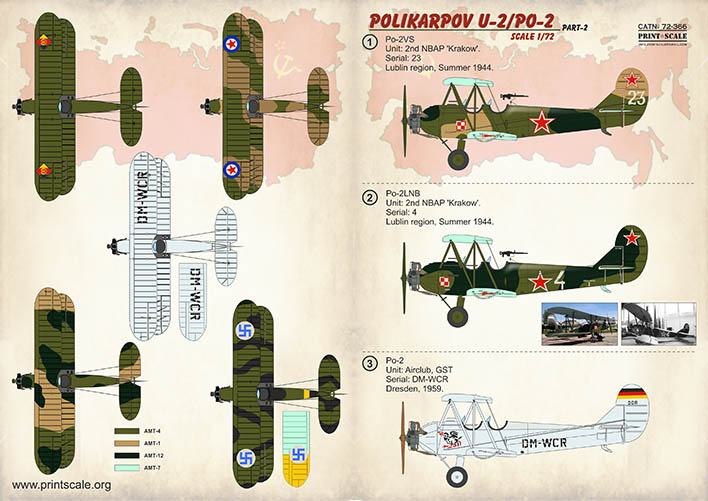 | Print Scale - PSL72366 - 1:72 | Polikarpov U-2/Po-2 Part 2 1. Po-2VS. Unit: 2nd NBAP 'Krakow'. Serial: 23. Lublin region, Summer 1944. 2. Po-2LNB. Unit: 2nd NBAP 'Krakow'. Serial: 4. Lublin region, Summer 1944. 3. Po-2. Unit: Airclub, GST. Serial: DM-WCR. Dresden, 1959. 4. Po-2. Serial: 9. Aircraft of one of the Northern Korean aeroclubs, 1949. 5. Po-2. Serial: 9. Aluminum overall. 6. U-2. Unit: THK. THK (Turkish Air league) was founded in 1925. Its first name was TTC (Turk Tayyare Cemiyeti = Turkish Airplane Society). The first plane they bought was Polikarpov U-2. Two of them remained in service until 1945. 7. Po-2. Unit: ASK 'Vorwards'. 8. Po-2. Unit: Eskadrila za vezu VS NOVJ. Serial: 2. 9. Po-2. Unit: VSJ. Serial: 0012 10. U-2, VU-3, captured machine, used by the Finnish Army 1941. 11. Po-2. Serial: 14 (red) More | Aircraft decals (military) | Catalogue | £15.99 | |
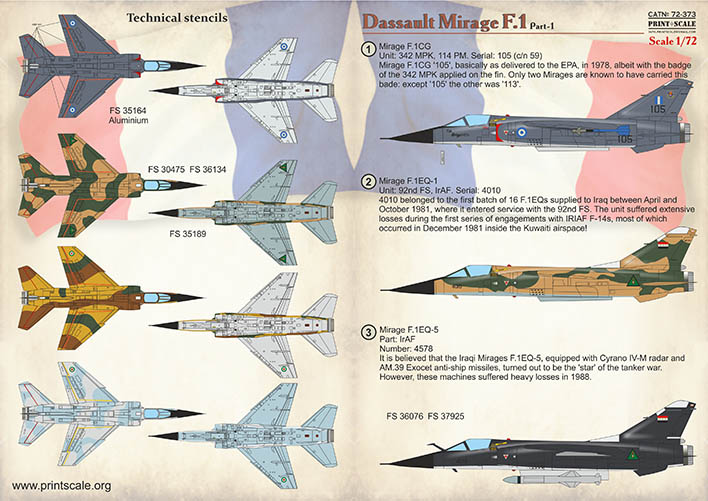 | Print Scale - PSL72373 - 1:72 | Dassault_Mirage F.1 Part 1 1. Mirage F.1CG Unit: 342 MPK, 114 PM. Serial: 105 (c/n 59). Mirage F.1CG '105', basically as delivered to the EPA, in 1978, albeit with the badge of the 342 MPK applied on the fin. Only two Mirages are known to have carried this bade: except '105' the other was '113'. 2. Mirage F.1EQ-1 Unit: 92nd FS, IrAF. Serial: 4010 belonged to the first batch of 16 F.1EQs supplied to Iraq between April and October 1981, where it entered service with the 92nd FS. The unit suffered extensive losses during the first series of engagements with IRIAF F-14s, most of which occurred in December 1981 inside the Kuwaiti airspace! 3. Mirage F.1EQ-5. Part: IrAF. Number: 4578 It is believed that the Iraqi Mirages F.1EQ-5, equipped with Cyrano IV-M radar and AM.39 Exocet anti-ship missiles, turned out to be the 'star' of the tanker war. However, these machines suffered heavy losses in 1988. 4. Mirage F1EQ-4: Iran Air Force. Serial:3-6205, first flight in IRIAF service, 1993. 21/01/2012 5. Mirage F1EQ6 - Iran - Air Force. Serial:3-6210. Tehran - Mehrabad International (THR / OIII) Iran - February 28, 2013. 6. Mirage F.1CE. Unit: Escuadron 141 "Patanes", Ala de Caza 14, Ejercito del Aire. Serial: 14-15 (C.14-15). Spain was one of the first export users of the Mirage F.1, ordering 15 Mirage F.1CE interceptors in 1972. All of Spain's 73 Mirages are assigned to the Ala de Caza 14 (Fighter Wing 14). 7. Mirage F1CE of Escuadron 141 (Ala de Caza 14) of Spain's Ejercito del Aire based at Albacete, and (left) the emblem of Ala 14. The Mirage F1CE is scheduled to remain in service with the Air Combat Command (MACOM) of the Fuerza Aerea throughout the 'eighties. 8. Mirage F.1CZ. Unit: 3 Sqn, SAAF.Serial: 206. AFB Rundu, 1987. Piloted by Capt. Arthur Piercy during a dogfight against MiG-23, it was damaged and forced landed. Pilot seriously wounded hard after ejection and paralyzed. 9. Mirage F.1CH. Unit: Escadrille de Chasse "Assad", Al Quwwat Aljawwiya Almalakiya Marakishiya. Serial: 127 Sidi Slimane AFB, Morocco, 1980. 10. Ecuador - Air Force Dassault_Mirage F1JA FAE803. Guayaquil - Jose Joaquin de Olmedo (Simon Bolivar) (GYE / SEGU) Ecuador - October 14, 2010. More | Aircraft decals (military) | Catalogue | £15.99 | |
 | Print Scale - PSL72376 - 1:72 | Gloster Javelin. Part 5 In the complete set 2 sheets Javelin F(AW) Mk.7, XH 835, 'NP', No.33 Squadron. Standard Scheme and national markings; black serial and silver air intake lips. Code in light blue, outlined in red; light blue, red and blue tail stripes. Wing Commander's pennant above code on nose (note slightly different position on the starboard side). Javelin F(AW) Mk.8, XH 979, Air Fighting Development Squadron. RAF Binbrook, 1962. Standard scheme and national markings; AFDS written in full in white under crest on fin. White fuselage serial; black air intake lips. Javelin F(AW) Mk.7, XH 899, 'P', No.25 Squadron as seen at Sculthorpe, 16th May 1959. Standard scheme and national markings; white serial and code, the latter repeated on fuselage. Silver and black bands flank squadron crest on fin. Javelin F(AW) Mk.7, XH 794, 'L', No.64 Squadron, RAF Duxford. Standard scheme and national markings; white serial and code. Silver air intake lips; white band on fin with red and blue trellis and unit badge within a white disc, the latter outlined in blue. Javelin F(AW) Mk.8, XH 966, 'X', No.41 Squadron, RAF Wattisham, September 1963. Standard scheme and national markings; red/white bars flanking unit marking on fin. Serial and fin code in white; air intake lips are black. Javelin F(AW) Mk.9, XH 772, 'G', No.11 Squadron, RAF Geilenkirchen (Germany). Standard scheme and national markings; white serial and code. Black air intake lips; yellow/black band across tail with unit marking superimposed. Javelin F(AW) Mk.9, XH 898, 'GHB', flown by the CO of No.228 OCU, RAF Leuchars, Sqn Ldr George H Beaton. Known to be the only natural metal finished Javelin to see operational service; black cockpit framing, intake lips and serials; standard national markings. Pilot's initials on fin in black. Javelin F(AW) Mk9, XH 904, 'T', No. 33 Squadron, as seen in Malta in June 1961. Standard scheme and national markings; white serial and code. Black air intake lips; blue/light blue/red band across tail with unit badge superimposed on a white disc. Javelin F(AW) Mk.9R, XH 895, 'G', No.64 Squadron, RAF Tengah, 1967. Standard scheme and national markings; white serial and code. Black intake lips; blue/red trellis on a white band across fin with unit marking superimposed. Javelin F(AW) Mk.9, XH 882, 'L', No.25 Squadron. Standard scheme and national markings; white serial and code. Black intake lips; silver bars, edged in black, flanking unit crest on fin. Javelin F(AW) Mk.9, XH 716, 'G', No.228 OCU (No. 11 Reserve Squadron), 1966. Standard scheme and national markings; white serial and code. Black air intake lips; No.11 Squadron badge here rendered in black on a white disc. The birds having also appeared in brown on occasion! Javelin F(AW) Mk.9, XH 721, 'MHM', flown by the CO of No. 60 Squadron, Wg Cdr Michael H Miller, RAF Tengah, 1966. Standard scheme and national markings; fuselage serial and codes in white. Black/ white bars across fin/ rudder; unit badge, also in white and black, on fin. Note command pennant on forward fuselage. More | Aircraft decals (military) | Catalogue | £20.99 | |
 | Print Scale - PSL72407 - 1:72 | Mikoyan MiG-29 "Fulcrum" 1. MIG-29 (9-12) part: 1-I AE, 120 8th IAP, 23-I WA, ZabVO number: 01 (p/n 2960515803), 1998, Domna Airfield. 2. MIG-29 (9-13) part: 2 Squadron 'Moscow ', 115th GvIAP number: 44 SOVIET AIR FORCE base near the city of Termez, near the Afghan border, Uzbekistan 1990. 3. MIG-29ub (9-51) part 2: AE, I-120th GvIAP, 14 Army Air Force and air defence number: 75 (c/n. 50903026969), 1999, Domna Airfield. 4. MiG-29 k Part: not available number: 311 First deck flying machine. 29 anchors with the star on the left side on landings-September 1, 1990. 5. MiG-29 (9-13) 290-series Number: 51 MiG-29 (9-13) 290 Series, vol. 1990. BN 51, Russian Air Force, Boris Gleb. In February 2000, the aircraft, together with the other side (the MiG-29 BN 47 and 23, and the MiG-29UB b.n.70) was transferred to the training regiment in Borisoglebsk (2 AE 120 IAP, a / d Domna), is at the time of a structural subdivision of Armavir Military Aviation Institute. As a result, once the reform of military educational institutions in 2002 established a single Summer Institute - Krasnodar VAI named Hero of the Soviet Union, AK Serov, which consisted of Armavir and Balashov Military Aviation Institute and Sts Training Center, 2001-2002 years. board 51 among others 'Borisoglebsk' 29's was transferred to Yerevan, where he continued his further service. The aircraft is depicted as of August 2001. 6. MIG-29 (9-13) part: not available number: 44 AA Ukraine, Gostomel airport, August 1992. 7. MIG-29 (9-13) part 40: wing number: 35 Vasilkov. 8. MIG-29ub part: 3 FS, 2 TW number: 61 Crimea, Kirov airbase, 1995. 9. MIG-29 "Kis" part: Orlik 2, PKW number: 4120 Estonia, 2008 g. PKW. 10. MIG-29 of the 31Sk Wing: 31/1 Sqn number: 6930 Airbase Fajrford. RIAT-98, 1998. 11. MIG-29ub : Polku Lotnictwa Mysliwskiego "Warszawa" Room: 15 base of Minsk-Mazowiecki. A similar camouflage are: 42. 12. MIG-29 Parts:? Sqn, IrAF number: 29060 Habbaniyah Airbase, 1990-1991 . 13. MIG-29 (9-13) number: 19. More | Aircraft decals (military) | Catalogue | £15.99 | |
 | Print Scale - PSL72421 - 1:72 | Lockheed F-104 Starfighter 1. F-104G 20+02 belonged to JBG 32. The code 'A' was unusual on Luftwaffe fighter-bombers at that time. (via Terry Panapolis). 2. RF-104G Starfighter,AE-235,AG51, Federal German Air Force (Luftwaffe). Dark Grey RAL 7012 (FS 26152) and Dark Green RAL 6014 (FS 34079 upper surfaces with Light Grey RAL 7001 (FS 26373) undersides. National markings in six positions; note fin fiash covered over by Canadian flag. 3. F-104 G Starfighter, DB+109,JB 32, Federal German Air Force (Luftwaffe). (FS 26152), (FS 34079), upper surfaces with Aluminum RAL 9006 undersides. National markings in standard six positions; medium blue band around nose. 4. F-104 G Starfighter, 26+03,JG 36, Luftwaffe. 5. F-104G Starfighter, 22+89, MFG 1, Marineflieger. 6. F-104G Starfighter, 24+33, MFG 2, Marineflieger. 7. F-104 G Starfighter, 22+59,JGB 31, Federal German Air Force (Luftwaffe). 8. F-104 G DC+234, JG 33, Federal German Air Force (Luftwaffe). 9. TF-104 G Starfighter, 26+30, JG 34, Luftwaffe. 10. F-104G Starfighter, JD+120, JG 74, Federal German Air Force (Luftwaffe), Neuburg, 1966. 11. F-104G Starfighter, 26+63, of the 'Vikings' aerobatic team, Marineflieger. More | Aircraft decals (military) | Catalogue | £15.99 | |
 | Print Scale - PSL72431 - 1:72 | Battle of France. 1940. Part-2 1. Caudron CR.714 C1. Unit: GC I/145 "Warsaw" (Polish), Armee de l'Air. Serial: 2 (I-204, N14, c/n 8546). Aircraft was flown by Polish volunteer group at Dreux. The Group's pilots downed several German aircraft in June 1940. The French fuselage roundel was partially overpainted by an incomplete Polish national insignia. 2. Caudron CR.714 C1. Serial: 8. Unit: 1 Escadrille, GC I/145 "Warsaw" (Polish), Armee de l'Air. Pilot - ppor.Eugeniusz Fiedorczuk. Villacoublay, May 1940. 3. Caudron CR.714 C1. Unit: 1 Escadrille, GC I/145 "Warsaw" (Polish), Armee de l'Air. Serial: 13 (I-207, N17, c/n 8549). Pilot - ppor.Boleslaw Gladych (Polish). Villacoublay, France, May 1940. 4. Caudron CR.714 C1. Unit: 2 Escadrille, GC I/145 "Warsaw" (Polish), Armee de l'Air. Serial: 7. Pilot - por.Zdzislaw Zadrozinski. Dreux, June 1940. 5. Caudron CR.714 C1. Unit: 2 Escadrille, GC I/145 "Warsaw" (Polish), Armee de l'Air. Serial: 10 (I-201, N11, c/n 8543). Pilot - pilot.kpr.Andrzej Niewara (Polish). Dreux, France, 8th June 1940. 6. Caudron CR.714 C1. Unit: 1 Escadrille, GC I/145 "Warsaw" (Polish), Armee de l'Air. Serial: 2. Pilot - ppor.Jerzy Godlewski. Circa 1940. 7. Caudron CR.714 C1. Unit: 2 Escadrille, GC I/145 "Warsaw" (Polish), Armee de l'Air. Serial: 3, Pilot - krp.Ernest Watolski, Villacoublay, June 1940. 8. Caudron CR.714 C1. Unit: 2 Escadrille, GC I/145 "Warsaw" (Polish), Armee de l'Air. Serial: 13, Pilot - por.Boleslaw Gladych (Polish). Villacoublay, France, May 1940. 9. Caudron CR.714 C1. Unit: GC I/145 "Warsaw" (Polish), Armee de l'Air. Serial: 6 (I-217, N27, c/n 8559). Lyon-Brone, France, May 1940. Finally it was captured by Germans. 10. Curtiss H-75A-1 N 1 (X8000) Serial: 4. Unit: 3 Escadrille, GC II/5, Toul- Croix-de-Metz May 10, 1940. More | Aircraft decals (military) | Catalogue | £14.99 | |
 | Print Scale - PSL72435 - 1:72 | Lockheed SR-71 Part-1 1. SR-71 Blackbird 61-7976. 976 was the first SR-71 to be flown on an operational mission; Ed Payne and Jerry O'Malley flew her over Viet Nam on Thursday, March 21, 1968. 22 years later she became the last blackbird to be flown to a museum, when Don Watkins and Bob Fowlkes flew her to the Air Force Museum at Wright-Patterson AFB in Dayton, Ohio, on Wednesday, March 27, 1990. 2. 10 May 1966 First SR-71 #958 delivered to Beale AFB, CA USAF Pilots: Doug Nelson/ Pennington (LSB)(LSW says 4 Apr 1966) On July 27th and 28th, 1976, The United States Air Force celebrated out bicentennial by performing Operation Glowing Speed, which was orchestrated to simply regain absolute speed and altitude records held by the Soviet MiG-25 Foxbat aircraft. SR-71 #17958, on display at the Museum of Aviation near Warner Robins Air Force Base in Georgia, was responsible for record setting flights during Operation Glowing Speed. 3. SR-71 Blackbird, 61-17979 USAF 9th SRW, Night Hawk, 1990. Limited Edition 800 Pieces Worldwide. Aircraft #61-7979 first flew on August 10th, 1967. Over the next 23 years it flew missions with the 9th Strategic Reconnaissance Wing from Beale AFB in California and Kadena AFB in Japan. In 1973 it flew six of the nine non-stop operational missions from the US to the Middle East to monitor the Yom Kippur war. Nearing the end of its career, the aircraft was briefly decorated with stunning "Night Hawk" artwork applied to the vertical stabilizers in chalk. 4. SR-71 Blackbird, 61-17970. This aircraft was lost on 17 June 1970 following a re-fueling collision with a KC-135Q (59-1474) tanker. Lt. Col. Buddy L. Brown and his RSO Maj. Mortimer J. Jarvis both ejected and survived the crash. The KC-135 made it back to Beale AFB, California with a damaged refueling boom and aft fuselage. Super Skater crashed into the desert. More | Aircraft decals (military) | Catalogue | £19.99 | |
 | Print Scale - PSL72444 - 1:72 | Mitsubishi Ki-21 Sally 1. Ki-21-Ib, 7th Group, 2nd Squadron, Malaya 1942. 2. Ki-21-llb of the 3rd Dokuritsu Hikotai, Imperial Japanese Army Air Force. The aircraft, with dorsal turret removed and stripped of all armament, was one of nine despatched on a commando mission against the American-held Yontan airfield on Okinawa on 24th May, 1945. 3. Ki-21-Ia 60th Sentai, 2nd Chutai, and used to fly with this appearance over Manchuria in 1939. 4. Ki-21-llb, 98th Group, 2nd Squadron, during operations against Calcutta, India, December 1943. 5. Ki-21-ll Ko (a) 22nd Hikoshidan, Shurebu Displaying field applied camouflaged Green patches, this aircraft was operated by the 22nd Wing Head Quarters and was based in Formosa during 1945. 6. Ki-21-llb 5 Hikoshidan. Based in Japan this aircraft bears the markings of the Head Quarters painted in White on the tail. Camouflage was applied with a brush covering the fuselage and upper surfaces. 7. Ki-21-ll Otsu, 14th Sentai, South Pacific, July 1944. 8. Ki-21-ll Ko(a) 81 Sentai 1 Chutai. Despite primarily using the Dinah some 'Sally' were used including this one. During 1943 81Sentai were based at Lakunai, New Britain. Painted with an uneven application of Green over the fuselage and upper surfaces. 9. Ki-21-l Otsu b 105 Kyoiku Hiko Rentai. Wearing only the national insignia on the wings, the tail bears the markings of the 105 Kyoiku Hiko Rentai Training Unit which in 1941 was based at Hamamatsu, Shizuoka Prefecture, Japan. 10. Ki-21-ll Ko (a) 62 Sentai 1 Chutai. Only the undersides of this aircraft were not painted in Green all other areas had an even application of paint. 62 Sentai became part of the 5th Hikoshidan in Tailand in January 1942. 11. Ki-21-l Ko (a) 60 Sentai 2 Chutai Painted in JAAF Green and JAAF Khaki this scheme was worn during 1938 whilst the type were operating in Manchuria. 12. Ki-21-l Otsu (b) 60 Sentai 2 Chutai Green camouflage pattern sprayed over Light Green and presumably applied in the field. This unit supported the invasion of Singapore in January 1942. More | Aircraft decals (military) | Catalogue | £14.99 | |
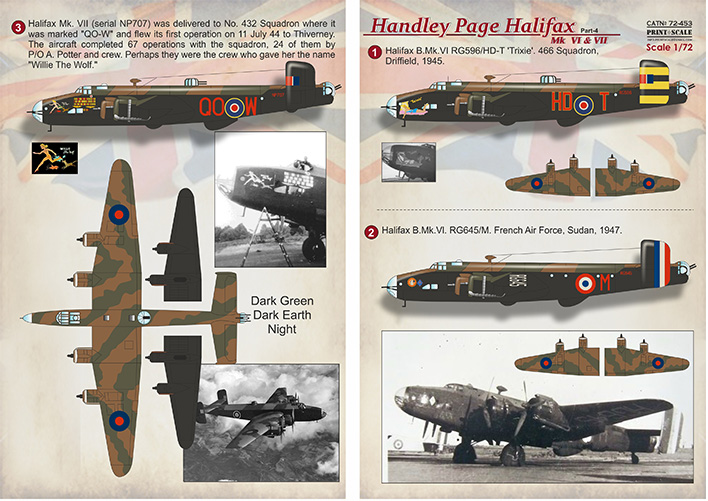 | Print Scale - PSL72453 - 1:72 | Handley-Page Halifax Part 4 1. Halifax B.Mk.VI RG596/HD-T 'Trixie'. 466 Squadron, Driffield, 1945. 2. Halifax B.Mk.Vl. RG645/M. French Air Force, Sudan, 1947. 3. Halifax Mk. VII (serial NP707) was delivered to No. 432 Squadron where it was marked "QO-W" and flew its first operation on 11 July 44 to Thiverney. The aircraft completed 67 operations with the squadron, 24 of them by P/O A. Potter and crew. Perhaps they were the crew who gave her the name "Willie The Wolf." More | Aircraft decals (military) | Catalogue | £15.99 | |
 | Print Scale - PSL72475 - 1:72 | Lockheed U-2/TR-1 1. Lockheed U-2R s/n 68-10331,of the 6th Strategic Reconnaissance Squadron, 9th Strategic Reconnaissance Wing, based at Osan Air Base, South Korea. 2. Lockheed TR-1A, s/n 80-0182 Note Bulldog insignia carried on fin. 3. Lockheed U-2R, s/n 68-10338, possibly serving with the 9th Strategic Reconnaissance Wing. Beale AFB. 4. Lockheed TR-1B, s/n 80-1091. The Q-bay was occupied by the second cockpit on this variant. Earlier TR-1B'swere white overall. 5. Lockheed U-2A, NACA-320. This is actually the prototype, as it appeared in February, 1957. The purpose of the NACA, (later to become NASA),markings was purely a cover-up exercise. The aircraft is shown as it appeared in the first officially released photograph of the U-2. 6. Lockheed U-2A, NASA 55741. 7. Lockheed TR-1A, c/n 80-01074. 8. Lockheed U-2R Senior Span, 68-10338. 9. Lockhed TR-1A , 80-01099. 10. Lockheed TR-1A , 80-01084. More | Aircraft decals (military) | Catalogue | £19.99 | |
 | Print Scale - PSL72487 - 1:72 | Focke-Wulf Fw-190A-8 1. Fw-190A-8; Black 11. Lt Gunther Heym; JG 51; Zichenau Airfield; Summer / Fall 1944. 74/75/76. The name "TANJA" is blow the cockpit. 2. FW190A-8 'Blue 8 + o', flown by Uftz. Dietrich of 12/JG 5 "Eismeer". The name "Erika" was carried under the cockpit, Herdla airfield (Norway), April 1945. 3. Fw-190A-8 W.Nr 175140, 6 + " (Brown outlined in black), of 7/JG 26 found in September 1944 at Melsbroek field, Belgium. RLM 75/83/76 camouflage. 4. Fw-190A-8 of 13/JG 54, France, Summer of 1944, RLM 74/75/76. 5. Fw-190 A-8 'Red 1 + I' of Lt. Hans Dortenmann, Staffelkapitan of 2./J.G. 54, France, June 1944. 6. Fw-190A-8/R8 of Sturmstaffel 1, pilot: Uffz, Oskar Bosch, Salzwedel field, Germany, February 1944. RLM 74/75/76. 7. Fw-190A-8. Commander of JG 300. Maj. Walther Dahl. RLM 75/83/76. Juteborg, December 1944. 8. Fw-190A-8 of ll/JG 300, Lobnitz field, Fall of 1944. The entire fuselage and wing bottom surfaces are painted with the RLM 77 primer, top surfaces are RLM 74/75. Rudder and ailerons RLM 76. 9. Focke-Wulf Fw-190F8 1.SG4. RLM 79/80/76. White 11 unknown pilot Italy 1944. 10. Fw-190A-8 of ll/JG301. Spring of 1945. RLM 75/83/76 Rudder mottled in RLM 81. 11. Fw-190A-8 from 3/KG 51. "Edelweiss" was the first Kampfgeschwader to convert to the Me-262 jet aircraft. This Anton, fitted with a rounded canopy and found at Bad Aibling (Germany) in May 1945, was probably part of a protection squadron for the jets in the same unit. The KG 51 fuselage code 9K has been painted in front of the cross in small letters, like on a bomber, and the individual number is large, as was the custom in fighter units. More | Aircraft decals (military) | Catalogue | £15.99 | |
Hannants Search Engine
Convert Currency
Copyright © 2001-2026 H. G. Hannant Limited. All rights reserved. | Website by Dessol
Privacy Policy | Cookie Information | Switch to Mobile Version